
 Comparisons of “healthy” vs. “disordered” genomes in psychiatry have not yet revealed sequence differences that can reliably predict the onset of mental disability. Rather, such disability seems to arise from as-yet-undetermined complex, probablistic interactions of genetic risk and environmental factors over the course of development. With this as the case, the demarcations between “healthy” and “disordered” may not be distinct, but rather fuzzy and hence unworthy of labels that give a false impression of being discrete states.
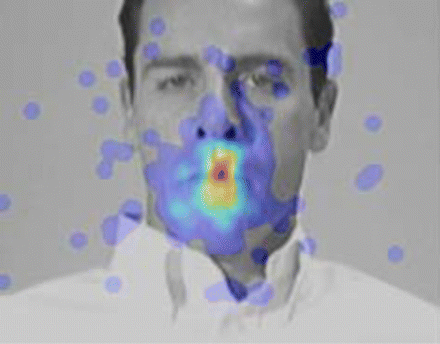
One recent paper that speaks to this issue is by Meyer-Lindenberg et al., “Genetic variants in AVPR1A linked to autism predict amygdala activation and personality traits in healthy humans” [doi: 10.1038/mp.2008.54]. Here, they explore genetic variation in the AVPR1A gene – a receptor for the pro-social neuropeptide vasopressin – and how it can modulate the activity of the amygdala when subjects view human faces (vs. a geometric shapes control condition). Since it is well known that the amygdala responds to a wide range of social and emotional stimuli and that activation of the amygdala can enhance or prevent the storage of such emotional or socially arousing events – and – that this process goes awry in autism and in subjects with amygdala damage (the picture above shows that patients with amygdala damage do not focus on the eyes of human faces) – the investigators have indeed focused-in on a key set of neural processes. They find the variation in the RS1 and RS3 polymorhphic sites in AVPR1a do indeed correlate with amygdala activity in healthy controls who were carefully screened for no history of mental disability. A great example of folks who carry the “healthy” label, but also the genetic risk and the neural correlates of autism.
![Reblog this post [with Zemanta]](https://i0.wp.com/img.zemanta.com/reblog_c.png)
Posted in Amygdala, AVPR1a | Tagged autism, Development, Genetic testing, Mental disorder | 2 Comments »

- Image by Simon Clayson via Flickr
Recently, the media has mourned the 5HTT-LPR which was stripped of its celebrity risk-allele status. Another gene however, the BDNF val66met variant (just a B-list celeb at the moment) has been slowly acquiring similar interest as the genetic variant that can be counted on to confer a biological association with any number of brain-based phenotypes, behaviors and – dare I say – grant funding.
Not so fast – according to Verhagen et al., in their recent, “Meta-analysis of the BDNF Val66Met polymorphism in major depressive disorder: effects of gender and ethnicity” [doi: 10.1038/mp.2008.109]. Here they report on 2,812 cases and 10,843 controls from 12 research studies on major depression. Their analysis found no overall association of the Met allele with major depression. However, when they consider just men who carry the Met/Met genotype, there was a significant association with risk of MDD.
Perhaps amidst the clamor as BDNF rises to the celebrity darling du jour, we can think more on the futility of the “disorder x genotype” approach in general and more on how best to make sense of – and productive use of – our genetic information. Genetic associations (spurious as they are) with DSM-IV clinical descriptions may not be particularly meaningful. Somehow, the basic biology and the clinical descriptions of what we call mental illness do not seem to be linking-up very well. Perhaps more celebrity-genes will have to fall from grace before we come to a new conceptual paradigm.
![Reblog this post [with Zemanta]](https://i0.wp.com/img.zemanta.com/reblog_e.png)
Posted in BDNF | Tagged Genetic testing | Leave a Comment »

- Image via Wikipedia

In this podcast, Michael Corbin, founder of everyminute.org, shares some of his personal background, interests and efforts in the area of suicide prevention and mental health advocacy.
You can reach Michael via email or the website contact page.
Posted in Uncategorized | Tagged Depression, interviews, Mental health, podcasts, Suicide | Leave a Comment »


- Image via Wikipedia

Just a place holder for future podcasts – short informal phone chats – with current scientists and social entrepreneurs working in the area of mental health … here’s the link and introductory passage. Hope this will inspire cross-disciplinary interactions from science to mental healthcare macro-policy. Hosted by libsyn.
Posted in Uncategorized | Tagged podcasts | Leave a Comment »

- Image via Wikipedia

Rare mutations that knock-out the function of monoamine oxidase a gene have long been known to give rise to developmental changes that increase the propensity of males to engage in aggressive behavior. The effects of so-called natural variants – that may slightly reduce or increase the amount of activity of the MAOA protein – can be harder to understand since they are less-definitive and perhaps more easily masked or influenced by the environment and developmental mileu. Nevertheless, the role of natural, common variation in the maoa gene and its relation to aggressive behavior in boys remains of interest – witness a news report today, “‘Warrior Gene’ Linked To Gang Membership, Weapon Use: FSU Study”.
Rather than debate the validity and merits of such sensational headlines, it may be more productive to understand how & why naturally occurring genetic variation might influence the development of the brain in a way that makes it more difficult for adolescents and adults to control their aggressive impulses. Clearly, healthy males have a predisposition to act out moreso than females, which – while at odds with our modern societal norms – comes along with our evolutionary legacy and phylogenetic relationship to other primates and mammals where male aggression is the rule. In this sense, the really exciting story, is not whether there is something amiss with schoolboys who carry certain genetic variants of maoa, but how such variants work over the course of normal brain development and why, in terms of our own evolutionary history, we carry such variants.
That male-male aggression can be a means to differentiate male fitness and – via sexual selection in females – reduce mutational load, has been widely shown across the sexually-reproducing biome. Thus, while variants such as the high expression 4-repeat VNTR in maoa have likely been helpful, rather than hurtful, in the establishment and survival of our noble species, it may be a difficult task to prove such a proposition. As Stephen Jay Gould once wrote, “Thus, we are presented with unproved and unprovable speculations about the adaptive and genetic basis of specific human behaviors: why some (or all) people are aggressive, xenophobic, religious, acquisitive, or homosexual” (Our Natural Place, p. 243). Nevertheless, we may learn a bit about ourselves as we relate genetic variation to both cognitive science and to rigorous phylogenetic analysis.
One great example of a recent paper that covers the link from genes to cognition is, “MAO A VNTR polymorphism and variation in human morphology: a VBM study” by Cerasa et al., [PMID: 18596609]. Here the team investigates the structure of the human male brain using a method known as voxel-based-morphometry (VBM) that allowed them to ask where in the brain one might observe grey-matter changes that are correlated to genotype? After an analysis of 33 high-maoa-expressing males vs. 26 low-expressing males, the team found that only in the orbitofrontal cortex were such associations significant. This, as noted by the team, is of interest, since the orbitofrontal cortex is an area of the brain that is known to regulate impulsivity. In this study, the high-expressing males had lower levels of grey matter in the orbitofrontal cortex, a result that is in-line with a previous finding – however it remains somewhat out of trend with earlier findings showing that smaller orbitofrontal cortex volumes (without respect to genotype) are associated with higher impulsivity and findings that show that boys with the high-expression form of MAOA were less likely to engage in aggressive behavior.
Clearly, this little bit of the genome containing the MAOA-VNTR has a complex – but interesting story to tell. The gene does not seem to show any evidence for recent positive selection, so perhaps the role of maoa and its effects on aggression were worked out long before our lineage came along. Indeed, now we must learn to bear our genetic legacy proudly and humanely. Good luck!
Posted in MAOA, Orbitofrontal cortex | Tagged Emotion, Frontal lobe | 4 Comments »

- Image by Nestlé via Flickr
Just a pointer to management expert Michael Porter’s new article in the NEJM.
“… expanded access without improved value is unsustainable and sure to fail.”
Posted in Uncategorized | Tagged economics | Leave a Comment »

- Image via Wikipedia

One of the most well-studied genetic polymorphisms in the behavioral- psychiatric- cognitive-genetics area is the 5HTT-LPR, a short repeating sequence that mediates the transcriptional efficiency of the serotonin transporter. Given the wide-ranging effects of 5HTT on the developing and mature nervous system, it is perhaps not surprising that variation in 5HTT levels can have wide-ranging effects on brain structure, function and behavior (see here and here for 2 of my own posts on this). One of the latest findings has to do with the issue of “functional connectivity” or the degree to which 2 separate brain regions co-activate and interact with each other – this type of functional interaction and integration of brain systems being a good thing.
Earlier studies have shown that individuals who carry the “short” allele at the 5HTT-LPR show less coupling of their frontal cortex (perigenual anterior cingulate cortex) with their amygdala – which perhaps indicates that their frontal cortex has a harder time regulating the amygdala. This may be a mechanistic explanation for why such people have been found to be more prone to anxiety. A new study by Pachecco et al., seems to support this mechanistic account – however, they confirm the coupling model using a different neuroimaging modality – which makes the paper especially interesting. In their article, “Frontal-Limbic White Matter Pathway Associations with the Serotonin Transporter Gene Promoter Region (5-HTTLPR) Polymorphism” [doi: 10.1523/JNEUROSCI.0896-09.2009] use a method known as diffusion tensor imaging, a modality that is particularly sensitive to white matter tracts that are known to function as high-speed interlinks between disparate areas of the brain. They find that a particular tract – the left frontal uncinate fasciculus – is differentially formed, and is less so, in carriers of the short allele. The authors suggest that the association of the 5HTT-LPR with functional connectivity may be somewhat due to the white matter tracts that connect separate brain regions. Interestingly, the finding was not seen in other white matter tracts (fasciculi) – which suggests that the genetic polymorphism is interacting with other – yet to be identified – factors (environment perhaps?) that lead to such a specific difference.
Posted in 5HTT, Amygdala, Cingulate cortex, White matter | Tagged Emotion, Frontal lobe | Leave a Comment »


- Image via Wikipedia

Shopaholics and political activists might want to take a look at Jonathan Roiser et al.‘s paper, “A Genetically Mediated Bias in Decision Making Driven by Failure of Amygdala Control” [doi:] as an early example of the nexus of “behavioral-neuro-economic-genetics” or “neuro-genetic-marketing” or “neuro-eco-geno” as it might (not) be called one day. In any case, it has long been known that humans are susceptible to the “framing effect” – that is – we favor certainty over risk when we stand to gain ($10 now vs. 20% chance of winning $50) and rather favor risk over certainty when we stand to lose (20% chance of losing $50 vs. lose $10 now). Political and retailing experts have long-since exploited these tendencies in voters/consumers (unemployment is on the rise – lets take a chance on this new policy! or this yogurt is 99% fat free! vs. its got 1% of unhealthy fat).
Roiser and team evaluate the extent to which individuals who are homozygous at the 5HTT-LPR “short” allele differ from “long(a)” allele homozygotes when confronted with win/lose, sure-thing/gamble contingencies. Interestingly, while both groups demonstrated the tendency to avoid risk when they stood to gain money and preferred to gamble when they stood to lose money, the group that was homozygous at the 5HTT-LPR was almost twice as likely to do so – thus identifying a group that is significantly more susceptible to the framing of choices (they otherwise did not differ from the “long(a)” group in control trials or in other aspects of overall performance).
Analysis of brain activity shows a now well-replicated association of “short”-allele genotypes with increased amygdala activity – in this case the association was observed when participants were confronted with the choice of “pick the sure thing” vs. “gamble” in both the gain and loss conditions. Also, the group reports on the functional coupling of the amygdala and cingulate cortex – an effect which has been previously associated with variation at the 5HTT-LPR – and shows that individuals who did not show functional coupling between these brain regions were more susceptible to the framing effect. Hence, the “short” allele group may have a harder time bringing cortical control to their immediate emotional responses.
What might these findings tell us about decision making in humans? Well, as pointed out by the authors, the findings in the amygdala and cingulate cortex suggest that the emotional systems of the participants are engaged as well as genetic factors, such as 5HTT that are known to regulate the early development and responsivity of these emotional systems.
Most of us already know that we don’t make decisions only using our minds – and doncha know – retailers and political pollsters are already experts at gaming our innate propensities. Some, it seems, perhaps more than others.
Posted in 5HTT | Tagged economics, Emotion, Neuroeconomics | 1 Comment »

- Image via Wikipedia

Just joining in on the “blog rally” as per Scott Shreeve’s suggestion. I hope team Orszag will follow the contest with interest.
-join the rally & raise awareness for this topic!
Posted in Uncategorized | Leave a Comment »

- Image via Wikipedia

Just having some fun with SNPedia’s new release of Promethase (0.1.66) which now has a superfast analysis option ($2 via a link to your Amazon.com account) as well as the usual free regular speed option. I had some fun comparing my 23andMe profile to my wife’s using the experimental “breeding” tool and – 214 seconds later – had a glimpse of the genetic probabilities that now hang like the Sword of Damocles over my children. A few SNPpets include:
rs1726866(T;T) – unable to taste bitter 80% likely to be unable to taste bitter
rs10246939(T;T) – unable to taste bitter
rs11200638(A;A) – ~10x increased risk of wet age related macular degeneration
rs7754840(C;C) – 1.3x increased risk for type-2 diabetes
rs324650(T;T) – higher IQ The rs324650(T;T) genotype boosts intelligence
rs2802288(A;A) – longer lifespan
rs1815739(C;C) – possibly increased sprint/power performance
Although I won’t be around to vouch for the longer lifespan, I can vouch for the insensitivity to bitter taste (both kids love broccoli) and our torn up furniture must confirm the tendency to sprint muscles … as for the others, I guess we’ll see in time. Thanks SNPedia!
(+2 points for mixing references to 2 Greek myths in 1 blog post)
Posted in Uncategorized | Tagged 23andMe, Genetic testing | 1 Comment »


- Image by dinesh_valke via Flickr
… from the Ashoka website … Ashoka’s Changemakers and the Robert Wood Johnson Foundation have launched a global search for “nudges” – innovative little pushes that help people make better decisions for their own health and the health of others.
2 finalists are working in the area of mental health:
Congratulations to Depression “nudge” and Room makeover
You can vote for a winner among the 10 finalists!
Posted in Uncategorized | Tagged entrepreneurship, Mental health | 1 Comment »

- Image via Wikipedia

Recently, I’ve been reading Brian Boyd’s new book, On the Origin of Stories, – a lengthy work that relates human evolution to our creative processes. This line of inquiry is closely related to an interest in genetics and brain function, since links between genetic variation and brain function can be used as a starting point in phylogenetic analyses and explorations into the origins of human nature. Human(ist)-specific genetic variants … hmmm … easier said than done – I know.
One reason why this topic may be especially complex are the very deep phylogenetic roots to human emotional regulation. Indeed, the emotions, although we might construe to be aspects of mental life, are rather much more aspects of our physical life. As Pliny the Elder pointed out when he opined “A merry heart doeth good like a medicine“, there is an obvious 2-way relationship between the our physical state (heart function for one) and our mental state. Thus, our understanding of the origins of human nature (or stories, in the case of Brian Boyd) may involve deep-rooted phylogenetic explorations that dig well before homo sapiens related its first tales.
How far back? Perhaps the paper by Porges, “The polyvagal theory: New insights into adaptive reactions of the autonomic nervous system” [doi:10.3949/ccjm.76.s2.17] offers some advice. He suggests that the regulation of cardiac function has been adapted within mammals to support the 2-way communication of facial expressions and heart function. To quote from Porges’ article, “A face–heart connection evolved as source nuclei of vagal pathways shifted ventrally from the older dorsal motor nucleus to the nucleus ambiguus. This resulted in an anatomical and neurophysiological linkage between neural regulation of the heart via the myelinated vagus and the special visceral efferent pathways that regulate the striated muscles of the face and head, forming an integrated social engagement system.” More specifically, he seems to point to the myelination of the mammalian vagus nerve (other vertebrates have an unmyelinated vagus).
This is a loooong way back in evolution. Still, it is a story well worth telling.
Posted in Vagus | Tagged Emotion, evolution | Leave a Comment »

Posted in Uncategorized | Tagged meme-art | Leave a Comment »
Remarks
Re-Tweetin’
Tweets by genes2brains2meBlog Stats
- 192,030 clickitas
Posting since April 2007
General topics
23andMe Addiction Add new tag aging Anxiety Art Arts autism B. K. S. Iyengar Biology Brain Buddism Central nervous system Cognition comics Consciousness Depression Development DNA Dopamine dualism economics Emotion Empathy Epigenetics evolution fear Frontal lobe Functional magnetic resonance imaging Gene Gene expression Genetics Genetic testing GWAS Health Health care Health insurance Hippocampus History Intelligence Kundalini language Major depressive disorder medication Meditation meme-art Memory Mental disorder Mental health Mind Mutation Nervous system Neural network Neuron Pain parasympathetic nervous system Patañjali Personalized medicine philosophy placebo Psychology Reactive oxygen species Religion and Spirituality Rett Syndrome schizophrenia Social Sciences spirituality Stem cell Stress Suicide synaptogenesis Teachers and Centers Twin Yoga Yoga Sutras of PatanjaliSpecific Items
- 5HTT
- ABCB1
- acetylcholine
- Actin
- ACTN3
- ADH1C
- ADORA2A
- ADRA2A
- AKT
- AMPA receptor
- Amygdala
- Angular gyrus
- ANK3
- APOE
- ARHGAP18
- ASIC1a
- ASPM
- ATXN1
- AVPR1a
- BAF53b
- Basal Ganglia
- BDNF
- CABYR
- CACNA1C
- CACNA2D1
- Caudate nucleus
- CB1 receptor
- CDC34
- CDH13
- Cell adhesion molecules
- Cerebellum
- CHAT
- CHRM3
- CHRNA4
- CHRNA7
- Chromosome structural variants
- Cingulate cortex
- Circadian
- clinical trial
- CNR1
- CNTNAP2
- Collateral sulcus
- COMT
- Corpus callosum
- COX1
- CREB
- CRHR1
- DARPP32
- DAT
- default network
- DISC1
- DLPFC
- DNAJC
- DNMT
- Dopamine
- DPP4
- DRD2
- DRD4
- DTNBP1
- DYRK1A
- EDA2R
- EGR1
- Estrogen
- evolution
- FGF20
- FMR1
- FNBP1L
- FOXA2
- FOXP2
- Frontal cortex
- Frontal pole
- Fusiform gyrus
- G-protein
- GAB2
- GABA
- GABRA2
- GABRG1
- GATA4
- Glucocorticoid receptor
- Glutamate
- GPR6
- GRIA3
- GRIK2
- GTPase
- HDACs
- Hippocampus
- HOXB8
- HRK
- HTR2A
- Hypothalamus
- IL3
- immunity
- Inferior frontal gyrus
- Insula
- Intronic or repetitive sequences
- Kalirin
- KCNA2
- KCNH2
- KCNIP3
- KCNJ6
- Kinesin
- Lateral septum
- Lateral ventricle
- LDB1
- Leptin
- LIMK1
- Locus coeruleus
- MAOA
- MAPK
- MCPH1
- MCR1-4
- MDGA2
- MECP2
- meditation
- MET
- metabolism
- MHC loci
- microRNA
- Middle frontal gyrus
- middle occipital gyrus
- Middle temporal gyrus
- Mindfulness
- Mitochondria
- MKP-1
- Motor cortex
- Myelin
- Neural crest
- NEUROG1
- NLGN3/4
- Noradrenaline
- NPBWR1
- NPSR1
- NRG1
- NRXB1
- NTRK2
- Nucleus accumbens
- NURR1
- Olfactory bulb
- OPRM1
- Orbitofrontal cortex
- OTR
- OXTR
- Parahippocampal gyrus
- Parasympathetic NS
- Parietal cortex
- PARP-1
- PAX6
- PCLO
- PER1
- PINK1
- PLCB1
- Posterior parietal cortex
- PSD95
- Putamen
- quantum physics
- RARB
- RGS2
- RGS4
- Rho GTPase
- RLN
- ROR1
- RORB
- Rostral fronto-occipital fasciculus
- RSRC1
- SAPAP3
- self-awareness
- SEMA(1-7)
- SETDB1
- SEZ6
- SIRT1
- SLC1A1
- SLITRK1
- SNAP25
- SNORD115
- SNRPN
- SOD2
- Somatosensory cortex
- SRPX2
- Stria terminalis
- Striatum
- Substantia nigra
- Subthalamic nucleus
- Superior temporal cortex
- Suprachiasmatic nucleus
- Supramarginal gyrus
- SWI/SNF
- Sylvian fissure
- Telomere
- Temporal lobe
- TGF-alpha
- TH
- Thalamus
- Thap1
- THBS1
- THBS2
- TNF-alpha
- Torsin A
- TPH2
- UBE3A
- UGT2B17
- Uncategorized
- Vagus
- VEGF
- Ventral tegmental area
- VGF
- Visual cortex
- White matter
- Yoga and Meditation
- ZNF804A


 Genes 2 Brains 2 Mind 2 Me