Feeds:
Posts
Comments

Posts Tagged ‘Genetic testing’

Horatio, Hamlet, and the Ghost (Artist: Henry ...
Image via Wikipedia

Amidst the steady stream of basic imaging and genetic science that pours forth into the literature each day (or in response to Eric Kandel‘s latest update on the state of brain science and mental health), how could anyone remain glum?  In Hamlet, the King asks, “How is it that the clouds still hang on you?” to which Hamlet replies, “Not so, my lord, I am too much in the sun“.  So it seems the case with John M. Grohol, whose recent article, “Chasing the Genetic Ghosts of Mental Illness” which rightly maintains an evenly skeptical long-term perspective on the (as-yet-unrealized-over) promise of genetic and brain imaging research. Certainly, patients may be encouraged by new findings, but as Grohol points out, there is a notorious 1-step forward, 2-steps back dynamic to basic research that can undermine the time-line of promise delivery.  Indeed, from a patient’s perspective, basic research that characterizes empirical therapeutic effects may only deliver marginal benefits at best.  Thus, there may be some need to better communicate on the fruits of basic research now – abundant or sparse as they may be.  I will keep Grohol’s perspective in mind.

Reblog this post [with Zemanta]

Read Full Post »

Prometheus Bound, by Scott Eaton, (2006).
Image via Wikipedia

Just a pointer to a new step-by-step guide video showing Promethease in action – nice!

Reblog this post [with Zemanta]

Read Full Post »

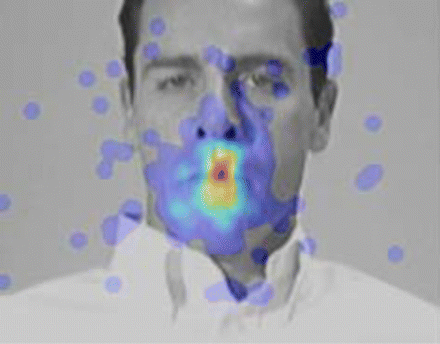
mouthComparisons of “healthy” vs. “disordered” genomes in psychiatry have not yet revealed sequence differences that can reliably predict the onset of mental disability.  Rather, such disability seems to arise from as-yet-undetermined complex, probablistic interactions of genetic risk and environmental factors over the course of development.  With this as the case, the demarcations between “healthy” and “disordered” may not be distinct, but rather fuzzy and hence unworthy of labels that give a false impression of being discrete states.

One recent paper that speaks to this issue is by Meyer-Lindenberg et al., “Genetic variants in AVPR1A linked to autism predict amygdala activation and personality traits in healthy humans” [doi: 10.1038/mp.2008.54].  Here, they explore genetic variation in the AVPR1A gene – a receptor for the pro-social neuropeptide vasopressin – and how it can modulate the activity of the amygdala when subjects view human faces (vs. a geometric shapes control condition).  Since it is well known that the amygdala responds to a wide range of social and emotional stimuli and that activation of the amygdala can enhance or prevent the storage of such emotional or socially arousing events – and – that this process goes awry in autism and in subjects with amygdala damage (the picture above shows that patients with amygdala damage do not focus on the eyes of human faces) – the investigators have indeed focused-in on a key set of neural processes.  They find the variation in the RS1 and RS3 polymorhphic sites in AVPR1a do indeed correlate with amygdala activity in healthy controls who were carefully screened for no history of mental disability.  A great example of folks who carry the “healthy” label, but also the genetic risk and the neural correlates of autism.

Reblog this post [with Zemanta]

Read Full Post »

Celebrity Book of Dreams
Image by Simon Clayson via Flickr

Recently, the media has mourned the 5HTT-LPR which was  stripped of its celebrity risk-allele status.  Another gene however, the BDNF val66met variant (just a B-list celeb at the moment)  has been slowly acquiring similar interest as the genetic variant that can be counted on to confer a biological association with any number of brain-based phenotypes, behaviors and – dare I say – grant funding.

Not so fast – according to Verhagen et al., in their recent, “Meta-analysis of the BDNF Val66Met polymorphism in major depressive disorder: effects of gender and ethnicity” [doi: 10.1038/mp.2008.109].  Here they report on 2,812 cases and 10,843 controls from 12 research studies on major depression.  Their analysis found no overall association of the Met allele with major depression.  However, when they consider just men who carry the Met/Met genotype, there was a significant association with risk of MDD.

Perhaps amidst the clamor as BDNF rises to the celebrity darling du jour, we can think more on the futility of the “disorder x genotype” approach in general and more on how best to make sense of – and productive use of – our genetic information.  Genetic associations (spurious as they are) with DSM-IV clinical descriptions may not be particularly meaningful.  Somehow, the basic biology and the clinical descriptions of what we call mental illness do not seem to be linking-up very well.  Perhaps more celebrity-genes will have to fall from grace before we come to a new conceptual paradigm.

Reblog this post [with Zemanta]

Read Full Post »

Richard Westall, The Sword of Damocles, (Briti...
Image via Wikipedia

Just having some fun with SNPedia’s new release of Promethase (0.1.66) which now has a superfast analysis option ($2 via a link to your Amazon.com account) as well as the usual free regular speed option.  I had some fun comparing my 23andMe profile to my wife’s using the experimental “breeding” tool and – 214 seconds later – had a glimpse of the genetic probabilities that now hang like the Sword of Damocles over my children. A few SNPpets include:
rs1726866(T;T) – unable to taste bitter 80% likely to be unable to taste bitter
rs10246939(T;T) – unable to taste bitter
rs11200638(A;A) – ~10x increased risk of wet age related macular degeneration
rs7754840(C;C) – 1.3x increased risk for type-2 diabetes
rs324650(T;T) – higher IQ The rs324650(T;T) genotype boosts intelligence
rs2802288(A;A) – longer lifespan
rs1815739(C;C) – possibly increased sprint/power performance

Although I won’t be around to vouch for the longer lifespan, I can vouch for the insensitivity to bitter taste (both kids love broccoli) and our torn up furniture must confirm the tendency to sprint muscles … as for the others, I guess we’ll see in time.  Thanks SNPedia!

(+2 points for mixing references to 2 Greek myths in 1 blog post)

Reblog this post [with Zemanta]

Read Full Post »

Jennifer Miller's Circus Amok
Image via Wikipedia

Just reblogging this sentiment published today in “Medical News Today”.

I’m not sure if I’d go so far to say the tests are “harmful”, since many patients and families are usually pretty enthusiastic to know more and learn more about the biological aspects of mental illness.  Certainly, genetic information has value, but its not yet clear how to extract and realize the value as an outcome improvement.  Some value might be realized in the short-term in the area of stigma-busting where the deep biological roots of the disorders are emphasized.

Nevertheless, patients and families should be wary of genetic fraudsters.

Reblog this post [with Zemanta]

Read Full Post »

Genetic Data
Image by giumaiolini via Flickr

As the personal genomics era dawns, it becomes clear that the new genetic information will lead to more new questions than answers.  Consider a well-intentioned parent who finds any number of suspicious risk factors in the genome of their child.  Perhaps a genetic risk variant for mental illness – an anxiety disorder perhaps?  What can be done?  What, if anything, should be done?

Of course there is no simple answer to this question.  Nevertheless, the technology itself may create strong demand for answers in the near future.  If it were me, I certainly would want to know – something, anything – to help.  Furthermore, there are already examples of willful misinformation in the consumer genetic marketplace that seem to prey on anxieties of parents, and which could ultimately heighten the need for reliable, evidence-based guidance.

To this end, the recent research article entitled, “A Genetically Informed Study of the Association Between Childhood Separation Anxiety, Sensitivity to CO2, Panic Disorder, and the Effect of Childhood Parental Loss“[Arch Gen Psychiatry. 2009;66(1):64-71], caught my attention. In this article, the authors consider Panic Disorder, a condition which can lead to the disruption of a healthy personal and professional life.  Genetic studies have shown that specific genes can contribute to the risk of the disorder, but also that these genes interact with early life and adult life experience.  What might these genes be doing in early life – and if we knew – then might we intervene early on to prevent the onset of the disorder later in life?

Again, there are more questions than answers here, but the research team of Battaglia et al., show – using 712 young adult twins – that a common genetic factor underlies childhood separation anxiety and the adult onset of panic disorder.  Thus, it may be the case that the sames genes that contribute to the risk of panic disorder, also may contribute to a form of childhood anxiety.  Having found evidence for a particular form of developmental continuity, the research team is one step closer to learning how a genomically-guided child-based early intervention might be structured.

Because there are many pathways that can lead to mental illness and many ways in which the genome interacts with the environment – it will be complex, if not impossible, to design early interventions that prevent the onset of mental illness.  In most cases, it is rather likely that most children who carry risk for mental illness, will – due to the probablistic nature of gene-gene and gene-environment interactions – just develop typically and not develop mental illness.  Neverthess, some will and its worth learning more.

Reblog this post [with Zemanta]

Read Full Post »

Steven Pinker on Open Source
Image by greeley via Flickr

A great article (here in the NYTimes magazine) on one psychologist’s reaction to his genome and the new consumer genomics.

Reblog this post [with Zemanta]

Read Full Post »

Flash circuit

Image by cibomahto via Flickr

A recent paper from Andreas Heinz and colleagues (doi: 10.1038/nn2222) provides more neuroimaging evidence in humans for a a circuit that regulates our responsivity to stimuli that evoke emotional responses.  The basic circuitry involves the amygdala (a place in the brain where emotional memories are registered), the prefrontal cortex (a part of the brain that is involved in making decisions and assessing threats) and the cingulate cortex (a place in the brain where expectations are compared to sensory inputs & outgoing responses).  These 3 brain regions are interconnected in a loop through various synaptic contacts and the responsivity of these synapses can be modulated by neuomodulators such as dopamine, serotonin and noradrenaline.  It turns out, that several neuroimaging studies have begun to demonstrate that this (relatively) simple circuitry underlies human personality and temperament. In the Heinz study, the level of dopamine that was released into the amygdala was correlated with levels of functional activation to emotional stimuli as well as a dimension of temperament known as negative affect.

I recall once having taken the Meyers-Briggs assessment in graduate school and had a blast comparing my results with my wife – who was almost my polar opposite. Now, the latest neuroimaging and imaging-genetic research has begun to explain the complexities of human personality in basic neural circuitry where genes such as 5HTT and MAOA ‘turn up’ or turn down’ the gain on various synaptic contacts in this circuit – leading to the immense, yet systematic variation in personality and temperament that makes our social lives so interesting.  As I navigate my way through marriage and parenthood, I’m often glad I took the personality test with my wife many years ago.  It always helps to see things from the other person’s perspective.  Now, as she obtains her 23andMe profile, perhaps we will begin to compare our genomes together – the ultimate form of marriage counseling !!  Click here for more personality tests.

Reblog this post [with Zemanta]

Read Full Post »

Karyogram of a human maleImage via Wikipedia Doctor David Ledbetter gives an eloquent editorial overview in his piece, “Cytogenetic Technology: Genotype and Phenotype” [doi: 10.1056/NEJMe0806570] on the renaissance underway in the field of medical cytogenetics. The use of high density arrays for genome-wide copy number variation has identified a slew of new sites showing recurrent microdeletion that are reliably found in patients with mental developmental disabilities (autism, mental retardation, schizophrenia to name a few). Ledbetter suggests that the ‘genotype first’ process of diagnosis is now much more effective with the help of the new arrays. He notes, “a pediatrician has the option of ordering this test as an adjunct to or replacement of a standard karyotype and can expect a much higher yield of clinically significant results”. This is an exciting realization of the long-awaited promise of genetics in medicine.

Reblog this post [with Zemanta]

Read Full Post »

Gene duplication illustration
Image by Colin Purrington via Flickr

A pair of Nature papers (PubMedIDs: 18668039, 18668038) find that mapping the risk of schizophrenia to the genome is more readily achieved when examining structural variation (insertions, deletions, duplications etc.). This is welcome news given the sparse success of SNP screening, although it would be reasonable to assume that SNPs can modify such structural variants (here for the most recent schizophrenia SNP association study). The pair of papers found similar sites, which is pretty amazing given that many structural variants are rare (see the 2006 survey report). The Copy Number Variation Project provides more details on this important class of variation.

Reblog this post [with Zemanta]

Read Full Post »

Joan of ArcImage by dbking via Flickr Amidst the excitement of new personalized genome services, the Economist reports on fraudsters found peddling ‘personalized supplements’ based on bogus genetic testing results. This is an extreme, tragicomic example to be sure, but highlights some of the issues that can arise when confronting one’s genetic blueprint. A recent paper by Stephanis et al., “Impact of Schizophrenia Candidate Genes on Schizotypy and Cognitive Endophenotypes at the Population Level(DOI) shows that in a population of healthy individuals, those that carry common variants (such as rs760761, rs1018381, rs2619522) located in the dysbindin (DTNBP1) gene, a risk factor for schizophrenia, show minor cognitive impairments such as decreased attentional capacity, worse performance on memory tasks, and alterations in schizotypal beliefs and experiences. Thus, it would seem that, common genetic variation associated with a complex psychiatric disorder can confer minor cognitive impairment in healthy individuals. As personalized genome services proliferate, healthy individuals will begin to recognize that they carry genetic risk for all kinds of ailmentsmental illness included. I admit to having cringed somewhat when typing out the blunt title of this post – fraudsters notwithstanding.

Reblog this post [with Zemanta]

Read Full Post »

By Richard Wheeler (Zephyris) 2006.Image via Wikipedia From time to time, it just seems hopeless to adhere to a reductionist strategy in the area of psychiatry and psychology. How, indeed, can our infinitely complex mind be understood in terms of tiny chemical bits ? Just when you’re ready to give up and bid adieu to Descartes and his mechanisms, along comes a reinvigorating paper like Professor Morgan Sheng’s, “Synaptic Accumulation of PSD-95 and Synaptic Function Regulated by Phosphorylation of Serine-295 of PSD-95” (DOI). This paper demonstrates that the the addition and removal of a single – that’s right, a single – phosphate group to Serine 295 of the PSD-95 protein is sufficient to activate or inhibit the recruitment of synaptic proteins such as AMPA receptors and potentiate excitatory post-synaptic current. Given that many complex mental illnesses are associated with synaptic deterioration, there seems to be great therapeutic significance to this finding. [Neuron, Vol 56, 488-502, 08 November 2007]

Reblog this post [with Zemanta]

Read Full Post »

BBC Bush House in London
Image by ➨ Redvers via Flickr

As reported on the BBC, a recent call by Lord Justice Sedley, for universal inclusion (tourists too) in Great Britain’s national DNA database, has fanned longstanding civil rights debates. Given that the national DNA database carries disproportionate levels of ethnic minorities, it hardly seems fair to search or use the database within a legal framework or presumption that its contents generalize to the UK population at large. Some have concluded that there is much more genetic variation within ethnic and racial groups than between groups, making the ethnic composition of the database, a non-issue. In contrast, the article (free on Pubmed central) , “Genetic structure, self-identified race/ethnicity, and confounding in case-control association studies,” led by Neil Risch and Nicholas Schork find that when many, many markers are used, clustering algorithms can reveal a strong correspondence between self-reported ethnicity and genetic background. This article was a good jumping-off point for me to learn more about this complex issue. I think its not to soon for me to start rehearsing what I’ll say to the cops when they pull me over for driving with an undesirable allele.

RELATED UPDATE … story on how US government insiders/lobbyists abuse public monies set aside for DNA testing.

Reblog this post [with Zemanta]

Read Full Post »

Schematic representation of MHC class I molecu...
Image via Wikipedia

To me, phylogenetics is one of the coolest ways to use human sequence diversity. I’m not an expert, but roughly speaking, the method involves looking at sequences among ancestral populations and comparisons to sequences in groups that have migrated out over space and time. In these out groups, recombination and mutation have caused genetic sequences to diverge – in some cases new alleles have been naturally selected for, and in most cases, new alleles thrived or crashed due the size and mating structure of a population. The genome carries the historical record of this change – the ultimate history book !

I recently had my Y-chromosome analyzed by the Genographic Project and was intrigued to discover a southwest asian heritage. More recently, Kenneth Kidd and colleagues report a detailed analysis of sequences in the KIR receptor gene complex on chromosome 19q13 and variation in the human leukocyte antigen (HLA) class I gene complex on chromosome 6p23. It has long been known that these regions are hypervariable, which is a good thing since our immune system exploits this diversity to counter ever-changing pathogen invasions – but how do two parts of the immune system continue to work together (KIR receptors bind to HLA antigens) when the separate, unlinked genomic regions show hypervariability ? Worse yet, if the KIR-HLA interaction is too weak, we are susceptible to infection, but, if too strong, we are susceptible to autoimmune attack. Quite a tight-wire to walk, amidst a deluge of pathogen invasions ! Kidd and colleagues use the ALFRED database to reveal some clues to the historical record of this. Apparently, the co-evolution is selective, where activating receptor (19q13) -ligand (6p23) complexes were strongly negatively selected for but not inhibitory receptor-ligand pairs.

Reblog this post [with Zemanta]

Read Full Post »

« Newer Posts