Feeds:
Posts
Comments

Archive for March, 2009

Binocular Smile
Image by cobalt123 via Flickr

Is the human brain a blank slate? or a pre-programmed machine that is ready to take the S.A.T.s right out of the box? Obviously neither, or both as it were. Some have gingerly waded into the nature vs. nuture debate and suggested that the human brain comes pre-wired to receive certain experiences – experience expectant – and thus acknowledge the importance of natural selection in shaping an organism via heritable factors but also the need to be able to use the brain to learn from experience and adapt on the fly.

In their paper entitled, “Nature versus Nurture in Ventral Visual Cortex: A Functional Magnetic Resonance Imaging Study of Twins [DOI:10.1523/JNEUROSCI.4001-07.2007] Thad Polk and colleagues provide a wonderful example of this.  The team suggested that the brain (visual system) should be somewhat innately (genomically if you will) prepared to process visual stimuli such as faces and objects, but not so for stimuli such as pseudo words.  They proposed to test the role of the genome by comparing patterns of brain activity in identical vs. fraternal twins.  If the brain activity patterns were very similar for identical twins, and less so for fraternal twins, then it is likely that the genome plays some role in the generation of brain (at least with respect to blood flow) responses to such stimuli. The team used fMRI to assess 13 pairs of identical twins and 11 pairs of fraternal twins for their brain responses to pictures of faces, houses, chairs and non-word strings on letters as well as control “scrambled” images that were comparable in visuo-spatial frequency.

Interestingly, the team found that for faces and houses, there were significant identical vs. fraternal differences in the “activation maps” of the twins but no such differences for chairs and pseudowords.  Thus it seems that the genome plays a role in the way the brain processes faces and houses (or perhaps faces and places in general), but not so much for items that are not found (or weren’t found by our evolutionary ancestors) in a natural setting.

I’m surprised by the chair result … although perhaps being a couch potato is something evolution does not select for.

Reblog this post [with Zemanta]

Read Full Post »

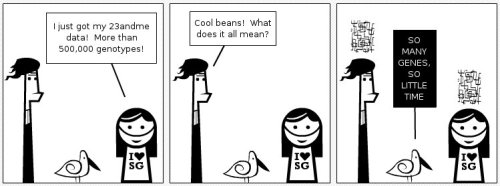
homebrew comics 2

Genes and the financial debacle

Read Full Post »

Just echoing this article in Wired on the construction of the human version of the Allen Brain Atlas (mouse genome).  I happened to participate in the early rounds of market research on this … very exciting to see it coming online!

Read Full Post »

Just stumbled onto this great educational resource ….

From an article that describes NERVE:

We’ve Got NERVE: A Call to Arms for Neuroscience Education
Kyle J. Frantz, Colleen D. McNerney and Nicholas C. Spitzer
“Are we neuroscientists doing our part to help revive science education, to stimulate teachers’ ingenuity, and diversify the intellectual capital among the next generation of scientists? Certainly we support progressive initiatives, including a major international Brain Awareness Campaign, local chapter grants for Society for Neuroscience (SfN) members, and activist committees for media relations, but are we doing enough? To enable neuroscientists worldwide to step out of the laboratory or office periodically to visit nontraditional neuroscience education venues, the Society for Neuroscience Public Education and Communication Committee has launched NERVE, the Neuroscience Education Resources Virtual Encycloportal (Fig. 1). This web-based compendium of teaching materials went live in September 2008 and has already received >10,000 visits from >100 countries around the globe. NERVE’s offerings are many: videos to stimulate discussion at town hall meetings, lesson plans for visits to local schools, and hands-on activities to break up long lectures, just to name a few. Regardless of the topic or venue, NERVE aims to meet our neuroscience education needs.”

The Journal of Neuroscience, March 18, 2009, 29(11):3337-3339; doi:10.1523/JNEUROSCI.0001-09.2009

Read Full Post »

facial expressions
Image by ibiscus27 via Flickr

One of the difficulties in understanding mental illness is that so many aspects of mental life can go awry – and its a challenge to understand what abnormalities are directly linked to causes and what abnormalities might be consequences or later ripples in a chain reaction of neural breakdown.  Ideally, one would prefer to treat the fundamental cause, rather than only offer palliative measures for symptoms that arise from tertiary neural inefficiencies. In their research article entitled, “Evidence That Altered Amygdala Activity in Schizophrenia Is Related to Clinical State and Not Genetic Risk“, [doi: 10.1176/appi.ajp.2008.08020261] (audio link) Rasetti and colleagues explore this issue.

Specifically, they focus on the function of the amygdala and its role in responding to, and processing, social and emotional information.  In schizophrenia, it has been found that this brain region can be somewhat unresponsive when viewing faces displaying fearful expressions – and so, the authors ask whether the response of the amygdala to fearful faces is, itself, an aspect of the disorder that can be linked to underlying genetic risk (a type of core, fundamental cause).

To do this, the research team assembled 3 groups of participants: 34 patients, 29 of their unaffected siblings and 20 demographically and ethnically matched control subjects.  The rationale was that if a trait – such as amygdala response – was similar for the patient/sibling comparison and dissimilar for the patient/control comparison, then one can conclude that the similarity is underlain by the similarity or shared genetic background of the patients and their siblings.  When the research team colected brain activity data in response to a facial expression matching task performed in an MRI scanner, they found that the patient/sibling comparison was not-similar, but rather the siblings were more similar to healthy controls instead of their siblings.  This suggests that the trait (amygdala response) is not likely to be directly related to core genetic risk factor(s) of schizophrenia, but rather related to apsects of the disorder that are consequences, or the state, of having the disorder.

A follow-up study using a different trait (prefrontal cortex activity during a working memory task) showed that this trait was similar for the patient/sibling contrast, but dissimilar for the patient/control contrast – suggesting that prefrontal cortex function IS somewhat linked to core genetic risk.  Congratulations to the authors on this very informative study!

Reblog this post [with Zemanta]

Read Full Post »

homebrew comic strip

comic

Read Full Post »