Feeds:
Posts
Comments

Archive for the ‘Uncategorized’ Category

ruler - STUPID INCOMPETENT MANUFACTURERS
Image by Biking Nikon PDX via Flickr

One of the difficult aspects of understanding mental illness, is separating the real causes of the illness from what might be secondary or tertiary consequences of having the illness.  If you think about a car whose engine is not running normally, there may be many observable things going wrong (pinging sound, stalling, smoke, vibration, overheating, loss of power, etc.) – but, what is the real cause of the problem?  What should be done to fix the car? – a faulty sparkplug or timing belt perhaps?  Such is often the problem in medicine, where a fundamental problem can lead to a complex, hard-to-disentangle, etiology of symptoms.  Ideally, you would fix the core problem and then expect the secondary and tertiary consequences to normalize.

This inherent difficulty, particularly in mental illness, is one of the reasons that genetic research is of such interest.  Presumably, the genetic risk factors are deeper and more fundamentally involved in the root causes of the illness – and hence – are preferable targets for treatment.  The recent paper, “Widespread Reductions of Cortical Thickness in Schizophrenia and Spectrum Disorders and Evidence of Heritability” [Arch Gen Psychiatry. 2009;66(5):467-477] seeks to ascertain whether one aspect of schizophrenia – a widespread and well-documented thinning of the neocortex – is due to genetic risk (hence something that is closer to a primary cause) or – rather – if cortical thinning is not due to genetics, and so more of a secondary consequence of things that go wrong earlier in the development of the illness.

To explore this idea, the team of Goldman et al., did something novel.  Rather than examine the differences in cortical thickness between patients and control subjects, the team evaluated the cortical thickness of 59 patients and 72 unaffected siblings as well as 196 unrelated, matched control participants.  If the cortical thickness of the siblings (who share 50% of their genetic variation) was more similar to the patients, then it would suggest that the cortical thinning of the patients was under genetic control and hence – perhaps – a biological trait that is more of a primary cause.  On the other hand, if the cortical thickness of the siblings (who share 0% of their genetic variation) was more similar to that of the healthy control participants, then it would suggest that cortical thinning was – perhaps more of a secondary consequence of some earlier deficit.

The high-resolution structural neuroimaging allowed the team to carefully assess cortical thickness – which is normally between a mere 2 and 4 millimeters – across different areas of the cortex.  The team reports that, for the most part, the cortical thickness measures of the siblings were more similar to the unrelated controls – thus suggesting that cortical thickness may not be a direct component of the genetic risk architecture for schizophrenia.  Still, the paper discusses several candidate mechanisms which could lead to cortical thinning in the illness – some of which might be assessed in the future using other imaging modalities in the context of their patient/sibling/control experimental design.

Reblog this post [with Zemanta]

Read Full Post »

Mi iPod con vídeo
Image by juanpol via Flickr

It was a great pleasure to speak with Professor Garet Lahvis from the Department of Behavioral Neuroscience at the Oregon Health and Science University, and learn more about how the biology of empathy and social behaviors in general can be approached with animal models that are suitable for genetic studies.  The podcast is HERE and the post on his lab’s recent paper, “Empathy Is Moderated by Genetic Background in Mice” is HEREThank you again Dr. Lahvis!

Reblog this post [with Zemanta]

Read Full Post »

LARRY DAVID AT TRIBECA FILM FESTIVAL WIKIPEDIA
Image by roberthuffstutter via Flickr

pointer to: Eye-on-DNA’s post of last nights episode of “Lopez Tonight” where Larry David shared the unveiling of his “Ancestry-by-DNA” results.  He was good sport and it was great to see science as FUNHis results made me wonder if such ancestry tests are reliable though.

Reblog this post [with Zemanta]

Read Full Post »

artist blog: Darryl Cunningham

two pencils grade hb
Image via Wikipedia

pointer to: Darryl Cunningham Investigates – an amazing artist who’s work delves into mental health topics.

Reblog this post [with Zemanta]

Read Full Post »

movie_poster

Read Full Post »

Genome oppression

genetics_protest

Read Full Post »

Stuart Little
Image via Wikipedia

** podcast interview accompanies this post ** Lab mice have it pretty good I suppose.  Chow, water and mating ad libitum, fresh bedding, no predators.  Back in grad school, I usually handled my little mouse subjects gently so as not to frighten them and always followed the guidelines for humane treatment.  At the end of the day, however, I must confess that I didn’t actually care or empathize much with them.  For the most part, my attitude was, “Hey, they’re just mice – its not like I have Stuart Little here!”   I wonder.

As genetics and psychology are increasingly used to jointly explore the mechanisms of human cognition, more and more papers – particularly in the area of social and emotional systems – will make me question the, “hey, they’re just mice” assumption.

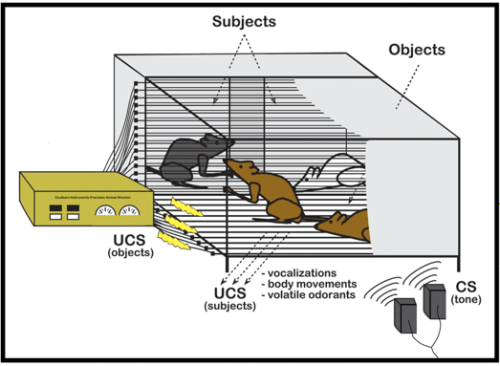
The free and open PLoS ONE paper, “Empathy Is Moderated by Genetic Background in Mice” is one of interest in this regard.  The authors have devised an experimental paradigm to ask whether emotional distress (to a brief foot-shock) in one mouse can influence the emotional state of an observer.  According to the authors, one of the inbred mouse strains, “acquired a classical conditioning (Pavlovian) association, which engendered a freezing response that was dependent upon the previous experience of distress in nearby conspecifics.”

Such a model – which to me, looks pretty humane, that is, in light of what they have learned about mice and empathy, and especially since human volunteers routinely participate in such mild wrist-shock paradigms – will likely be very useful for studies of specific genes where one can compare the “empathy” scores of inbred strains with and without the genetic modification.

mouseempathy

Reblog this post [with Zemanta]

Read Full Post »

Junk DNA

junkDNA

Read Full Post »

Just echoing the recent story of an Italian court that decided to shorten – by 1 year – the sentence of a defendant convicted of murder, based on genetic and brain imaging data.  Here is a previous post and podcast link covering some of the issues on this topic.

Read Full Post »

hdac_lesson

Read Full Post »

ipod
Image by Oliver Lavery via Flickr

Daniel R. Weinberger, M.D., Chief of the Clinical Brain Disorders Branch and Director of the Genes, Cognition and Psychosis Program, National Institute of Mental Health  discusses the background, findings and general issues of genes and mental illness in this brief interview on his paper, “A primate-specific, brain isoform of KCNH2 affects cortical physiology, cognition, neuronal repolarization and risk of schizophrenia”.  Click  HERE for the podcast and HERE for the original post.

Thanks again to Dr. Weinberger for his generous participation!

Reblog this post [with Zemanta]

Read Full Post »

psd_on_wall

Read Full Post »

neuroligin_neurexin

Read Full Post »

“Methland: The Death and Life of an American Small Town” by Nick Reding is a closer look at the rise of illicit methamphetamine use that grew along socio-economic fault-lines propagated by the rise of financial capitalism and deregulation beginning in the late 1970’s.  Now 30 years later, there is no end in sight for the worlds most addictive home-grown drug that continues to ensnare millions of lives and render our closely held ideal of “small town life” an empty myth.  So go small towns all across America into the darkness – where politicians cater to corporate behemoths who they fear as too big to fail or just as likely to offshore to lower wage economies.  An eye-opening and heartbreaking documentary of how an addictive drug can highlight the socio-economic and political failures of a society.

Reblog this post [with Zemanta]

Read Full Post »

SfN encodings

Read Full Post »

Gliascience 2009

SfNneuroblogbadgeHey, why should neurons get all the adulation – you know – like an organization with 40,000 members complete with an annual fest in exotic locales?  After all, glial cells outnumber neurons many-fold and a single astrocyte can ensheath and support many hundreds of neurons.  Perhaps it may be that who gets top billing may not be so much an issue of who is more important, but just a matter of who is better known (its who you know in life that matters right?).
These were my thoughts at the start of Professor Ben A. Barres’ talk, “What do Glial Cells Do?” which I greatly enjoyed today.  One of the key things glia do, it turns out, is to help neurons form new synapses.  This can be shown by culturing astrocytes and then applying the conditioned media to rat ganglion cells – who respond by making new postsynaptic densities and also increasing the externalization of AMPA receptors.  The mediator of this process was identified as thrombospondin – a molecule that is secreted by astrocytes and binds, via its EDF-repeat domain, to a neurally expressed molecule known as alpha-2-delta-1 calcium channel subunit which signals in an integrin-like manner to initiate the formation of excitatory synapses.  A few other highlights from the talk were:

-thrombospondin is the gene which is MOST upregulated in expression when human vs. monkey brain mRNA levels are compared.

-the synapse-inducing effects of astrocytes work only in immature astrocytes and injured/reactive astrocytes, but not mature ones.

-overexpression of the alpha-2-delta-1 calcium channel subunit can induce synapse formation.

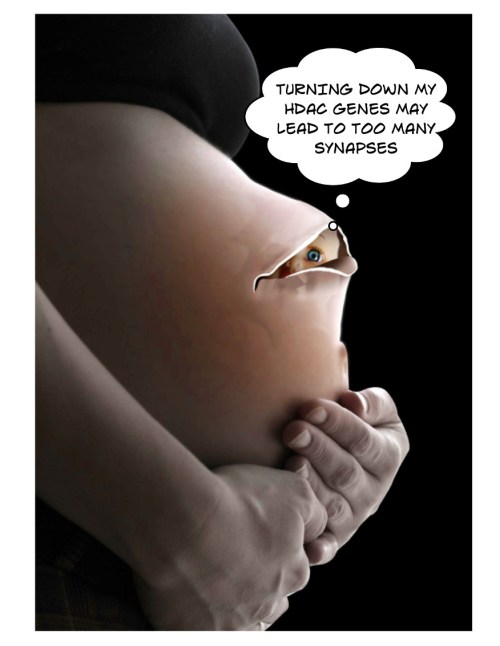
-some medications such as gabapentin/neurontin bind to the alpha-2-delta-1 calcium channel subunit and can actually interfere with the new synapse formation – red flagging these meds for use during pregnancy and in children

-there is a metal-binding domain in alpha-2-delta-1 calcium channel subunit which may – possibly – be a target for lead binding and be a reason for why small amounts of exposure to lead can lead to mental retardation

Another highlight of the talk was Professor Barres brief personal comments on the importance of gender and cultural diversity in the practice of science. I was impressed by his warm and supportive remarks to students who may be concerned about diversity and discrimination in the field of science.  Check out his wikipedia page for more.

Read Full Post »

SfN sugar rush

brainjellies

Read Full Post »

SfNneuroblogbadgeTodays session, “Synaptic Receptor and Regulation” has been a wonderful overview of a great diversity of synaptic components.  Across the talks, it is abundantly clear that synaptic proteins – particularly those located in the post-synaptic density (PSD) are over-represented in mental and developmental disorders.  Hence, it is clear that understanding how these proteins work will help understand brain-related illness.  Another common theme is that most of the proteins discussed so far seem to interact via a common latticework of proteins such as PSD95 and gephrin which are prone to polymerize in ways that provide a scaffold for ion channels and other receptors that intitiate action potentials.  Hence, it seems that 3-D structure IS function when talking about synapses.  Just a smattering of highlights for me were:

-amazing 3-D tomographic reconstructions of the PSD

-protein palmitoylation is necessary for proper spine formation (perhaps because ras & rho use such modifications during signalling?)

-that a conformational change in collybistin upon binding with neuroligins is what promotes the clustering of ion channels

-a failure to stabilize AMPA receptors is an underlying cause of mental retardation

-the localization of synapses in the axon initial segment is regulated by neurofascin – which is expressed just there in that very tiny aspect of a neuron!

-beautiful 3-D reconstructions of dentrites, spines and astrocytes entwined together and also detailed freeze-fracture replica images of AMPA receptor localization (clustered in the center of the active zone) and NMDA channels (more diffusely spaced)

-the dishevelled gene (the mouse knockout has a behavioral phenotype) regulates AcH receptor localization in c. elegans.

-red hot chilli pepper spice (a.k.a. capsaicin) is actually able to cause AMPA receptors to internalize and depress neural activity.

-the PSD is highly conserved in vertebrates and has very ancient evolutionary roots as far back as our common ancestor with yeast! yet the most divergent genes are those involved in neural development.

-still trying to figure out what “the calyx of held” is … more on that later … blasted wifi here

Read Full Post »

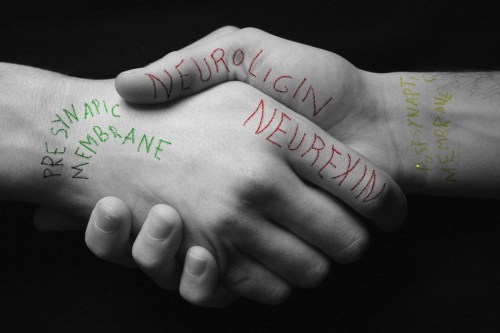
SfNneuroblogbadgeWhile most presentations at SfN cover brief snippets of research, yesterday it was a delight to hear the story of neurexins and neuroligins – the whole, decades worth of research, story – from Professor Thomas Sudhof, whose lab has been responsible for the purification and biochemical characterization of these proteins.  Without re-telling the tale here, a few neat highlights about these proteins who form a transynaptic bridge with neurexins on the pre-synaptic membrane binding to neuroligins on the post-synaptic membrane:
-neurexins were first purified using alpha-latrotoxin (a.k.a black widow venom!)

-there are thousands of spice variants of a single neurexin gene and these have rather specific affinities for different splice variants of neuroligins (how are these splicing events regulated to ensure the right pairs find each other?)

-the mere act of ectopic expression of neuroligins is sufficient induce the formation of synapses in neuronal cell lines – however this will not happen if the neuroligin is missing its neurexin binding domain.  Apparently, different neuroligin genes confer the formation of different types of inhibitory vs. excitatory synapses.

-interestingly, the deletion of any pair of the 3 (NL1,2,3) neuroligin genes has little effect – albeit for a few subtle social behavior phenotypes in mice.  Deletion of all 3 of the NL genes is lethal.

-In humans, mutations in neuroligins such as R87W and R451C are associated with autism spectrum disorder.  Apparently, these mutations do not fold properly and do not make it to the cell surface.

-The R451C mutation, when expressed in a mouse leads to more inhibitory synapses in the cortex and more excitatory synapses in the hippocampus.  The mice are BETTER able to learn/unlearn the water-maze paradigm but show subtle social affiliation phenotypes.

-There are a number of other mutations in genes that interact with the neurexins and neuroligins that are also associated with mental disability, suggesting that the proper regulation of synaptic organization and excitatory/inhibitory balance is a key aspect of optimal mental function.

Read Full Post »

100_0371Happened to snap this pic of Thomas Insel, Director of NIMH this morning.  I couldn’t help wonder what he might have been thinking.

“Sheese, my institute pays a bundle for this, and even I can’t find a bite to eat?”

Just wondering.

Read Full Post »

« Newer Posts - Older Posts »