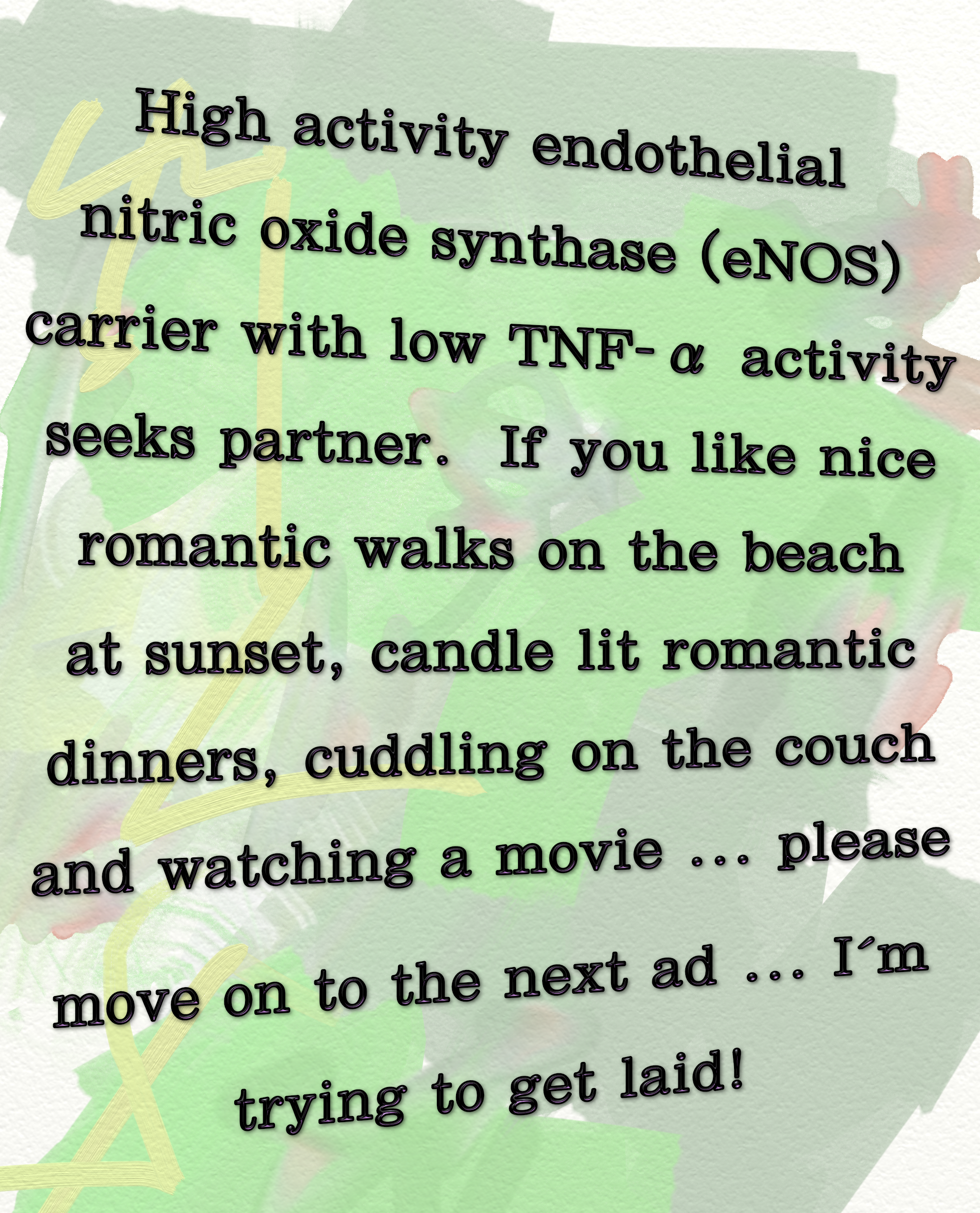
Posted in Uncategorized | Tagged Art, personal ads | Leave a Comment »
 As a big fan of black and white photography, I’m intrigued by the concept of “Splitting” or so-called “black and white” thinking. It’s something we all do to different degrees … when we avoid dealing with the “shades of gray” and group things in our life into “all good” or “all bad” groups.
Psychologists have considered this cognitive tendency to be a normal part of cognitive development (eg. good guys vs. bad guys), a response to stress, and also a part of various psychopathologies (funny, how psychiatrists have a tendency to group us into the “normal” and “abnormal”, huh?).
Is there anything wrong with seeing the world in black and white? Perhaps, if you label mildly annoying people as “bad”, you’ll soon have no friends … but otherwise, I’m not sure. Simplicity can be soothing.
I mean, our brains have a strong tendency to work at the extremes … for example, when it comes to cognition and movement. We’re wired with so-called striatonigral (Go) and striatopallidal (NoGo) neural pathways that are engaged when cognition is transduced into action. In the primal world of our ancestors, we didn’t survive very long if we danced around fretfully pondering the costs and benefits of running, or not running, from saber tooth tigers! So, it’s no surprise, that we’re inherently uncomfortable in the wishy-washy, indecisive, muddling middle ground when making a decision. We want to “go” or “freeze”, “do it” or “don’t”, “good” or “bad” … just make a f**king decision already.
Here’s a link to some current research on the “Go” and “NoGo” brain systems … and their genetic underpinnings (eg. the DRD2 protein is active when we are flummoxed with uncertainty which keeps us lingering in the NoGo state). Hey, our genome got us here … in one piece … it helped us stay alive … that’s not necessarily a bad thing.
thanks for the pic amadeus
Posted in Dopamine, DRD2, Striatum, Substantia nigra, Uncategorized | Tagged cognitive distortion, splitting | Leave a Comment »
Liking the way their legs are helically intertwined. DNA is everywhere …

photo cred to gildam (nsfw).
Posted in Uncategorized | Tagged Art | Leave a Comment »
 If I pay to have my house fire-proofed, it creates a free economic benefit for my next-door neighbors. If I smoke and barbecue all day long, the smoke creates an economic risk or cost for those same folks. These are examples of what economists call “externalities … a cost or benefit, not transmitted through prices, incurred by a party who did not agree to the action“.
So, what happens if I publish my genome sequence online … does anyone else get a benefit? or incur a cost? My children? My siblings? What if I were an identical twin?
Do twins favor being more similar? … in which case, maybe, they might see positive externalities?
Posted in Uncategorized | Tagged economics, Twin | Leave a Comment »
 OK, so we have some 20,000-ish genes to help build a brain with billions of neurons and trillions of synapses … and guess what … our brains don’t work as well as we think they might. Surprised?
Current psychological scientists suggest that there are some 19 social cognition biases, 8 memory biases, 42 decision-making biases, 35 probability-belief biases. Wow! That’s a lot of skewed thinking, not to mention concomitant stress it can generate. As a starting point to probing your own cognitive biases, check out John Grohol’s article on the 15 most common cognitive distortions:
1. Filtering.
Taking negative details and magnifying them …
2. Polarized Thinking.
Things are either “black-or-white” …
3. Overgeneralization.
Coming to a general conclusion based on a single incident …
4. Jumping to Conclusions.
Anticipate that things will turn out badly …
5. Catastrophizing.
We expect disaster to strike …
6. Personalization.
Thinking that everything is some kind of reaction to us …
7. Control Fallacies.
We see ourselves as helpless victims of fate …
8. Fallacy of Fairness.
We feel resentful because life is not fair …
9. Blaming.
We hold other people responsible for our pain …
10. Shoulds.
Rules about how others and we should behave …
11. Emotional Reasoning.
We believe that what we feel must be true automatically …
12. Fallacy of Change.
Needing to change people because our hopes depend on them …
13. Global Labeling.
Generalizing one or two qualities into a negative global judgment …
14. Always Being Right.
Having to prove that our opinions and actions are correct …
15. Heaven’s Reward Fallacy.
Expect our sacrifice and self-denial to pay off …
Oh crap … I’m loosing it … I do (think) all of these! Will be fun to sort out what genes relate to what biases.
[Do you know what gene regulates the initiation of new synapses?]
Posted in Uncategorized | 1 Comment »

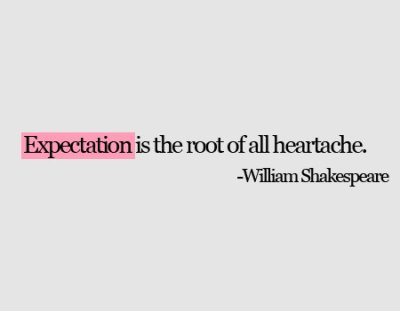 Perhaps someday, but it’s complicated. This is because the brain is not a simple input-output device. If we step on a thumbtack, it hurts … but can hurt more if you are feeling sad and lonely and much less if you are in love and just won the lottery. Expectations and memories matter, and so – our genotype – is something that reflects the development brain systems used for processing emotions, memories and expectations (like, um, the whole brain does this).
This paper explored this question using a shoulder exercise soreness assay and the COMT genotype and found that:
Participants that endorsed cognitions consistent with pain catastrophizing and had a genetic predisposition to low COMT enzyme activity had significantly higher pain intensity and pressure pain ratings when compared with groups with 1 or no risk factors.
“Pain catastrophizing” is a measure of how much a person ruminates (unable to suppress or divert attention away from pain-related thoughts) and/or focuses on and exaggerates the threat value of a painful stimuli and/or feels helpless and unable to cope with the adversity of painful stimuli. It may be the most important aspect of coping with pain … an understanding that your perspective modulates your pain.
This may be worth noting given the “dramatic increase in accidental deaths associated with the use of prescription opioids and also an increasing average daily morphine equivalent dose” despite the finding that “there is no clear evidence that long-term opiate therapy for chronic back pain is efficacious”.
Posted in COMT | Tagged Dopamine, Pain | Leave a Comment »

Image by The Library of Congress via Flickr
“On mathematical grounds, it is difficult to understand how 10-to-the-14th synaptic connections in the human brain could be controlled by a genome with approximately 10-to-the-6th genes.”
“… the classic dichotomy between “hard-wired” nativism and the “plasticity” championed by anti-nativists was woefully off the mark. Historically, “Anti-nativists”—critics of the view that we might be born with significant mental structure prior to experience—have often attempted to downplay the significance of genes by appealing to neural plasticity, viz. the brain’s resilience to damage and its ability to modify itself in response to experience, while nativists often seem to think that their position rests on downplaying (or demonstrating limits on) plasticity.”
Well, sort of … think of genes as used for pre-wiring while experience then shapes the pre-wired system.
“… it may be more profitable to draw a distinction, between prewiring and rewiring—each of which can be had in abundance without precluding the other.”

Posted in Uncategorized | Tagged Development, Genetics | Leave a Comment »

Posted in Uncategorized | Tagged Art, personal ads | Leave a Comment »
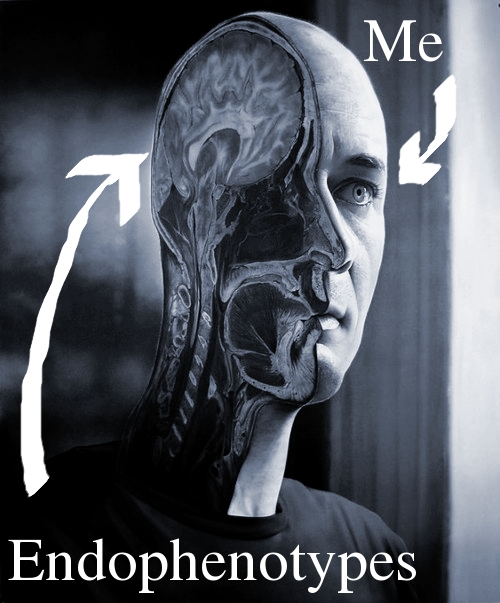
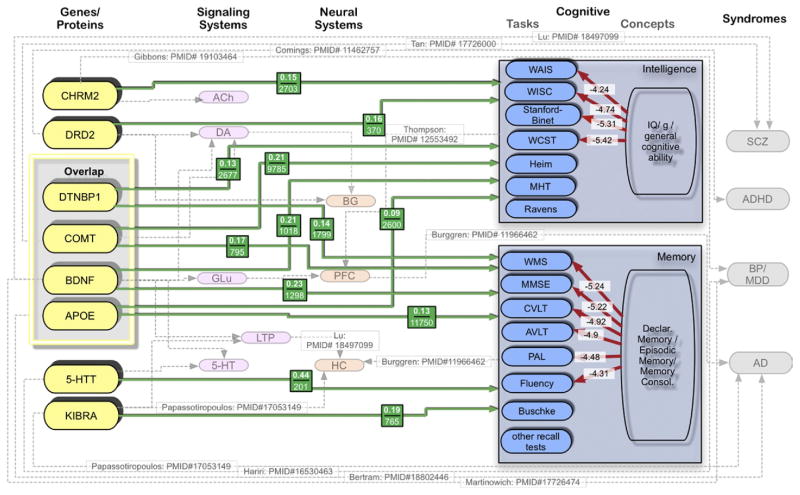 Probably not. But, just in case you were wondering, it looks a lot like this. Its (um, YOU) are a multi-level model showing overlap in genetic targets as well as signaling and neural systems between disparate latent constructs of memory and intelligence with no less than five levels of phenotype complexity (gene, signaling, neural, cognitive, and syndrome). This super-techno-geeky-view of humanity is because:
In order to identify phenotype constructs that may ultimately be successful in genetic association studies, the field needs to move beyond the now traditional endophenotype approach and begin to build and refine multivariate multilevel phenotype models.
Check out the paper here and the super-cool PubMed exploration tools … especially PubAtlas.
Posted in Uncategorized | Tagged endophenotype, Genetics | Leave a Comment »


From a collection of my PubMed articles … link to the application.
Posted in Uncategorized | Leave a Comment »
 After writing 4 books and thousands of learned pages on the topic of evolution … all to little avail. Charles Darwin enjoyed his elder years “shusshhing” priests whenever he had the chance.
Posted in Uncategorized | Tagged evolution, joke | Leave a Comment »

 Hey Yin, we have a genome and a brain … what’s the relaionship?
I dunno Yang. Lets focus on variation. Genome sequence variation can vary with the brain … and … gene expression can vary with the brain … however … genome sequence variation can vary with gene expression … but … here’s a paper showing that gene expression is under the control of genome sequence variation. Purrrr.
Hey Yin, the correlation between genome sequence variation and gene expression confuses me. I mean, gene expression can change if the environment changes right? Doesn’t this confound research that uses genome sequence variation?
Meow.
thanks for the pic noyfb.
Posted in Uncategorized | Tagged Gene expression, Genome, Heritability | Leave a Comment »
 I mean, how many people are really needed to run a sufficiently powered genome-wide association study? Are there enough people on the planet? Heather J. Cordell’s review, Detecting gene-gene interactions that underlie human diseases, seems optimistic, but, at this point, it seems a valid question … at least if you want to detect gene-gene interactions.
“The historical lack of success in genetic studies of complex disease can largely be attributed, not to ignored biological interactions, but rather to under-powered studies that surveyed only a fraction of genetic variation …”
thanks for the pic heckyeahart

Posted in Uncategorized | Tagged Genetic testing, Genetics, Genome-wide association study, Statistics | Leave a Comment »
Remarks
Re-Tweetin’
Tweets by genes2brains2meBlog Stats
- 191,751 clickitas
Posting since April 2007
General topics
23andMe Addiction Add new tag aging Anxiety Art Arts autism B. K. S. Iyengar Biology Brain Buddism Central nervous system Cognition comics Consciousness Depression Development DNA Dopamine dualism economics Emotion Empathy Epigenetics evolution fear Frontal lobe Functional magnetic resonance imaging Gene Gene expression Genetics Genetic testing GWAS Health Health care Health insurance Hippocampus History Intelligence Kundalini language Major depressive disorder medication Meditation meme-art Memory Mental disorder Mental health Mind Mutation Nervous system Neural network Neuron Pain parasympathetic nervous system Patañjali Personalized medicine philosophy placebo Psychology Reactive oxygen species Religion and Spirituality Rett Syndrome schizophrenia Social Sciences spirituality Stem cell Stress Suicide synaptogenesis Teachers and Centers Twin Yoga Yoga Sutras of PatanjaliSpecific Items
- 5HTT
- ABCB1
- acetylcholine
- Actin
- ACTN3
- ADH1C
- ADORA2A
- ADRA2A
- AKT
- AMPA receptor
- Amygdala
- Angular gyrus
- ANK3
- APOE
- ARHGAP18
- ASIC1a
- ASPM
- ATXN1
- AVPR1a
- BAF53b
- Basal Ganglia
- BDNF
- CABYR
- CACNA1C
- CACNA2D1
- Caudate nucleus
- CB1 receptor
- CDC34
- CDH13
- Cell adhesion molecules
- Cerebellum
- CHAT
- CHRM3
- CHRNA4
- CHRNA7
- Chromosome structural variants
- Cingulate cortex
- Circadian
- clinical trial
- CNR1
- CNTNAP2
- Collateral sulcus
- COMT
- Corpus callosum
- COX1
- CREB
- CRHR1
- DARPP32
- DAT
- default network
- DISC1
- DLPFC
- DNAJC
- DNMT
- Dopamine
- DPP4
- DRD2
- DRD4
- DTNBP1
- DYRK1A
- EDA2R
- EGR1
- Estrogen
- evolution
- FGF20
- FMR1
- FNBP1L
- FOXA2
- FOXP2
- Frontal cortex
- Frontal pole
- Fusiform gyrus
- G-protein
- GAB2
- GABA
- GABRA2
- GABRG1
- GATA4
- Glucocorticoid receptor
- Glutamate
- GPR6
- GRIA3
- GRIK2
- GTPase
- HDACs
- Hippocampus
- HOXB8
- HRK
- HTR2A
- Hypothalamus
- IL3
- immunity
- Inferior frontal gyrus
- Insula
- Intronic or repetitive sequences
- Kalirin
- KCNA2
- KCNH2
- KCNIP3
- KCNJ6
- Kinesin
- Lateral septum
- Lateral ventricle
- LDB1
- Leptin
- LIMK1
- Locus coeruleus
- MAOA
- MAPK
- MCPH1
- MCR1-4
- MDGA2
- MECP2
- meditation
- MET
- metabolism
- MHC loci
- microRNA
- Middle frontal gyrus
- middle occipital gyrus
- Middle temporal gyrus
- Mindfulness
- Mitochondria
- MKP-1
- Motor cortex
- Myelin
- Neural crest
- NEUROG1
- NLGN3/4
- Noradrenaline
- NPBWR1
- NPSR1
- NRG1
- NRXB1
- NTRK2
- Nucleus accumbens
- NURR1
- Olfactory bulb
- OPRM1
- Orbitofrontal cortex
- OTR
- OXTR
- Parahippocampal gyrus
- Parasympathetic NS
- Parietal cortex
- PARP-1
- PAX6
- PCLO
- PER1
- PINK1
- PLCB1
- Posterior parietal cortex
- PSD95
- Putamen
- quantum physics
- RARB
- RGS2
- RGS4
- Rho GTPase
- RLN
- ROR1
- RORB
- Rostral fronto-occipital fasciculus
- RSRC1
- SAPAP3
- self-awareness
- SEMA(1-7)
- SETDB1
- SEZ6
- SIRT1
- SLC1A1
- SLITRK1
- SNAP25
- SNORD115
- SNRPN
- SOD2
- Somatosensory cortex
- SRPX2
- Stria terminalis
- Striatum
- Substantia nigra
- Subthalamic nucleus
- Superior temporal cortex
- Suprachiasmatic nucleus
- Supramarginal gyrus
- SWI/SNF
- Sylvian fissure
- Telomere
- Temporal lobe
- TGF-alpha
- TH
- Thalamus
- Thap1
- THBS1
- THBS2
- TNF-alpha
- Torsin A
- TPH2
- UBE3A
- UGT2B17
- Uncategorized
- Vagus
- VEGF
- Ventral tegmental area
- VGF
- Visual cortex
- White matter
- Yoga and Meditation
- ZNF804A


 Genes 2 Brains 2 Mind 2 Me