Feeds:
Posts
Comments
Methylation Sites on DNA

Image via Wikipedia

DNA methylation is THE key driver of epigenetic regulationWhere goest CpG methylation, then followest chromatin remodellingNOT the other way around.

“The heritability of genomic methylation patterns clearly shows that once established, DNA methylation is dominant over chromatin modifications.”

Some neurodevelopmental processes (here) seem to depend on DNA methylation, but, is this the main purpose of all this methylation?

Nope.

Our genome is a huge junk pile.  That’s right … we are built from a genome, of which some 40%, are old retroviruses, transposons and other broken legacies of foreign DNA that inserted themselves into the genomes of our mammalian ancestors.  These ancient viruses can be very dangerous and wreak havoc if they are allowed to be transcribed.  DNA methylation helps keep this from happening.  Its a HUGE job … some 60% of all CpG’s are methylated … likely THE main purpose of DNA methylation.

“The lack of cell-type-specific methylation at either enhancers or promoters indicates that DNA methylation is likely to have a negligible or very small role in development, and that the methylation changes seen at some low-CpG promoters are likely to be a result of transcriptional activation rather than a cause.”

“The data indicate that the bulk of the genome is methylated as the default state, and unmethylated regions are protected from a promiscuous DNA methylating system by a combination of very high CpG densities and histone modifications and variants that repel DNA methyltransferase complexes.”

So, we must keep in mind when reading the epigenetic literature (a methyl group here or there contributes to less anxiety) that there is a much more vital process happening (ie., lack of a methyl group here or there can lead to a lethal viral attack). Occasionally, in the process of keeping us alive, our physiological systems can make life difficult.  C’est la vie!

Also, it appears that methylation is like an enormous fire-hose spraying methyl groups everywhere in the genome to dampen the ground and prevent any small fires (viruses) from igniting. How much stock can you put in research findings that hinge on the appearance/disappearance of 1 or 2 errant methyl groups?


Enhanced by Zemanta

Can you imagine uttering that phrase in the future? Yep.

“… transgenic mice with increased Setdb1 expression in adult forebrain neurons show antidepressant-like phenotypes in behavioral paradigms for anhedonia, despair and learned helplessness.”

SETDB1 is a protein that helps methylate lysine #9 on the histone H3 DNA binding protein … which leads to DNA CpG methylation … which leads to repression of the NMDA receptor subunit, NR2B/Grin2b … which leads to the anti-depressant-like phenotype.

Recall that 60% of CpGs are methylated and that, in the brain (unlike other terminally differentiated tissues), these methyl groups are popping on and off a lot … perhaps reflecting an ongoing, constant tuning of the inhibition/excitation balance.

thanks for the pic whaddap.

Enhanced by Zemanta

Probably not … but perhaps genes that predispose to certain personality or cognitive traits that help/hinder our ability to form stable social bonds.

“Several demographic variables including marriage, having siblings and children and educational attainment explain part of the variance in loneliness. Genetic factors, both additive and non-additive, explain about 37% of the variance.”

A LOT of genetic data is out there … and more coming all the time … easy to get excited about, but hard to make sense of.  Here’s an epic story of just one SNP.

One of the best research teams in the business performed a genomewide association study (GWAS) of neuroticism in 1,227 US Caucasion participants and found associations (P values of 10−5 to 10−6) with several markers – including rs7151262 in the MAMDC1 gene.  Later they replicated the finding in a German sample of 1,880 (P values in the same directions 0.006–0.025).

Very exciting to ponder the ways in which this SNP might relate to the development of brain systems that process emotional information!

More recently, they attempted another replication of the MAMDC1 gene for association with neuroticism in 2,722 US Caucasion participants.  This time they report, “the current analysis failed to detect a significant association signal“.

Some 5,829 people were involved in the research and the data suggest that rs7151262 may or may not contribute to one’s neurotic tendencies.  If you knew your rs7151262 genotype would it change the way you think about yourself?

I don’t know … the confusion over the (+) vs. (-) association data would make me … well, neurotic.

thanks for the photo jinxmesomethingcrazy.

Enhanced by Zemanta

That 70s personal genome

“Listen Eric, you should think about how useful your newfangled Personal Genome is going to be.  There are a lot of reasons why all this information doesn’t tell you much”

“For example, have you thought about epigenetic effects that might be environmentally induced and can be transmitted across multiple subsequent generations?  Genotypes of individuals in previous generations might even be a better predictor of phenotype than an individual’s own genotype.”

“I know that Copy-Number Polymorphic (CNP) duplications are highly variable among individual and are considered inaccessible by most existing genotyping and sequencing technologies, but I’m still getting my genome sequenced anyway.”

“Can you please help Eric understand that rare variants and large variants (deletions, duplications and inversions) are individually rare, but collectively common in the human population might account for much more of heritability than common variation.  Nothing is known about these rare variants!”

“Yeah, Eric doesn’t realize that a very large number of closely linked genes can exhibit context-dependent and non-additive effects.”

“Gene by environment innnterraaaaactiiooon … coooool.”

–real science here.

Dear Mrs. Jones,

The genetic profiling results show that your son carries 2 copies of the so-called “short” allele at the serotonin transporter linked polymorphic region (5-HTTLPR) and also 2 copies of the T allele of the G-703T polymorphism (rs4570625) in the tryptophan hydroxylase-2 (TPH2) gene.

Some studies find correlations between this genotype and higher amygdala activity – which, in turn – has been correlated with a number of anxiety-related traits and disorders.

In short, you may wish to expect that your son may grow up to be slightly more shy, bashful, diffident, inhibited, reticent, shrinking, hesitant, timid, apprehensive, nervous, wary, demure, coy, blushing, self-effacing, apprehensive, fearful, faint-hearted, wimpish, mousy, lily-livered, weak-kneed, unsure & doubtful.

Congratulations!  He will be a handful to raise as a child but one day make a great scientist, and an even better science blogger.


* thanks fyns for the pic.

Whyi ujjayi ?

The ocean is an example of a natural resource.
Image via Wikipedia

For most of us, the concept of “breath control” is silly.  I mean, like, I’ve been doing it naturally since I was, like zero years old … now you’re telling me I should work to control my breath?  Yep. 

Here’s an amazing physiological feat that your breath performs:

Respiratory sinus arrhythmia.

Respiratory sinus arrhythmia (RSA) is a naturally occurring variation in heart rate that occurs during a breathing cycle. Heart rate increases during inhalation and decreases during exhalation.

Heart rate is normally controlled by centers in the medulla oblongata. One of these centers, the nucleus ambiguus, increases parasympathetic nervous system input to the heart via the vagus nerve. The vagus nerve decreases heart rate by decreasing the rate of SA node firing. Upon expiration the cells in the nucleus ambiguus are activated and heart rate is slowed down. In contrast, inspiration triggers inhibitory signals to the nucleus ambiguus and consequently the vagus nerve remains unstimulated.

Adults in excellent cardiovascular health, such as endurance runners, swimmers, and bicyclists, are also likely to have a pronounced RSA. Meditation and relaxed breathing techniques can temporarily induce RSA. RSA becomes less prominent with age, diabetes and cardiovascular disease.

This is just obscure science-talk for the notion that slowing down and extending the breath is a good thing – good because increasing the length of one’s exhalation stimulates the vagus nerve which has wonderful effects on a person’s heart rate (slowing it), immune system, and sense of well-being (e.g., in 2005, the Food and Drug Adminsitration approved vagus nerve stimulation for the treatment of depression).

Yoga practitioners use something called ujjayi breathing wherein they constrict the back of the throat, which allows the breath to flow more slowly and evenly. This tends to increase Respiratory Sinus Arrhythmia and its concomitant health benefits. 

As Richard Freeman so eloquently describes in the video below, breath control is the heart, soul and root of yoga practice.

Enhanced by Zemanta

“Oneness with the universe”, “the divine”, “immortality” and “inner peace” are just a few popular themes of yoga.  Practitioners delight in pondering these themes whilst in their deep meditative states attained through breathing and movement.  It’s bliss – it really is.

Here are a few quotes by Woody Allen on the very same themes:

I’m astounded by people who want to ‘know’ the universe when it’s hard enough to find your way around Chinatown.

Not only is there no God, but try finding a plumber on Sunday.

Students achieving Oneness will move on to Twoness.

What if everything is an illusion and nothing exists? In that case, I definitely overpaid for my carpet.

You can live to be a hundred if you give up all the things that make you want to live to be a hundred.

There’s certainly a gap between the perfect world of the ancient yogis and our modern lives – and Woody Allen, with his famous neurotic streak and wit – makes great light of it.  Have you ever found yourself doubting yogic wisdom in your everyday life?

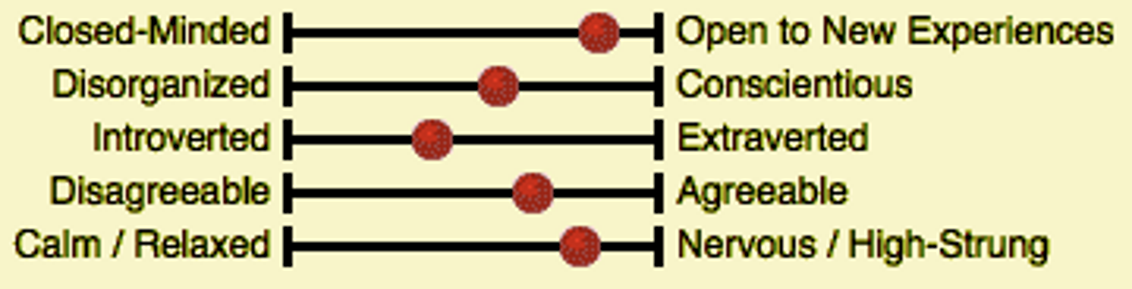
Recently, I took an online assessment for the so-called Big Five personality dimensions and found that (like 30% of the population) I also have a neurotic streak.  The assessment declared “you tend to be nervous, high-strung, insecure, worrying” (my results are shown in the figure above).  True enough (I even carry a few genetic risk factors), and perhaps is why sometimes I can be tormented by a skeptical inner-voice that bursts my bliss as I dwell in meditation.  Sooo annoying!

We all love Woody Allen’s movies and quips.  Perhaps we see ourselves in his endearing neurotic characters? and can collectively laugh at the movie screen (even if we are wracked with neurotic grief on the inside)?  I don’t know.  In any case, its not actually fun to be, or funny to be with a really neurotic person … someone who is always ruminating on their insecurities and fears.  They can drive themselves, and you, nuts!

Can yoga and meditation help? Can they help a neurotic person shift from being a veritable prisoner of their fears and insecurities, wracked with neurotic grief on the inside – to being a more objective observer – more like a detached watcher of their own stream of consciousness – eventually coming to laugh at their inner drama as they might at a Woody Allen movie?

Here’s a research article that may shed light on the topic.  Traits, States, and Encoding Speed: Support for a Top-Down View of Neuroticism/State Relations by Drs. Michael D. Robinson and Gerald L. Clore.  You can read the open-access article, so I’ll just jump to the part I thought was so interesting.

The authors explored the extent to which people suffer from neurotic tendencies as a function of how well they are able to perceive and encode information as it streams into the brain.  Some folks encode neural information more efficiently and, these folks, tend to suffer less from their neurotic tendencies.  The exciting aspect of these neural processes, is that they can be improved with appropriate training and practice.

Common to these theories is the idea that anxious individuals are often trapped by habitual ways of thinking and that a focus on the present, for example, as facilitated by mindfulness training, is successful in breaking such habitual, self-defeating modes of thought linked to high neuroticism.

Therefore, the link between the present data and therapeutic techniques such as mindfulness practice must be somewhat speculative. Nevertheless, it is also worth pointing out that the largest predictor of categorization performance is practice. Furthermore, practice is viewed as the most important contributor to mindfulness-related skills. Therefore, it may be that discrimination skills, even of a reaction-time variety, can be trained that that such training would be useful in alleviating neuroticism-linked distress.

So perhaps the yogic wisdom of Woody Allen rests, not in the jokes themselves, but in a kind of mindfulness that allows him to step back and monitor his own stream-of-consciousness.  Much indeed to make light of. Worth practicing and practicing in 2011 … to laugh at myself in 2012.

Enhanced by Zemanta

What are you wired to do?

The Jerk
Image via Wikipedia

If you’ve ever watched Steve Martin’s movie “The Jerk“, you may chuckle at the notion of having a “special purpose”.

Nevertheless, you may have wondered about your own special purpose … what are YOU meant to do?  What are some things that give meaning to YOUR life – you know – social connections (having friends and family)?, a sense of purpose (changing the world)?  a sense of self-control (earning a good wage, being healthy and having a modest home)?  satisfaction that comes from a sense of mastery (playing piano sonatas, perfecting yoga poses)?

Yes, yes, yes and yes … according to this research … these are avenues well worth exploring … keep going!!

Ask your genome, however, and it will surely give you a different answer.  By genome, I mean the long chemical strings of A, G, T, C’s that encode the machinery that constitute YOU – your brain and body.  It may have a different agenda.

The biochemical problem for the genome is that it is so damn unstable.  The long string of A, G, T, C’s has an unfortunate chemical tendency to want to break, slip, loop, slide and in so many other ways come unhinged.  We call this process mutation – and for the most part – its something that f**ks up the lives of perfectly good organisms.  Damn genome instability!

What’s a genome to do?  Apparently, one solution to this problem of mutation and the unfortunate load of mutations that can accumulate within an organism or population of organisms, is to exchange one’s DNA with other similar (but non-mutated) stretches of DNA.  Just ‘cut’ out one stretch and ‘paste’ in another, just like you might ‘cut and paste’ a revised paragraph into an essay you are writing.  No problemo!  Now all those deleterious mutations can no longer continue to pile up in the genome, since they can be cut out, and then new bits of DNA pasted in.  This process is known as genetic recombination.  In humans this process takes place in the reproductive system … its hypothesized to be the reason that sex evolved in the first place.

Yes, the genome loves genetic recombination (which necessitates having male and females who want to, um, get together) to lower the load of deleterious mutations.  What a selfish genome we have (although I’m not complaining)!

OK, so happiness research tells us that we need to have friends, self-direction, purpose, mastery etc …  and the genome tells us we need to have (ahem) sex.  So who’s right?

Check out this article  “Money, Sex and Happiness: An Empirical Study” (referencing “Measuring the Quality of Experience”, Princeton University, 2003).

… among a sample of 1000 employed women, that sex is rated retrospectively as the activity that produces the single largest amount of happiness. Commuting to and from work produces the lowest levels of happiness. These two activities come top and bottom, respectively, of a list of 19 activities.

Hmmm.  Are we a whole lot less sophisticated that we want to admit?  Perhaps.  Its not a simple answer, but interesting to think that amidst all the effort we make to attain health, close relationships, security, inner-peace, etc … at the end of the day … we just want to have sex.

Enhanced by Zemanta
NYCSub 7 car exterior
Image via Wikipedia

Playa with gold NY Yankees hat worn sideways:  Man, I’ve got mad feva for the flava of these chips.

Hipster girl with multicolor wool sherpa hat:  You better watch out playa, you’ll pass on some ill health to your kids.

Playa:  Kids! I ain’t tryin’ to have no kids.  Besides, that’s some Lamarckian shit you’re talkin’.  Dads can’t pass on stuff they get from eatin’ junk food … only girls can.

Girl:  You ever hear of epigenetic reprogramming?

Playa:  You buggin’ gurrrl.  How are my sperm cells supposed to carry all that “past history” and shit to my kids.  I mean the fucked up cheeto-eating fat cells are in my ass, not my balls.  My sperm cells ain’t got nuthin’ but some nekkid DNA coiled up in them – no room for the epigenome in MY sperm babe.  Did I say my DNA was naaaked?

Girl:  You’re balls ain’t as dumb as you think.

Playa:  Oooh Shit!  Say that again!  Please!  Tell me about my sperm cells too!

Girl:  Slow down playa.  Read the paper by Carone et al., “Paternally Induced Transgenerational Environmental Reprogramming of Metabolic Gene Expression in Mammals” [DOI 10.1016/j.cell.2010.12.008].  They show that mouse fathers can pass on all kinds of crazy changes to their offspring’s liver function depending on the dad’s diet.

Playa:  Damn!  So I have to think about what I’m eating now? what I’m puttin’ into my sperm cells?

Girl:  If you want your nekkid DNA to be with me … ha ha!

Playa: Shit, that re-programming shit is messed UP!

Girl:  Don’t hate the playa, just hate the game – the epigenetic game!

Enhanced by Zemanta
Bronze Chola statue depicting Shiva dancing as...
Image via Wikipedia

In the early 1900’s the world-famous sculptor Auguste Rodin was observed at a museum in Madras, India performing various yogic poses as he stood in front of a statue of Nataraja (Shiva performing a cosmic dance – shown here).  In fact, Rodin was nearly arrested for performing his strange contortions as the local Indian patrons and the museum guards looked on in horror, at the strange foreign man – who was moved to tears by the statue – deforming himself publicly.

This is the story told by V. S. Ramachandran in chapter 8 of his book,  The Tell-Tale Brain.  In this chapter, Ramachandran explores the brain systems that underlie our aesthetic experiences – the aesthetic jolt – as experienced by an enraptured Rodin, at the sight of the dancing Shiva.  There is much brain science and biology at work here (more posts to come).

For the moment though, just consider how deeply moved was Rodin by Shiva’s physical forms.  He wrote a poem, “The Dance of Shiva (covered here).  A master sculptor, and expert on human anatomy, Rodin’s poem reveals his deep sense of bones and musculature and is even echoed today by yoga instructors who prompt students to remain strong and poised while softening the face and emotions.  He declared the dancing Shiva, “the perfect embodiment of rhythmic movement”!

Wow!  Who would have thought that one’s ongoing voyage into yoga – often practiced as a slow rhythmic dance of shifting postures – could end up, not just in better physical and mental health, but as a living, breathing form of “high art”!  These are my favorite lines:

The human body attained divinity in that age, not because
we were closer to our origins … but because we believed in freeing ourselves completely
from the constraints of now, and we spun away into the
heavens.  It is a pleasure sorely missed…

Ramachandran explores the brain circuitry that we use when we feel the ecstasy of an aesthetic jolt – the kind that leaves us “spinning away into the heavens”.  Its an ability we all have – to feel free – & I hope I can learn to tap into it.  Yoga – with its bizarre and exotic forms – and meditation may provide a means to explore this aspect of life.

Enhanced by Zemanta

I’m so ashamed of …

Are there events in your past that you hide from your friends and colleagues?  Are there parts of your body that you keep covered at all times?  You may think to yourself, “If people see this side of me, they won’t want to associate with me”.

Are you afraid of losing your job?  Losing your spouse or partner?  Creditors who who leave threatening messages?  A physical ailment that could be serious?

If you are an American, you are (statistically) likely to be overweight, over indebted and under increasing threat of losing your job and health benefits.  You may have friends that have “dropped out” of the social loop while being overwhelmed with these many adversities.  They themselves may feel stigmatized or too ashamed to face their usual circle of friends, and might rather stay out of touch.  Its an awful irony how feelings of shame and fear can cause our social relations to deteriorate just when we need them most.

Even if you haven’t dropped out, you may eat, drink or otherwise seek to numb these feelings of fear or shame.  But, deep down inside you may already be aware that by numbing your feelings of fear and shame, you also suppressing other emotions such as affection and joy – and thus undermining the social-familial bonds you are so afraid of losing.  Again, its an awful irony how fear, shame and anxiety can lead us to self-inflicted ruin.

Nevertheless, the grim reality remains.  Our bodies are unsightly, unfit and falling apart as we age.  Our careers paths are no longer certain in the new global economy.  We owe a lot of money and have barely the means to pay it back.  We do not have the resources to pay for old age.  Holy crap!  This is a dire view of the world hunh?!

What to do?  How to avoid the downward spiral of fear and anxiety?  Is there an upside to a deteriorating body?  a loss of career?  a down-shift to a much lower standard of living?

Check out this lecture by Dr. Brene Brown, who has carried out a great deal of social science research on this topic.  You will be amazed.  You will be uplifted.  You will begin to see that THERE IS an upside, and a way to break out of the cycle (unlike corporations, we won’t be getting a bailout).

Yoga and meditation practitioners may enjoy the parts of her talk on “self-love” and “courage” – a word whose origins lie in “cor” the word for “heart” and an ability to look inwardly and face the truth – a common theme, especially in Anusara yoga.

Note to readers:  Lately I’ve been focused on various personal and introspective themes, rather than the usual molecular-cognitive science-ology.  These themes set a base for exploring the basic biology of our emotional and cognitive lives and I’ll be digging into the brain-biology of these themes in the year to come.

Enhanced by Zemanta
A drill instructor addressing United States Ma...
Image via Wikipedia

Sweating it out as a new yoga-meditation student, my instructor often says, “Make this pose feel good”!  Bend here, press there, twist, up on one hand and … feel good? If you’ve practiced yoga, you may know what I’m talking about.  And, if you’re like me, you’re hooked on this unique aspect of yoga.  With an emphasis on breath control and meditation, yoga allows its practitioners to “feel the pleasure” instead of “feel the pain”.

Admittedly, I’ve had many sore morning-afters, but I’m starting to find that when I’m intensely focused on my breath, the experience of moving in and out of postures is a pleasurable one – not like other activities motivated by a “come on!  push it!” & “no pain, no gain” mentality.

This yogic mentality has led to a profound change in my life.

Read the rest in Elephant Journal

Enhanced by Zemanta

Mmmm, I taste delicious

Peanut M&M's
Image via Wikipedia

The holiday foods are here – everywhere – and, even if you are steeped in a diet or other austerities, your friends and in-laws may not be.  The sights, the smells, the pleasures of sharing exotic tastes with your loved ones … I mean, if you can’t indulge now … when?  What’s a mindful person to do?

A timely article appeared in this week’s issue of Science Magazine entitled,  Thought for Food: Imagined Consumption Reduces Actual Consumption [doi: 10.1126/science.1195701]  by researchers from Carnegie Mellon University & the title says it all.  Imagined consumption, where experimental volunteers were asked to imagine consuming an M&M candy – not just the visualization of the M&M itself, but the actual eating of it – either 3 or 30 times.  The researchers then let the volunteers dig into a bowl of real M&Ms and recorded how much they ate.  The article reports that volunteers who imagined eating an M&M 30 times, when offered a bowl of real M&Ms to snack on, actually ate fewer M&Ms (about 43% less) than volunteers who imagined consuming 3 M&Ms.

This finding, wherein “imagined consumption” either 30 or 3 times resulted in less “actual consumption”, held up when investigators manipulated the food in question (M&Ms or cheese blocks),  the order in which volunteers experienced different experimental trials, and across a control trial where volunteers were asked to imagine placing quarters into a laundry machine 3 or 30 times (resulted in no differences in actual M&M consumption).  Perhaps most striking was a comparison of “imagined moving” either 3 or 30 M&Ms into a bowl (folks who imagined moving 30 M&Ms actually ate MORE afterwards) in contrast to the trials where volunteers “imagined consuming” either 3 or 30 (the group that imagined consuming 30 M&Ms actually ate LESS).  This result verified the commonly-held notion that the sight of food whets the appetite and creates an incentive to consume.

Man, M&Ms are my favorite!  The veritable gateway drug of all holiday cakes, cookies, pies and candies.  Just reading about this research has me craving a handful of those holiday red and green M&Ms right now.

OK, I will use what yogic training I have to slow down my thought processes, to increase my self-awareness and to visualize – not just the treats themselves (lest I end up eating more) but the act of eating them, savoring them and feeling the pleasure of the experience.  I’ve learned – through yoga – that this pleasure, and all the wonderful pleasures in life, are really just inside me – all part of a deep-seated inner peace and joy.  I don’t need to seek pleasures ravenously in the outside world.  The wonderful pleasures of taste, smell, texture, appearance etc. lie within me, and are accessible through my imagination, breathing and meditation.

Enjoy your holidays!  And when you find yourself alongside the desert table, realize that YOU are an amazing being – delicious on the inside – much moreso than cookies and cake.

Enhanced by Zemanta

Mind-body training for kids

My 2 boys are so lucky … they get to spend time with their yoga teacher … postures, reading, coloring, meditation … I’m lucky too. Music by Dhamaru!

I probably deserve a punch in the head (see video). I will try harder to emphasize that this blog is NOT about “genes cause this” and “genes cause that”, but rather about the way we can use our genetic information as a tool – just one of many – to explore our relationships with each other, our past, other species and the environment. Still, you are welcome to punch me in the head (see video) if you like.


Browse your body

Was checking out the new Body Browser by Google.  Yogis seem to be very knowledgeable about anatomy and physiology, so perhaps this might be a useful instructional tool.  My favorite item to view is the vagus nerve, which – as I’ve blogged about here, here and here – is nothing short of a real live Kundalini serpent inside your body (well, perhaps a little short, insofar as the nerve does not extend all the way to the sacrum and muladhara, but rather just to the swadhisthana chakra).  Seriously though, clinical studies have shown that stimulation of this nerve, brings a relief from anguish, and many a yogi knows how to activate this nerve via breathing and other bodily maneuvers.  Here’s a screenshot from the body browser.

Playing with Google’s Ngram site … exploring the usage of words & phrases in the zillions of books currently digitized by Google.  Here are a few charts showing the frequency of a few popular yoga words published between 1808 and 2008.

There seems to have been a spike of mentions in the early 1900’s followed by a wave in 1980 and a recent wave in 2000.  Vipassana meditation and the term “namaste” seemed only to catch the 2000 wave, but not the earlier yoga wave … seems it was yoga that caught on first and then finer aspects of the practices followed later?

yogaearliest blips in 1810 then a spike in 1980


ashtanga mentioned in the early 1800’s!?

bhagavad – its spikes seem to presage the spikes in yogic terms?


anusaramentioned in the very early 1900’s!?

vipassanano wave in 1980, but tracks the 2000 wave

meditationalways a commonly used term in many non-yogic contexts


namaste caught on only in the recent wave

what other words might be of interest???

Anguish
Image by matt.doane via Flickr

Do folks who experience LaLa Land get hooked on it?  Do they desire to get back there, again and again and again?  Is this why yoga teachers say that – if you let go – yoga will transform your life?  I want to let go.  I want to advance in my practice and let the transformation happen – to spend as much time in LaLa Land as possible.  I do!  I do!

But I’m torn.

my full article appears in Elephant Journal

Enhanced by Zemanta