Feeds:
Posts
Comments

Posts Tagged ‘economics’

Homo Sapiens album cover
Image via Wikipedia

pointer to: Professor Paul De Grauwe‘s interview (mp3) and recent article in the Financial Times declaring the flawed debate on macroeconomic policy (to stimulate or not) based on present models that do not account for the emotional and cognitive biases of homo sapiens.  He calls for new behavioral economic models based on the work of Robert Shiller and others who – together with psychologists and neuroimagers – are synthesizing a newer evolution of homo economicus – which may lead us to a better (less crisis-prone perhaps?) macroeconomic world.  (A few related posts on this topic here)

Hmmm. What might the genome of homo economicus look like?

Reblog this post [with Zemanta]

Read Full Post »

vix

In 1802, in a letter to then Secretary of the Treasury, Albert Gallatin, Thomas Jefferson warned that, “If the American people ever allow private banks to control the issue of their money, first by inflation and then by deflation, the banks and corporations that will grow up around them (around the banks), will deprive the people of their property until their children will wake up homeless on the continent their fathers conquered.” (source)  Although the US now does have a central government bank, Jefferson’s warning still chillingly echoes through our current crisis as we teeter on this very brink.

The reasons why the US financial system lies stricken now (not to mention many times before) are complex for sure, but for a neuroscience & genetics buff like myself, its fun to consider the underlying mechanisms of human biology and behavior within a macroeconomic framework.  What role for the brain and human nature? How does our understanding of human social and emotional behavior reconcile with the premise of so-called “rational” behavior of investors and consumers in a marketplace? Can we regulate and design a debacle-proof economic system that accounts for human social and emotional influences on otherwise rational behavior? Luckily, if you are interested in these questions, you need only to pick up a copy of “Animal Spirits: How Human Psychology Drives the Economy, and Why It Matters for Global Capitalism” by George Akerlof and Robert Shiller, who cover this very topic in great detail and provide a broad framework for neuropsychological research to inform macroeconomic policy.  A lofty and distant goal indeed, but perhaps the only way forward from such spectacular wreckage of the current system.

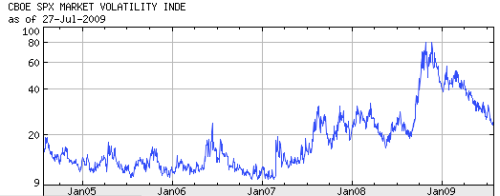
One such aspect of so-called “animal  spirits” could be, for example – fear – which has been blamed many times for financial panics and is covered in great measure by Akerlof and Shiller.  During the depths of the great depression, FDR famously tried to shake people loose from their animal spirits by suggesting “Only Thing We Have to Fear Is Fear Itself” (listen to the audio).   As another example, consider the chart at the top of the post – a 5yr trace of the VIX an index of volatility in the price of stock options over time.  In a bull or a bear market, when there are clear economic signals that stock prices should rise or fall, the VIX is rather low – since people feel relatively certain about the overall direction of the market.  Note however, what happened in the fall of 2008, when the heady days of the housing boom ended and our current crisis began – the VIX rockets toward 100% volatility – indicating rather dramatic swings in future earnings estimates and hence, tremendous uncertainty about the future direction of the market.  Indeed, for high flying investors (who may reside in tall buildings with windows that open) the VIX is sometimes referred to as the fear index.

What – in terms of brain mechanisms – might underlie such fear – which seems to stem from the uncertainty of whether things will get better or worse?  What do we know about how humans react to uncertainty and how humans process uncertainty?  What brain systems and mechanisms are at play here? One recent report that uses genetic variation as a tool to peer into such brain mechanisms suggests that dopamine signaling modulates different brain areas and our propensity to respond in conditions of low and high uncertainty.

In their article, “Prefrontal and striatal dopaminergic genes predict individual differences in exploration and exploitation“, [doi:10.1038/nn.2342] Michael Frank and colleagues examine individual differences in a so-called exploration/exploitation dilemma.  In their ‘‘temporal utility integration task’’, individuals could maximize their rewards by pressing “stop” on a rotating dial which can offer greater rewards when individuals press faster, or when individuals learn to withold and wait longer, and, in a third condition when rewards are uncertain.  The authors liken the paradigm to a common life dilemma when there are clear rewards to exploiting something you know well (like the restaurant around the corner), but, however, there may be more rewards obtained by exploring the unknown (restaurants on the other side of town).  In the case of the VIX and its massive rise on the eve of our nations financial calamity, investors were forced to switch from an exploitation strategy (buy housing-related securities!!!) to an exploration strategy (oh shit, what to do?!!).

The neurobiological model hypothesized by Frank and colleagues predicts that the striatum will be important for exploitation strategies and find supporting data in gene associations with the striatally-enriched DARPP-32 gene (a marker for dopamine D1-dependent signalling) and DRD2 for the propensity to respond faster and slower, respectively, in the exploitative conditions (rs907094 & rs1800496).  For the exploratory conditions, the team found an association with the COMT gene which is well-known to modulate neural function in the prefrontal cortex (rs4680). Thus, in my (admittedly loose) analogy, I can imagine investors relying on their striata during the housing boom years and then having to rely more on their prefrontal cortices suddenly in the fall of 2008 when it was no longer clear how to maximize investment rewards.  Egregious bailouts were not yet an option!

Click here and here to read more breakthrough neuroeconomics & genetic research from Michael Frank and colleagues.  Here and here for more on Shiller and Keynes.

Reblog this post [with Zemanta]

Read Full Post »

PRINCETON, NJ - OCTOBER 13:  Princeton Profess...
Image by Getty Images via Daylife

pointer to: Paul Krugman’s summary of basic factors that prevent healthcare from ever functioning in an efficient Adam Smith, Burton Malkiel kind of free market.  His comments based on Kenneth Arrow‘s 1963 paper “Uncertainty and the welfare economics of health care“.

Reblog this post [with Zemanta]

Read Full Post »

homebrew comics 11

Independence of the FED in banana republico
… caught this related video on the same topic on July 24th.

The core issues of government transparency and consumer protection seem to apply to healthcare reform as well.  How best can the government protect consumers ? paternalistic behavior or transparency ?

Consumer protection: myth or bluedog denial

Read Full Post »

Lessons in economics
Image by Grim Reaper With A Lawnmower via Flickr

Very much enjoyed Professor & Blogger Tyler Cowen’s new book.  He muses on the deep seated joy that people have in self-ordering information and the economic value that comes from facilitating this natural instinct.  As a blogger-in-training, the book has really helped me better understand how a blog might fit into existing value-chains within the world of homo-economicus who, according to Professor Cowen, is using social media to become more entrepreneurial and humane.  Its easy to imagine how folks may try and self-order their genome information in the years to come.  I hope I can help facilitate this by sharing my own enthusiasm and experience as an early adopter.  If you want your assumptions on human behavior to be shaken up in a good way – read this book!

Reblog this post [with Zemanta]

Read Full Post »

John Doe
Image by TW Collins via Flickr

Was bummed to hear Nick Haymenn say (download & listen to minute 10 on this Bloomberg News podcast) that GE healthcare has abandoned its molecular & imaging diagnostics program aimed at early detection and intervention.

Crap, that sets things back quite a bit across the medical universe I suspect.

Reblog this post [with Zemanta]

Read Full Post »

OMG! OMG! Tyler Cowen!!
Image by fling93 via Flickr

Just feeling inspired by this short interview with Tyler Cowen.  I share his feeling that blogging is mainly just a way to share your enthusiasm … but certainly would be nice to have Professor Cowen’s brain power on top of the enthusiasm!

Reblog this post [with Zemanta]

Read Full Post »

The Merchant of Venice
Image by Kessiye via Flickr

pointer to — Financial analyst Andy Kessler’s recent article “Technology Review: A Pound of Cure” discusses whether several  $billion of government incentives for digitizing health information is enough to root out inefficiencies in a $2.4 trillion industry.  Not if hospitals have any say, suggests Kessler.  However, the long-run prospects of digitizing should help eventually wring inefficiency out of the system.

I’ve enjoyed his previous books on finance and very much enjoyed his keen financial analyst insights into healthcare in “The End of Medicine: How Silicon Valley (and Naked Mice) Will Reboot Your Doctor“.

Reblog this post [with Zemanta]

Read Full Post »

HEALTHCARE FOR ALL
Image by spike55151 via Flickr

Just a pointer to an amazing analysis on the politics of moving forward with a more comprehensive government sponsored healthcare option.  Sadly, but not surprisingly, the flow of lobbying funds predicts who will vote to maintain the status quo.

Reblog this post [with Zemanta]

Read Full Post »

Michael Porter
Image by Nestlé via Flickr

Just a pointer to management expert Michael Porter’s new article in the NEJM.

“… expanded access without improved value is unsustainable and sure to fail.”

Reblog this post [with Zemanta]

Read Full Post »

Mike Defensor at a political rally in Cebu City
Image via Wikipedia

Shopaholics and political activists might want to take a look at Jonathan Roiser et al.‘s paper, “A Genetically Mediated Bias in Decision Making Driven by Failure of Amygdala Control” [doi:] as an early example of the nexus of “behavioral-neuro-economic-genetics” or “neuro-genetic-marketing” or “neuro-eco-geno” as it might (not) be called one day.  In any case, it has long been known that humans are susceptible to the “framing effect” – that is – we favor certainty over risk when we stand to gain ($10 now vs. 20% chance of winning $50) and rather favor risk over certainty when we stand to lose (20% chance of losing $50 vs. lose $10 now).  Political and retailing experts have long-since exploited these tendencies in voters/consumers (unemployment is on the rise – lets take a chance on this new policy! or this yogurt is 99% fat free! vs. its got 1% of unhealthy fat).

Roiser and team evaluate the extent to which individuals who are homozygous at the 5HTT-LPR “short” allele differ from “long(a)” allele homozygotes when confronted with win/lose, sure-thing/gamble contingencies.  Interestingly, while both groups demonstrated the tendency to avoid risk when they stood to gain money and preferred to gamble when they stood to lose money, the group that was homozygous at the 5HTT-LPR was almost twice as likely to do so – thus identifying a group that is significantly more susceptible to the framing of choices (they otherwise did not differ from the “long(a)” group in control trials or in other aspects of overall performance).

Analysis of brain activity shows a now well-replicated association of “short”-allele genotypes with increased amygdala activity  – in this case the association was observed when participants were confronted with the choice of “pick the sure thing” vs. “gamble” in both the gain and loss conditions.  Also, the group reports on the functional coupling of the amygdala and cingulate cortex – an effect which has been previously associated with variation at the 5HTT-LPR – and shows that individuals who did not show functional coupling between these brain regions were more susceptible to the framing effect.  Hence, the “short” allele group may have a harder time bringing cortical control to their immediate emotional responses.

What might these findings tell us about decision making in humans?  Well, as pointed out by the authors, the findings in the amygdala and cingulate cortex suggest that the emotional systems of the participants are engaged as well as genetic factors, such as 5HTT that are known to regulate the early development and responsivity of these emotional systems.

Most of us already know that we don’t make decisions only using our minds – and doncha know – retailers and political pollsters are already experts at gaming our innate propensities.  Some, it seems, perhaps more than others.

Reblog this post [with Zemanta]

Read Full Post »

whcc europe 2008 021
Image by Lloyd Davis via Flickr

Just enjoyed Uwe Reinhardt’s lecture on the current and future economics of healthcare in the U.S. and was very much struck by his emphasis on evidence-based medicine (predicts a potential 30% savings in Medicare spending) as a means to rid the current system of overspending.  A must-see, is the telling graphic showing how the northwest has vastly lower costs/enrollee than the rest of the country – this, he suggests, is where the Obama administration will focus their reform efforts.  Seems like basic science (which is oft blamed for raising the cost of healthcare) may yet be deployed to improve outcomes and keep costs in-line.

Reblog this post [with Zemanta]

Read Full Post »

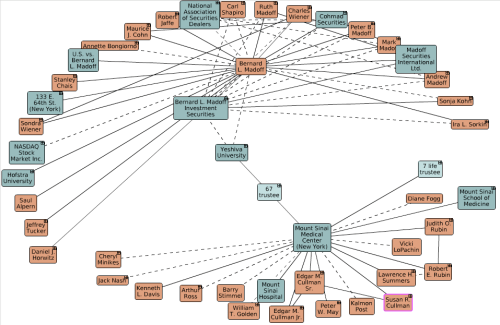
With a number of research institutes succumbing to the Madoff fraud, I wondered whether my own host, Mount Sinai School of Medicine, might be exposed to financial losses.  While I have no way of really knowing (I wonder if the trustees do), I stumbled onto this neat relationship tracking tool @ Muckety.com.  When I search “Mount Sinai School of Medicine” and “Bernard Madoff“, I find a rather non-overlapping, unlinked set of social networks, with only 1 connection – a Mr. David S. Gottesman who apparently serves as a trustee and generous patron for both MSSM and Yeshiva University (YU reported a loss $110M invested in Madoff Securities).   What’s your institute’s exposure ?

linkstomadoff_muckety1

Reblog this post [with Zemanta]

Read Full Post »

John Maynard Keynes {{ru|Джон Мейнард Кейнс}} ...
Image via Wikipedia

Many folks would agree that money is not the route to happiness.  But, lets be honest, when some of your money is taken from you and just given to someone else – well now, that sure enough, has a way of pissing you off !  Such is a common refrain today, as taxpayer funds (your money) are used by Congress to bail out large banks and corporations, not to mention any number of people who irresponsibly bought mc-mansions they could not afford.  Increasingly, there is a disconnect between what people “feel” and policy recommendations based on the cold, hard, complex, econometric, quantitative financial models used to justify these so-called bailouts.  “It just feels wrong, but the experts tell us its for the best“.  Strong medicine ? Hmmm.

John Maynard Keynes (pictured here) used the term ‘animal spirits’ to describe shifts in human mood that could have unpredictable effects on market behavior.  In his recent podcast/lecture from the London School of Economics, Professor Robert Shiller opines further on these types of disconnects – those that exist between cold and dry economic models and real-life warm and fuzzy humans who inhabit a world constrained by these models that do not buffer against boom & bust cycles.  Notably, Shiller, who is now highly in demand, was widely ignored during the last great disconnect – the one where people felt so good while the stock market and housing market inflated to levels that defied sound economic models (interestingly, he remains puzzled by our new Treasury Secretary, Timothy Geithner, who also never conceded that anything might be wrong with the financial system during the pre-bust years at the Federal Reserve Bank of New York – how could he miss it ?).  Perhaps if we improved the economic models, then we could smooth-out the booming & busting ?

Shiller argues for a more flexible and sophisticated financial system that can better account for some of the emotional and social biases that make homo economicus such a greedy, panicky and yet often selfless and generous creature.  Rather than static, fixed contracts, he suggests products that can function to hedge against what he calls, “psychological contagion”.  Presently, he has created a number of such helpful products including securities which can hedge against the movement of house prices (via his Case-Shiller index) and newer securities (in development) that carry no counter-party risk and are somewhat less bubble-prone.  He also advocates more research to connect financial engineering with behavioral finance which should help develop more advanced economic models that account and quantify discrete types of social and emotional biases that arise in the marketplace.

In any case, it is clear from listening to Shiller, and from his previous books, that financial engineering is best used as a tool to help everyday folks manage the inherent uncertainties of life over the long run (in contrast to financial engineering for the purposes of creating illusory wealth bubbles).  I’m certainly a fan of Robert Shiller and wonder how basic brain science and behavioral finance might help his already groundbreaking work on the construction of financial instruments that factor-in the innate behavioral (sometimes irrational) biases that people have in assessing risk and making decisions based on long-term rather than short term outcomes.  There must be many – and even some that are influenced by genetic factors.  The new fields of neuroeconomics and its synthesis with behavioral genetics might, one day, even allow me to hedge against my own genetic risk (I carry 2 copies of the DRD4 7-repeat VNTR which, apparently, is associated with a 25-50% increase in risk taking).

My parents intuitively understood this somehow – they wisely gave me an allowance.

Reblog this post [with Zemanta]

Read Full Post »

Economy of American Samoa
Image via Wikipedia

Click here to listen to the free NPR podcast: “Uwe Reinhardt, professor of economics and public affairs at Princeton University, calls the health care sector the “strongest economic locomotive working for us.” He estimates that by 2015, health care will be one-fifth the size of the U.S. economy and says this is a good time to expand health insurance coverage for the uninsured.”

Reblog this post [with Zemanta]

Read Full Post »

Scale of the debt …

Just thought this NY Times graphic nicely captured the outlays of debt taken on during the recent weeks by the US Central Bank. Healthcare spending is usually the big item(s), but the new debt really dwarfs it.  Immense new pressure on the financing of healthcare.

Read Full Post »

U.S. Treasury Secre...

Image by Getty Images via Daylife

Amidst the current economic panic, I’m feeling more shocked than usual when listening to the flip-flopping, falsehoods, fabrications, backstepping, about-facing and unabashed spin-doctoring spewing forth from the news media. If watched long enough, one may even develop empathy for Henry Paulson who carries the weight of the global economy on his shoulders. Nevertheless, what do we know about making mistakes ? Not necessarily global financial catastrophies, but little everyday mistakes. Why do some of us learn from our mistakes ? What’s going on in the brain ? Enter Michael Frank, Christopher D’Lauro and Tim Curran, in their paper entitled, “Cross-task individual differences in error processing: Neural, electrophysiological and genetic components” [Cognitive, Affective, & Behavioral Neuroscience (2007), 7 (4), 297-308]. Their paper provides some amazing insight into the workings of human error-processing.

It has been known for some time that when you make a mistakke – oops! – mistake, that there are various types of electrical current that emanate from the frontal midline (cingulate cortex) of your brain.  The so-called error related negativity (ERN) occurs more strongly when you are more focused on being correct and also seems to be more strong in people with certain personality traits (apparently not news commentators or politicians) while the error positivity (Pe) occurs more strongly when you become consciously aware that you made an error (perhaps not functioning in news commentators or politicians). Perhaps the ERN and Pe are basic neural mechanisms that facilitate an organisms adaptive ability to stop and say, “hey, wait a minute, maybe I should try something new.” The Frank et al., paper describes a relation between learning and dopamine levels, and suggests that when dopamine levels dip – as happens when our expectations are violated (“oh shit!, I bought stock in Lehman Brothers) – that this may facilitate the type of neural activity that causes us to stop and rethink things. To test whether dopamine might play a role in error processing, the team examined a common variant (rs4680) in the catechol-o-methyl transferase gene, a gene where A-carriers make a COMT enzyme that is slower to breakdown dopamine (a bulky methionine residue near the active site) than G-allele-carriers. Subjects performed a learning task where correct responses could be learned by either favoring positive feedback or avoiding negative feedback as compared to neutral stimuli. The team suspected that regardless of COMT genotype, however, there would be no COMT association with learning strategy, since COMT influences dopaminergic activity in the frontal cortex, and not in the striatum, which is the region that such reinforcement learning seems to be stored.

Interestingly, the team found that the error positivity (Pe) was higher in participants who were of the A/A genotype, but no difference in genetic groups for the error related negativity (ERN). This suggests that A/A subjects deploy more attentional focus when they realize they have made an error. Lucky folks ! My 23andMe profile shows a GG at this site, so it seems that when I make errors, I may have a normal ERN, but the subcortical dopamine that dips as a result does not (on average) result in much greater attentional focus. Oh well, I guess its the newsmedia pool for me.

Reblog this post [with Zemanta]

Read Full Post »

Economic advis...Image by Getty Images via Daylife A recent article in “Technology Review” profiles Austan Goolsbee, a professor at the University of Chicago School of Business & senior economic advisor to Barack Obama. I was surprised by a comment he made suggesting that as healthcare spending continues to expand, he can see it becoming a central driver of economic growth, if not, a major foundation of economic growth. Indeed, the end product of all this bioscience is much more valuable than a new car or big-screen LCD television. I’m hoping we’ll hear more on this new perspective in the coming months (and 4 years).

Reblog this post [with Zemanta]

Read Full Post »

Just saw this on engadget … fun and useful – just like chumby but with a medical twist. Who knows, it may someday make housecalls (see link below).Related articles by Zemanta

Reblog this post [with Zemanta]

Read Full Post »

A United Airline...
Image by Getty Images via Daylife

Just a pointer to a great overview article of trends in medical tourism at Economist magazine. Hope the price of jet fuel doesn’t put a damper on these exciting trends.

Reblog this post [with Zemanta]

Read Full Post »

« Newer Posts - Older Posts »