
Posts Tagged ‘meme-art’
Cold windows
Posted in Uncategorized, tagged Art, meme-art on January 2, 2010| Leave a Comment »
Genes & brains art
Posted in Uncategorized, tagged Art, meme-art on January 2, 2010| Leave a Comment »



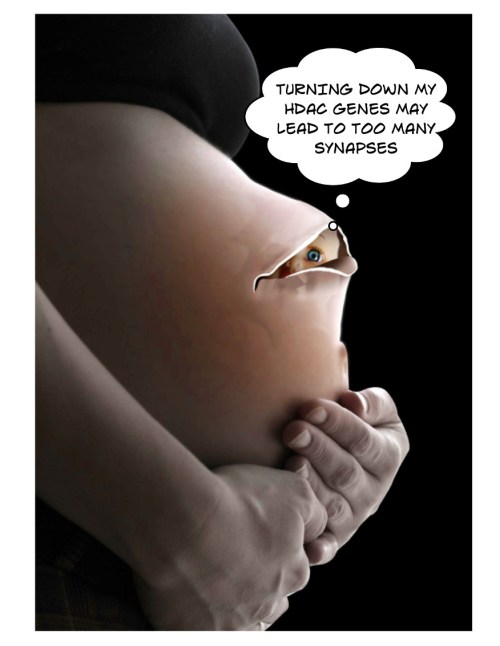
Sometimes I think …
Posted in Uncategorized, tagged Art, meme-art on December 20, 2009| Leave a Comment »

monoamine oxidase a
Posted in MAOA, tagged Art, meme-art on December 17, 2009| Leave a Comment »
Epigenetics and cognitive development – quick sketch overview
Posted in BDNF, MECP2, tagged Anxiety, Art, autism, Cognition, cognitive development, Development, Epigenetics, Gene, Gene expression, MECP2, meme-art, Rett Syndrome, schizophrenia, Stress, synaptogenesis, Transcription on December 16, 2009| 2 Comments »
Some quick sketches that might help put the fast-growing epigenetics and cognitive development literature into context. Visit the University of Utah’s Epigenetics training site for more background!
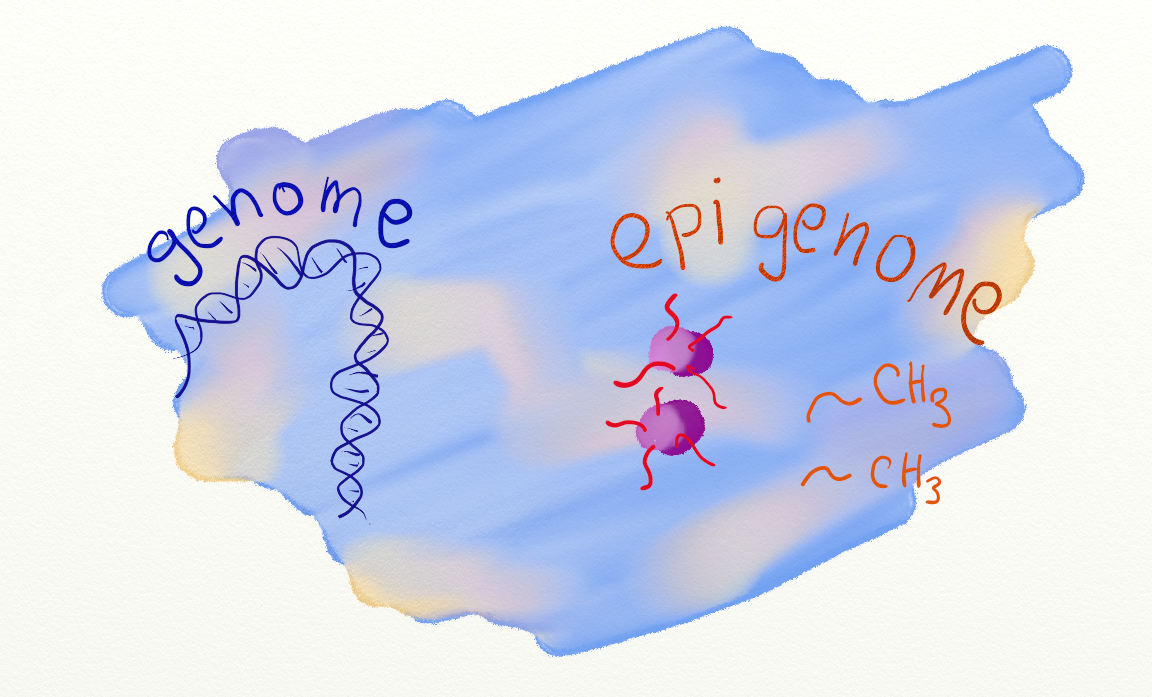
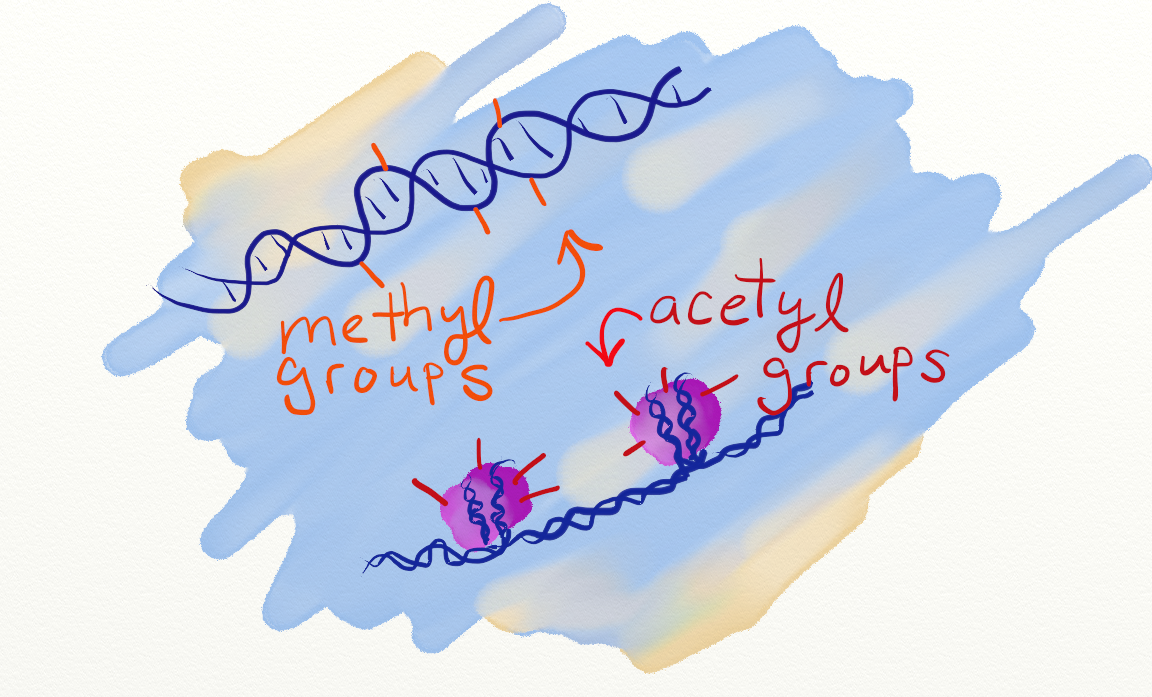
The genome is just the A,G,T,C bases that encode proteins and other mRNA molecules. The “epi”genome are various modification to the DNA – such as methylation (at C residues) – and acetylation of histone proteins. These changes help the DNA form various secondary and tertiary structures that can facilitate or block the interaction of DNA with the transcriptional machinery.
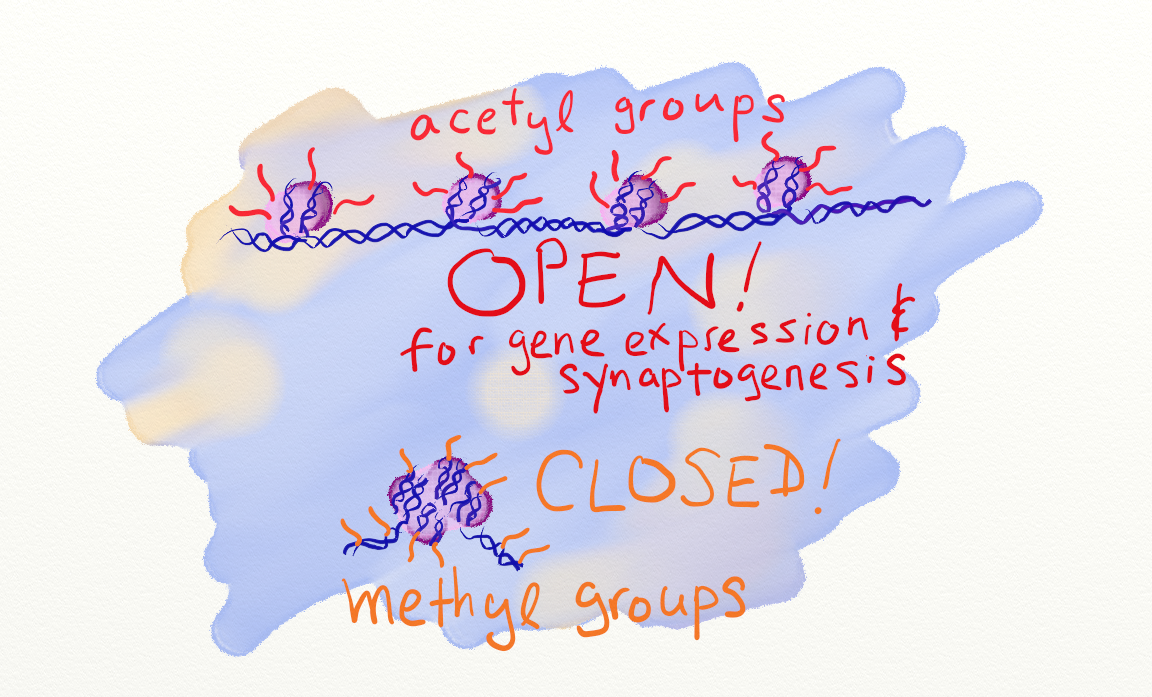
When DNA is highly methylated, it generally is less accessible for transcription and hence gene expression is reduced. When histone proteins (purple blobs that help DNA coil into a compact shape) are acetylated, the DNA is much more accessible and gene expression goes up.
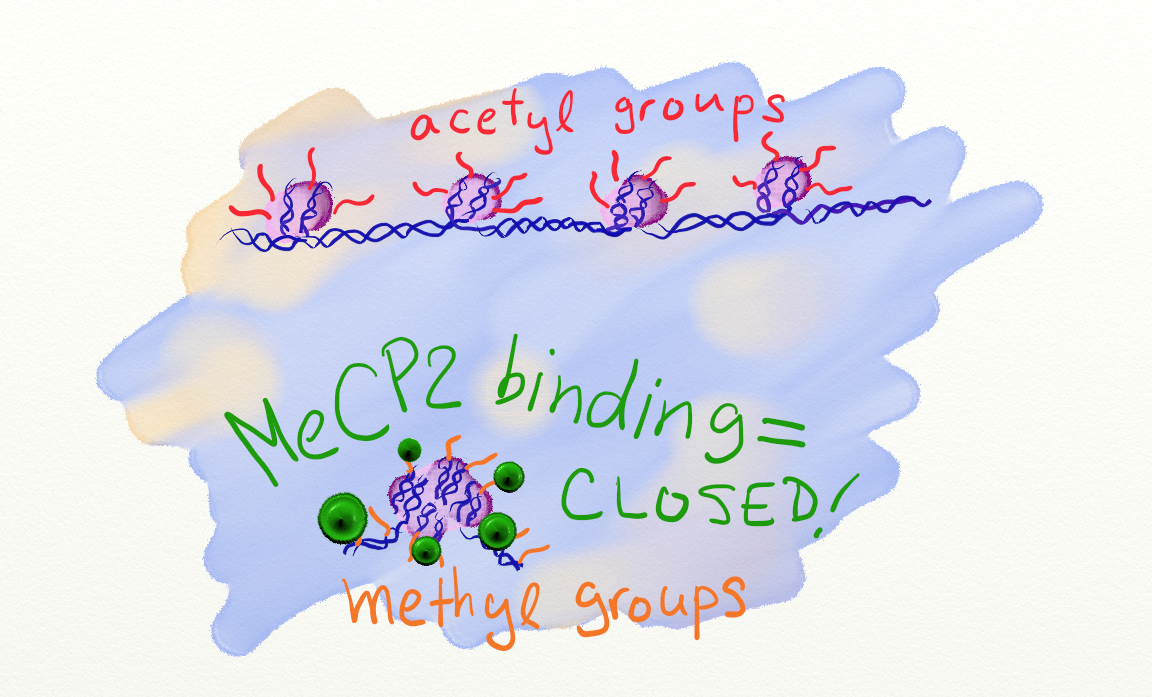
We know that proper epigenetic regulation is critical for cognitive development because mutations in MeCP2 – a protein that binds to methylated C residues – leads to Rett syndrome. MeCP2 is normally responsible for binding to methylated DNA and recruiting histone de-acetylases (HDACs) to help DNA coil and condense into a closed form that is inaccessible for gene expression (related post here).
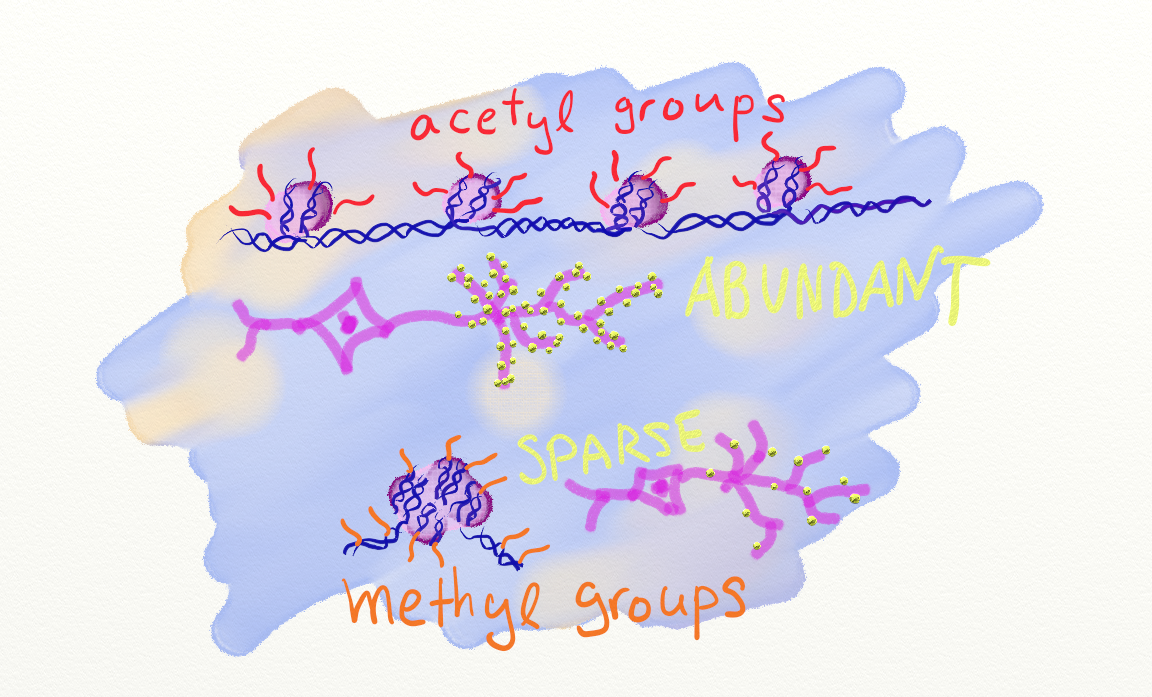
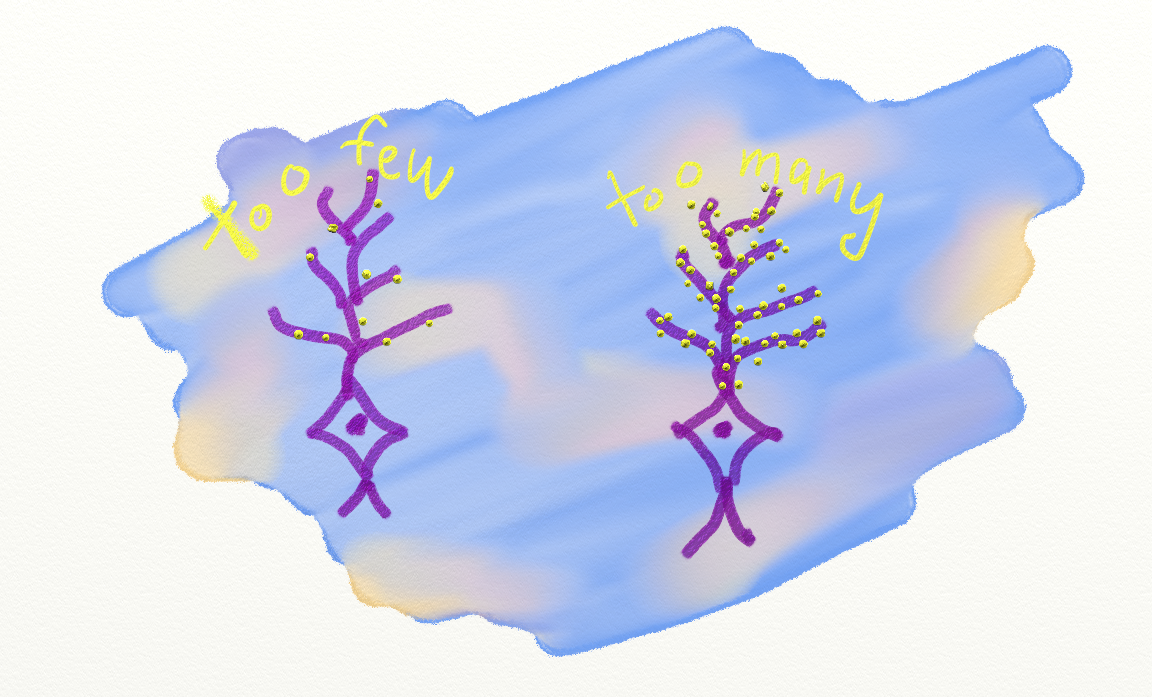
When DNA is accessible for gene expression, then it appears that – during brain development – there are relatively more synaptic spines produced (related post here). Is this a good thing? Rett syndrome would suggest that – NO – too many synaptic spines and too much excitatory activity during brain development may not be optimal. Neither is too little excitatory (too much inhibitory) activity and too few synaptic spines. It is likely that you need just the right balance (related post here). Some have argued (here) that autism & schizophrenia are consequences of too many & too few synapses during development.
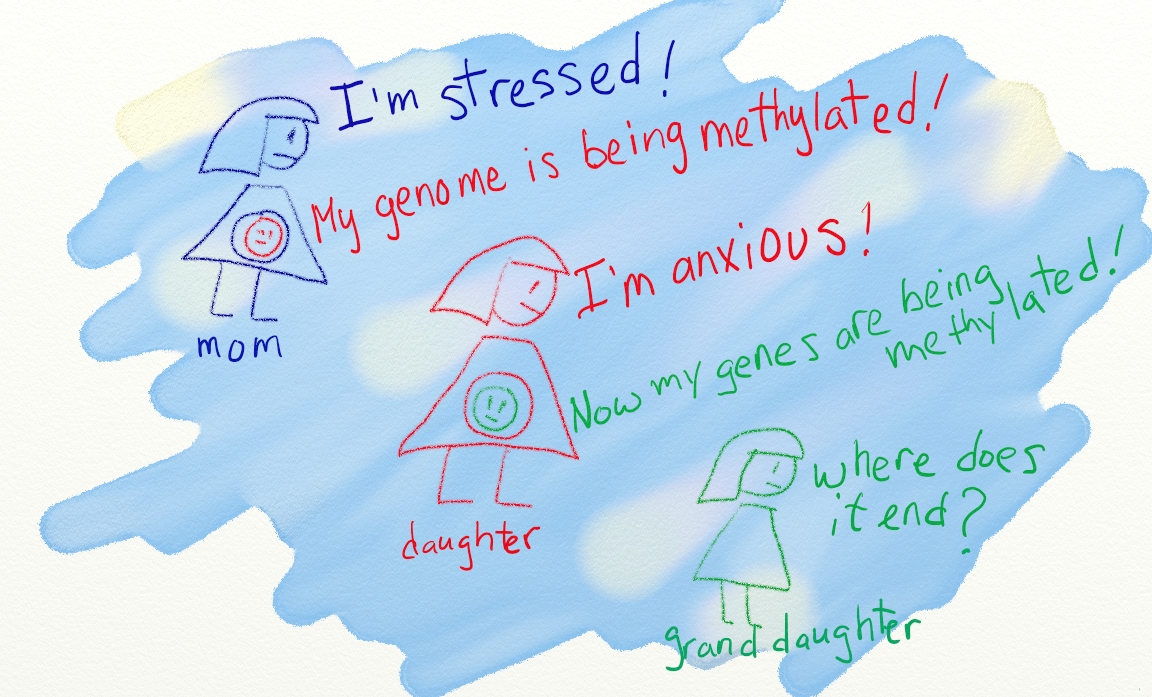
The sketch above illustrates a theoretical conjecture – not a scenario that has been verified by extensive scientific study. It tries to explain why epigenetic effects can, in practice, be difficult to disentangle from true (changes in the A,G,T,C sequence) genetic effects. This is because – for one reason – a mother’s experience (extreme stress, malnutrition, chemical toxins) can – based on some evidence – exert an effect on the methylation of her child’s genome. Keep in mind, that methylation is normal and widespread throughout the genome during development. However, in this scenario, if the daughter’s behavior or physiology were to be influenced by such methylation, then she could, in theory, when reaching reproductive age, expose her developing child to an environment that leads to altered methylation (shown here of the grandaughter’s genome). Thus, an epigenetic change would look much like there is a genetic variant being passed from one generation to the next, but such a genetic variant need not exist (related post here, here) – as its an epigenetic phenomenon. Genes such as BDNF have been the focus of many genetic/epigenetic studies (here, here) – however, much, much more work remains to determine and understand just how much stress/malnutrition/toxin exposure is enough to cause such multi-generational effects. Disentangling the interaction of genetics with the environment (and its influence on the epigenome) is a complex task, and it is very difficult to prove the conjecture/model above, so be sure to read the literature and popular press on these topics carefully.
![Reblog this post [with Zemanta]](https://i0.wp.com/img.zemanta.com/reblog_e.png)
genetics casts a long shadow
Posted in Uncategorized, tagged Art, meme-art on December 12, 2009| Leave a Comment »

gambling genes
Posted in DRD2, tagged advertisement, Art, meme-art on December 8, 2009| Leave a Comment »

burger joint
Posted in Uncategorized, tagged advertisement, Art, meme-art on December 7, 2009| Leave a Comment »

spoof ad
Posted in Uncategorized, tagged advertisement, Art, meme-art on December 6, 2009| Leave a Comment »

life insurance
Posted in Uncategorized, tagged advertisement, Art, meme-art on December 5, 2009| Leave a Comment »

Topoisomerase
Posted in Uncategorized, tagged Art, meme-art on November 18, 2009| Leave a Comment »
Beer ad
Posted in Uncategorized, tagged Art, meme-art on November 17, 2009| Leave a Comment »

genes and brains meme-art
Posted in Uncategorized, tagged Art, meme-art on November 16, 2009| Leave a Comment »

Lonely Hearts Club “braines”
Posted in Uncategorized, tagged Art, Arts, meme-art on November 15, 2009| Leave a Comment »

The DETERMINATORS (not) coming soon to a theatre near you
Posted in Uncategorized, tagged Art, meme-art on November 6, 2009| Leave a Comment »

Genome oppression
Posted in Uncategorized, tagged Art, meme-art on November 6, 2009| Leave a Comment »

Junk DNA
Posted in Uncategorized, tagged Art, meme-art on November 5, 2009| Leave a Comment »

Thrombospondin is mother’s milk for dendrites
Posted in THBS1, THBS2, tagged Art, meme-art on November 4, 2009| Leave a Comment »
Early lessons in epigenetic regulation of brain development
Posted in Uncategorized, tagged Art, meme-art on October 31, 2009| Leave a Comment »
PSD-95 postsynaptic density on the wall
Posted in Uncategorized, tagged Art, meme-art on October 25, 2009| Leave a Comment »

Remarks
Re-Tweetin’
Tweets by genes2brains2meBlog Stats
- 191,823 clickitas
Posting since April 2007
General topics
23andMe Addiction Add new tag aging Anxiety Art Arts autism B. K. S. Iyengar Biology Brain Buddism Central nervous system Cognition comics Consciousness Depression Development DNA Dopamine dualism economics Emotion Empathy Epigenetics evolution fear Frontal lobe Functional magnetic resonance imaging Gene Gene expression Genetics Genetic testing GWAS Health Health care Health insurance Hippocampus History Intelligence Kundalini language Major depressive disorder medication Meditation meme-art Memory Mental disorder Mental health Mind Mutation Nervous system Neural network Neuron Pain parasympathetic nervous system Patañjali Personalized medicine philosophy placebo Psychology Reactive oxygen species Religion and Spirituality Rett Syndrome schizophrenia Social Sciences spirituality Stem cell Stress Suicide synaptogenesis Teachers and Centers Twin Yoga Yoga Sutras of PatanjaliSpecific Items
- 5HTT
- ABCB1
- acetylcholine
- Actin
- ACTN3
- ADH1C
- ADORA2A
- ADRA2A
- AKT
- AMPA receptor
- Amygdala
- Angular gyrus
- ANK3
- APOE
- ARHGAP18
- ASIC1a
- ASPM
- ATXN1
- AVPR1a
- BAF53b
- Basal Ganglia
- BDNF
- CABYR
- CACNA1C
- CACNA2D1
- Caudate nucleus
- CB1 receptor
- CDC34
- CDH13
- Cell adhesion molecules
- Cerebellum
- CHAT
- CHRM3
- CHRNA4
- CHRNA7
- Chromosome structural variants
- Cingulate cortex
- Circadian
- clinical trial
- CNR1
- CNTNAP2
- Collateral sulcus
- COMT
- Corpus callosum
- COX1
- CREB
- CRHR1
- DARPP32
- DAT
- default network
- DISC1
- DLPFC
- DNAJC
- DNMT
- Dopamine
- DPP4
- DRD2
- DRD4
- DTNBP1
- DYRK1A
- EDA2R
- EGR1
- Estrogen
- evolution
- FGF20
- FMR1
- FNBP1L
- FOXA2
- FOXP2
- Frontal cortex
- Frontal pole
- Fusiform gyrus
- G-protein
- GAB2
- GABA
- GABRA2
- GABRG1
- GATA4
- Glucocorticoid receptor
- Glutamate
- GPR6
- GRIA3
- GRIK2
- GTPase
- HDACs
- Hippocampus
- HOXB8
- HRK
- HTR2A
- Hypothalamus
- IL3
- immunity
- Inferior frontal gyrus
- Insula
- Intronic or repetitive sequences
- Kalirin
- KCNA2
- KCNH2
- KCNIP3
- KCNJ6
- Kinesin
- Lateral septum
- Lateral ventricle
- LDB1
- Leptin
- LIMK1
- Locus coeruleus
- MAOA
- MAPK
- MCPH1
- MCR1-4
- MDGA2
- MECP2
- meditation
- MET
- metabolism
- MHC loci
- microRNA
- Middle frontal gyrus
- middle occipital gyrus
- Middle temporal gyrus
- Mindfulness
- Mitochondria
- MKP-1
- Motor cortex
- Myelin
- Neural crest
- NEUROG1
- NLGN3/4
- Noradrenaline
- NPBWR1
- NPSR1
- NRG1
- NRXB1
- NTRK2
- Nucleus accumbens
- NURR1
- Olfactory bulb
- OPRM1
- Orbitofrontal cortex
- OTR
- OXTR
- Parahippocampal gyrus
- Parasympathetic NS
- Parietal cortex
- PARP-1
- PAX6
- PCLO
- PER1
- PINK1
- PLCB1
- Posterior parietal cortex
- PSD95
- Putamen
- quantum physics
- RARB
- RGS2
- RGS4
- Rho GTPase
- RLN
- ROR1
- RORB
- Rostral fronto-occipital fasciculus
- RSRC1
- SAPAP3
- self-awareness
- SEMA(1-7)
- SETDB1
- SEZ6
- SIRT1
- SLC1A1
- SLITRK1
- SNAP25
- SNORD115
- SNRPN
- SOD2
- Somatosensory cortex
- SRPX2
- Stria terminalis
- Striatum
- Substantia nigra
- Subthalamic nucleus
- Superior temporal cortex
- Suprachiasmatic nucleus
- Supramarginal gyrus
- SWI/SNF
- Sylvian fissure
- Telomere
- Temporal lobe
- TGF-alpha
- TH
- Thalamus
- Thap1
- THBS1
- THBS2
- TNF-alpha
- Torsin A
- TPH2
- UBE3A
- UGT2B17
- Uncategorized
- Vagus
- VEGF
- Ventral tegmental area
- VGF
- Visual cortex
- White matter
- Yoga and Meditation
- ZNF804A


 Genes 2 Brains 2 Mind 2 Me