Feeds:
Posts
Comments

Posts Tagged ‘Personalized medicine’

The hydrophobic cell membrane prevents charged...
Image via Wikipedia

Few genes have been studies as intensely as apolipoprotein E (APOE).  In particular, one of its variants, the epsilon-4 allele has been especially scrutinized because it is correlated with an earlier onset (about 10 years earlier than average) of Alzheimer’s Disease.  Among the many roles of APOE – its just a tiny cholesterol binding protein – are those as participant in synaptic plasticity, early neural development, damage-response and other processes – all of which share the need for the synthesis and movement of neuronal membranes (see the fluid mosaic model) and their component parts – such as cholesterol.   Hence, whenever neural membranes are being synthesized (plasticity & development) or damaged (overstimulation and other sources of oxidative damage) the tiny APOE is there to help with its membrane stabilizing cholesterol molecule in hand. Over the course of a lifetime, routine damage to neuronal membranes adds up (particularly in the hippocampus where constant storage-recall memory functions place enormous demands on synaptic plasticity systems), and individuals (such as epsilon-4 carriers) may simply show more wear-and-tear because their version of APOE is not as optimal as the other forms (epsilon-2 and -3).
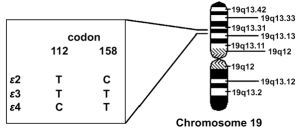
apoeWith this etiological model in mind, perhaps you would like to take better care of you cell membranes (much like your car mechanic implores to change your car’s spark plugs and oil to keep the engine clean on the inside).  Moreover, perhaps you would like to do-so especially if you knew that your APOE system was less optimal than average.  Indeed, results from the recent REVEAL study suggest that folks who are in their 50’s are not unduly distressed to make this genetic inquiry and find out their genotypic status at this APOE polymorphism – even though those who discovered that they were epsion-4 carriers reported more negative feelings, understandably.  Still, with a number of education and intervention strategies available, an optimistic outlook can prevail.

Furthermore, there are ever newer diagnostic strategies that can improve the rather weak predictive power of the genetic test.  For example, cognitive assessments that measure hippocampal-dependent aspects of memory or visual orienting have been shown to be valid predictors of subsequent dementia – even moreso in populations that carry the APOE epsilon-4 allele.  Other forms of neuroimaging that directly measure the structure and function of the hippocampus also have tremendous sensitivity (here for a broad review of imaging-genetics of AD) and can, in principle, provide a more predictive view into one’s distant future.

On the very cutting edge of this imaging-genetic crystal ball technology, lies a recent paper entitled, “Distinct patterns of brain activity in young carriers of the APOE-e4 allele” by Fillippini and colleagues [doi: 10.1073/pnas.0811879106].  Here, the research team asks whether individuals in their late 20’s show structural/functional brain differences that are related to APOE genotype.  They employ various forms of imaging analysis such as a comparison of brain activity when subjects were performing a novel vs. familiar memory task and also an analysis of so-called resting state networks – which reflect a form of temporal coherence (brain areas that oscillate in-sync with each other when subjects are lying still and doing nothing in the scanner).  For the analysis of the memory task, the team found that APOEe4 carriers showed more activation in the hippocampus as well as other brain regions like the anterior midbrain and cerebellum.  When the team analysed a particular resting state network – the default mode network – they found differences in the medial temporal lobe (containing head of the hippocampus and amygdala) as well as the medial prefronal cortex.  According to the paper, none of these differences could be explained by differences in the structure or resting perfusion of the young-adult brains in the study.

Wow, these results seem to suggest that decades before any mild cognitive impairments are observable, there are already subtle differences in the physiology of the APOEe4 brain – all of which could be detected using the data obtained in 6 minutes of rest. 6 minutes of rest and spit in a cup – what does the future hold?

Reblog this post [with Zemanta]

Read Full Post »

RICHMOND, CANADA - FEBRUARY 12:  Simon Whitfie...
Image by Getty Images via Daylife

While often the object of scorn from its capitalistic southern neighbor, the Canada Foundation for Innovation has just awarded Dr. David Kennedy a large research grant to deploy both neuroimaging and genetic markers in the development of personalised treatment for schizophrenia – through a program dubbed “neuroIMAGENE“.  Dr. Kennedy suggests that this technological strategy may actually save money in the long run by helping physicians select the proper medication and dosage.

Capitalistic scorn huh? This news comes as the U.S. healthcare flagship GE healthcare flushes its own personalized medicine effort all the while nary a Canadian bank requires bailout largesse.  Indeed.

Reblog this post [with Zemanta]

Read Full Post »

John Doe
Image by TW Collins via Flickr

Was bummed to hear Nick Haymenn say (download & listen to minute 10 on this Bloomberg News podcast) that GE healthcare has abandoned its molecular & imaging diagnostics program aimed at early detection and intervention.

Crap, that sets things back quite a bit across the medical universe I suspect.

Reblog this post [with Zemanta]

Read Full Post »

Steven Pinker on Open Source
Image by greeley via Flickr

A great article (here in the NYTimes magazine) on one psychologist’s reaction to his genome and the new consumer genomics.

Reblog this post [with Zemanta]

Read Full Post »

Karyogram of a human maleImage via Wikipedia Doctor David Ledbetter gives an eloquent editorial overview in his piece, “Cytogenetic Technology: Genotype and Phenotype” [doi: 10.1056/NEJMe0806570] on the renaissance underway in the field of medical cytogenetics. The use of high density arrays for genome-wide copy number variation has identified a slew of new sites showing recurrent microdeletion that are reliably found in patients with mental developmental disabilities (autism, mental retardation, schizophrenia to name a few). Ledbetter suggests that the ‘genotype first’ process of diagnosis is now much more effective with the help of the new arrays. He notes, “a pediatrician has the option of ordering this test as an adjunct to or replacement of a standard karyotype and can expect a much higher yield of clinically significant results”. This is an exciting realization of the long-awaited promise of genetics in medicine.

Reblog this post [with Zemanta]

Read Full Post »

Just saw this on engadget … fun and useful – just like chumby but with a medical twist. Who knows, it may someday make housecalls (see link below).Related articles by Zemanta

Reblog this post [with Zemanta]

Read Full Post »

Image representing Gizmodo as depicted in Crun...
Image via CrunchBase, source unknown

Just re-posting from Gizmodo … this looks like a positive step … a medical chumby.

Reblog this post [with Zemanta]

Read Full Post »

The selection and dosing of medication in psychiatry is far from scientific – even though a great deal of hard science goes into the preclinical design and clinical development. One reason, among many, has to do with the so-called ‘inverted-U-shaped’ relationship between the dose of a psychoactive compound and an individuals’ performance. Some folks show dramatic improvement with a given dose (their system may be functioning down at the low side of the inverted U mountain and hence, and added boost from medication may send their system up in performance), while others may actually get worse (those who are already at the peak of the inverted U mountaintop). How can a psychiatrist know where the patient is on this curve – will the medication boost raise or topple their patient’s functioning ? Some insight comes in the form of a genetic marker closely linked to the DRD2 gene, that as been shown to predict response to a dopaminergic drug.

Michael Cohen and colleagues, in their European Journal of Neuroscience paper (DOI: 10.1111/j.1460-9568.2007.05947.x) entitled, “Dopamine gene predicts the brain‘s response to dopaminergic drug” began with a polymorphism linked to the DRD2 gene wherein one allele (TaqA1+) is associated with fewer DRD2 receptors in the striatum (these folks should show improvement when given a DRD2 agonist) while folks with the alternate allele (TaqA1-) were predicted to show a falling off of their DRD2 function in response to additional DRD2 stimulation. The research team then asked participants to perform a cognitive task – a learning task where subjects use feedback to choose between a ‘win’ or ‘not win’ stimulus – that is well known to rely on proper functioning of DRD2-rich frontal and striatal brain regions.

Typically, DRD2 agonists impair reversal learning and, as expected, subjects in the low DRD2 level TaqA1+ genetic group actually got “more” impaired – or perseverated longer on rewarding stimuli and required more trials to switch on the go and figure out which stimulus was the “win” stimulus. Similarly, when differences in brain activity between baseline and positive “you win” feedback was measured, subjects in the drug treated, TaqA1+ genetic group showed an increase in activity in the putamen and the medial orbitofrontal cortex while subjects in the TaqA1- showed decreases in brain actiity in these regions. The authors suggest that the TaqA1+ group generally has a somewhat blunted response to positive feedback (sore winners) but that the medication enhanced the frontal-striatal reaction to positive feedback. Functional connectivity analyses showed that connectivity between the frontal cortex and striatum was worsened by the DRD2 agonist in the TaqA1+ genetic group and improved in the TaqA1- group.

Although the interpretations of these data are limited by the complexity of the systems, it seems clear that the TaqA1 genetic marker has provided a sort of index of baseline DRD2 function that can be useful in predicting an individual’s relative location on the theoretical inverted-U-shaped curve.

Reblog this post [with Zemanta]

Read Full Post »

An assortment of drugs, including 150mg Effexo...Image via Wikipedia Recent meta-analytical research, “Selective Publication of Antidepressant Trials and Its Influence on Apparent Efficacy” (N Engl J Med 2008;358:252-60) reveals that while 94% of published antidepressant drug trials show positive findings, only 51% of all such (published and unpublished) trials show positive effects (with a range of effect sizes from 11-69%). This is probably not surprising to patients and physicians (investors? … well, maybe) who often search in vain, using trail and error, for a medication that can provide relief from major depression, one the the top disease burdens world-wide. Many have suggested that pharmacogenetics may provide a key to understanding the tremendous variability in medication response. For example, variations in the ABCB1, ATP-binding cassette sub-family B member 1, gene seem to predict who may show a response to certain antidepressants (citalopram, paroxetine, amitriptyline, and venlafaxine) medications, that are shuttled across the blood-brain-barrier endothelial membrane by ABCB1. In a pharmacogenetic medication trial involving 443 inpatients with depression who were treated at the Max Planck Institute of Psychiatry, the SNPs 2032583, rs2235015, rs2032583 and rs2235015 predict significantly different time course of response to treatment over 6 weeks. The paper, “Polymorphisms in the Drug Transporter Gene ABCB1 Predict Antidepressant Treatment Response in Depression” (doi: 10.1016/j.neuron.2007.11.017) is an example of pure and applied science at is best. The results pose a vexing dilemma for “really big” pharma however since the market size of genetic responders is obviously much smaller than market at large. Nevertheless, it seems inexorable change is underway.

Reblog this post [with Zemanta]

Read Full Post »

Joan of ArcImage by dbking via Flickr Amidst the excitement of new personalized genome services, the Economist reports on fraudsters found peddling ‘personalized supplements’ based on bogus genetic testing results. This is an extreme, tragicomic example to be sure, but highlights some of the issues that can arise when confronting one’s genetic blueprint. A recent paper by Stephanis et al., “Impact of Schizophrenia Candidate Genes on Schizotypy and Cognitive Endophenotypes at the Population Level(DOI) shows that in a population of healthy individuals, those that carry common variants (such as rs760761, rs1018381, rs2619522) located in the dysbindin (DTNBP1) gene, a risk factor for schizophrenia, show minor cognitive impairments such as decreased attentional capacity, worse performance on memory tasks, and alterations in schizotypal beliefs and experiences. Thus, it would seem that, common genetic variation associated with a complex psychiatric disorder can confer minor cognitive impairment in healthy individuals. As personalized genome services proliferate, healthy individuals will begin to recognize that they carry genetic risk for all kinds of ailmentsmental illness included. I admit to having cringed somewhat when typing out the blunt title of this post – fraudsters notwithstanding.

Reblog this post [with Zemanta]

Read Full Post »

A 21 mg patch applied to the left arm
Image via Wikipedia

Uhl and colleagues present a genome-wide search for SNPs that distinguish smokers (nicotine dependence) – and perhaps more importantly – successful smoking quitters, in their recent article in the free and open-access journal BioMed Central. As pointed out in the article, this work is a step closer to personalized “efforts to match vulnerable individuals with the prevention and treatment strategies most likely to work for them.” A set of genetic variants that distinguish nicotine dependence from a control population with no personal history of smoking or substance abuse was identified and a novel set of variants that distinguish folks who’ve had success after using the patch and other self-help methods are exciting new tools that were produced by the study.

Reblog this post [with Zemanta]

Read Full Post »

Navigenics
Image via Wikipedia

I’m not sure how they will compete with the open community effort of the Personal Genome Project, but they do have a very slick commercial. Check out Navigenics and you’ll feel your saliva start to flow !

Reblog this post [with Zemanta]

Read Full Post »

Harvard University
Image via Wikipedia

Christopher Rowland gives a great perspective on the new venture fund at the Harvard Partners Healthcare system. If you want a peek at the future of personalized medicine, check out the Partners Center for Genetics and Genomics – where basic research is seamlessly integrated with clinical care. I attended their first annual meeting in 2005 and took home a lot to think about. This year’s meeting features Regina Herzlinger, who will discuss economic framework issues. I wonder if the Partners system is adopting or experimenting with new payor models … certainly the new venture fund will support research, but what about everyday clinical care?

Reblog this post [with Zemanta]

Read Full Post »

« Newer Posts