Archive for the ‘Uncategorized’ Category
Genes2brains2 bloggers pad – I wish
Posted in Uncategorized, tagged Art, meme-art on January 10, 2010| Leave a Comment »
Gametes
Posted in Uncategorized, tagged Art, meme-art on January 9, 2010| Leave a Comment »

Thousands of genes together with thousands of resting-state nodes actually makes the genes-to-cognition problem LESS complex
Posted in Uncategorized, tagged Biology, Brain, Cognition, connectome, default network, Development, DNA, Dopamine, Frontal lobe, Functional magnetic resonance imaging, Genetics, Memory, Mental health, Prefrontal cortex, Psychology, resting state network on January 7, 2010| Leave a Comment »
 DON’T tell the grant funding agencies, but, in at least one way, the effort to relate genetic variation to individual differences in cognitive function is a totally intractable waste of money.
Let’s say we ask a population of folks to perform a task – perhaps a word memory task – and then we use neuroimaging to identify the areas of the brain that (i) were associated with performance of the task, and (ii) were not only associated with performance, but were also associated with genetic variation in the population. Indeed, there are already examples of just this type of “imaging-genetic” study in the literature. Such studies form a crucial translational link in understanding how genes (whose biochemical functions are most often studied in animal models) relate to human brain function (usually studied with cognitive psychology). However, do these genes relate to just this task? What if subjects were recalling objects? or feelings? What if subjects were recalling objects / experiences / feelings / etc. from their childhoods? Of course, there are thousands of common cognitive operations one’s brain routinely performs, and, hence, thousands of experimental paradigms that could be used in such “imaging-genetic” gene association studies. At more than $500/hour (some paradigms last up to 2 hours) in imaging costs, the translational genes-to-cognition endeavor could get expensive!
DO tell the grant funding agencies that this may not be a problem any longer.
The recent paper by Liu and colleagues “Prefrontal-Related Functional Connectivities within the Default Network Are Modulated by COMT val158met in Healthy Young Adults” [doi: 10.1523/jneurosci.3941-09.2010] suggests an approach that may simplify matters. Their approach still involves genotyping (in this case for rs4680) and neuroimaging. However, instead of performing a specific cognitive task, the team asks subjects to lay in the scanner – and do nothing. That’s right – nothing – just lay still with eyes closed and just let the mind wander and not to think about anything in particular – for a mere 10 minutes. Hunh? What the heck can you learn from that?
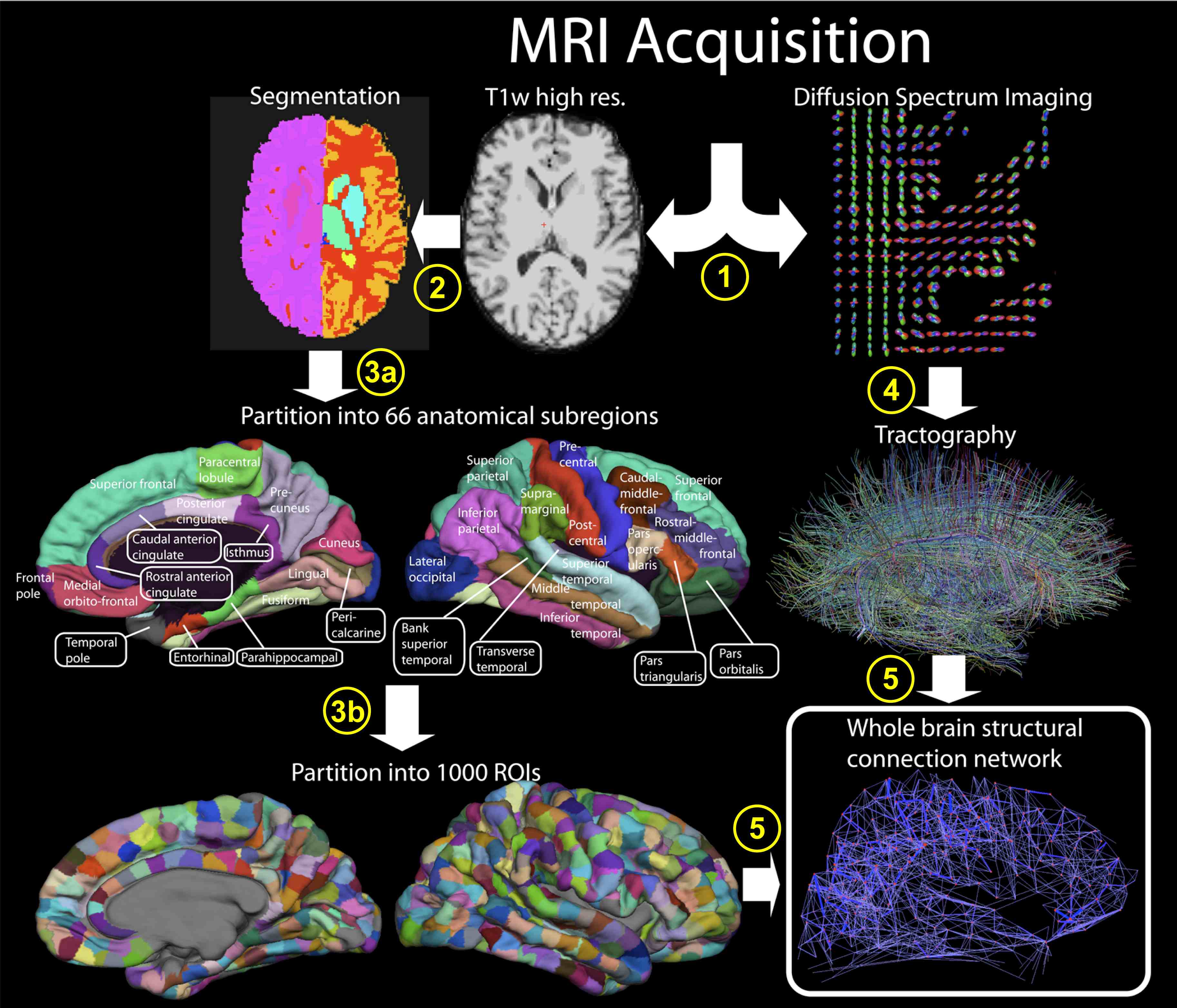
It turns out that one can learn a lot. This is because the neural pathways that the brain uses when you are actively doing something (a word recall task) are largely intact even when you are doing nothing. Your brain does not “turn off” when you are laying still with your eyes closed and drifting in thought. Rather, your brain slips into a kind of default pattern, described in studies of “default networks” or “resting-state networks” where wide-ranging brain circuits remain dynamically coupled and actively exchange neural information. One really great paper that describes these networks is a free-and-open article by Hagmann et al., “Mapping the Structural Core of Human Cerebral Cortex” [doi: 10.1371/journal.pbio.0060159] from which I’ve lifted their Figure 1 above. The work by Hagmann et al., and others show that the brain has a sort of “connectome” where there are thousands of “connector hubs” or nodes that remain actively coupled (meaning that if one node fires, the other node will fire in a synchronized way) when the brain is at rest and when the brain is actively performing cognitive operations. In a few studies, it seems that the strength of functional coupling in certain brain areas at rest is correlated (positively and negatively) with the activation of these areas when subjects are performing a specific task.
In the genetic study reported by Liu and colleagues, they found that genotype (N=57) at the dopaminergic COMT gene correlated with differences in the functional connectivity (synchronization of firing) of nodes in the prefrontal cortex. This result is eerily similar to results found for a number of specific tasks (N-back, Wisconsin Card Sorting, Gambling, etc.) where COMT genotype was correlated with the differential activation of the frontal cortex during the task. So it seems that one imaging paradigm (lay still and rest for 10 minutes) provided comparable insights to several lengthy (and diverse) activation tasks. Perhaps this is the case. If so, might it provide a more direct route to linking genetic variation with cognitive function?
Liu and colleagues do not comment on this proposition directly nor do they seem to be over-interpreting their results in they way I have editorialized things here. They very thoughtfully point out the ways in which the networks they’ve identified and similar and different to the published findings of others. Certainly, this study and the other one like it are the first in what might be a promising new direction!
![Reblog this post [with Zemanta]](https://i0.wp.com/img.zemanta.com/reblog_c.png)
Gene meets brain comic
Posted in Uncategorized, tagged Art, meme-art on January 6, 2010| 1 Comment »

On the genetics of epigenetics (part un)
Posted in Uncategorized, tagged aging, Development, DNA, DNA methylation, Epigenetics, Gene, Gene expression, Genetic testing, histone, histone acetylation, Transcription factor, Twin on January 5, 2010| 3 Comments »
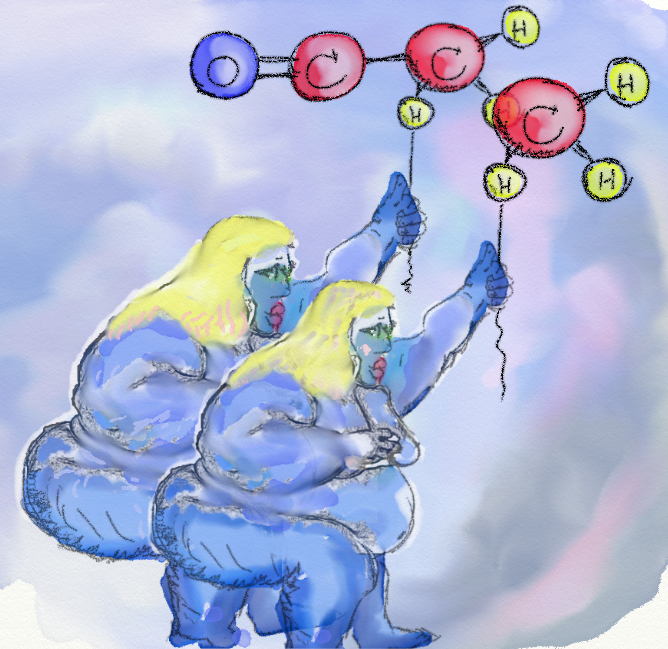 Last year I dug a bit into the area of epigenetics (indexed here) and learned that the methylation (CH3) and acetylation (OCCH3) of genomic DNA & histones, respectively, can have dramatic effects on the structure of DNA and its accessibility to transcription factors – and hence – gene expression. Many of the papers I covered suggested that the environment can influence the degree to which these so-called “epigenetic marks” are covalently bonded onto the genome during early development. Thus, the thinking goes, the early environment can modulate gene expression in ways that are long-lasting – even transgenerational. The idea is a powerful one to be sure. And a scary one as well, as parents who read this literature, may fret that their children (and grandchildren) can be epigenetically scarred by early nutritional, physical and/or psycho-social stress. I must admit that, as a parent of young children myself, I began to wonder if I might be negatively influencing the epigenome of my children.
I’m wondering how much physical and/or social stress is enough to cause changes in the epigenome? Does the concern about epigenetics only apply to exposure to severe stress? or run of the mill forms of stress? How much do we know about this?
This year, I hope to explore this line of inquiry further. For starters, I came across a fantastic paper by Fraga et al., entitled, “Epigenetic differences arise during the lifetime of monozygotic twins” [doi:10.1073/pnas.0500398102]. The group carries out a remarkably straightforward and time honored approach – a twin study – to ask how much identical twins differ at the epigenetic level. Since identical twins have the same genome sequence, any differences in their physiology, behavior etc. are, strictly speaking, due to the way in which the environment (from the uterus to adulthood) shapes their development. Hence, the team of Fraga et al., can compare the amount and location of methyl (CH3) and acetyl (OCCH3) groups to see whether the environment has differentially shaped the epigenome.
An analysis of some 40 identical twin pairs from ages 3-74 years old showed that – YES – the environment, over time, does seem to shape the epigenome (in this case of lymphocytes). The most compelling evidence for me was seen in Figure 4 where the team used a method known as Restriction Landmark Genomic Scanning (RLGS) to compare patterns of methylation in a genome-wide manner. Using this analysis, the team found that older twin pairs had about 2.5 times as many differences as did the epigenomes of the youngest twin pairs. These methylation differences also correlated with gene expression differences (older pairs also had more gene expression differences) and they found that the individual who showed the lowest levels of methylation also had the highest levels of gene expression. Furthermore, the team finds that twin pairs who lived apart and had more differences in life history were more likely to have epigenetic differences. Finally, measures of histone acetylation seemed consistent with the gradient of epigenetic change over time and life-history distance.
Thus it seems that, as everyday life progresses, the epigenome changes too. So, perhaps, one does not need extreme forms of stress to leave long-lasting epigenetic marks on the genome? Is this true during early life (where the team did not see many differences between pairs)? and in the brain (the team focused mainly on lymphocytes)? Are the differences between twins due to the creation of new environmentally-mediated marks or the faulty passage of existing marks from dividing cell-to-cell over time? Will be fun to seek out information on this.
echoblog: Educational resources for cognitive science
Posted in Uncategorized, tagged Cognitive science, Education, Psychology on January 4, 2010| Leave a Comment »
pointer to: Al Fin’s recent post chock full of great links to educational videos. Incredible wealth of expertise just a few clicks away. Thanks Al Fin!!
Cold windows
Posted in Uncategorized, tagged Art, meme-art on January 2, 2010| Leave a Comment »

Genes & brains art
Posted in Uncategorized, tagged Art, meme-art on January 2, 2010| Leave a Comment »



Best wishes for 2010!
Posted in Uncategorized on December 30, 2009| Leave a Comment »

Sometimes I think …
Posted in Uncategorized, tagged Art, meme-art on December 20, 2009| Leave a Comment »

Recalling finch beaks using variable decision criteria to learn from whence we came
Posted in Uncategorized, tagged Charles Darwin, Development, episodic memory, evolution, Frontal lobe, Functional magnetic resonance imaging, Galápagos Islands, Genetics, individual differences, John Gould, Jonathan Weiner, Memory, Natural selection, Neuroimaging, Psychology on December 14, 2009| Leave a Comment »

- Image via Wikipedia

In his book, The Beak of the Finch, Jonathan Weiner describes the great diversity of finches on the Galapagos Islands – so much diversity – that Darwin himself initially thought the finch variants to be completely different birds (wrens, mockingbirds, blackbirds and “gross-bills”). It turns out that one of the pivotal events in Charles Darwin‘s life was his work in 1837 with the great ornithologist John Gould who advised that the birds were actually closely related finches and also specific to separate islands!
Fast-forward to 2009, and we are well on our way to understanding how closely related species can, via natural selection of genetic variation, diverge across space and time. The BMP4 and CaM genes, for example, have been associated with beak morphology in what are now known as Darwin’s Finches. Wonderful indeed, but now consider, for a moment, the variability – not of finch beaks – but of human cognition.
If you’ve ever been a part of a team or group project at work or school, you know that very few people THINK just like you. Indeed, variability in human cognition can be the source of a lot of frustration. Let’s face it, people have different experiences stored away (in a highly distributed fashion) in their memory banks, and each persons brain is extensively wired with trillions of synapses. Of course! nobody thinks like you. How could such a complex organ function exactly the same way in 2 separate individuals.
Perhaps then, if you were an alien visitor (as Darwin was to the Galapagos Islands) and you watched 5 separate individuals devise a plan to – oh lets just say, to improve healthcare accessibility and affordability – and you measured individuals based solely on their “thinking patterns” you might conclude (as Darwin did) that you were dealing with 5 separate “species”. Just flip the TV between FOX, CNN, CNBC, CSPAN and MSNBC if you’re not convinced!
However, if you were to take a more in-depth approach and crack open a current issue of a neuroimaging journal – you might come to the exact opposite conclusion. That’s right. If you looked at patterns of brain activity and other indirect measures of neural network dynamics (what I casually meant by “thinking patterns” ) you would mostly see conclusions drawn from studies where many individuals are pooled into large groups and then probed for forms of brain activity that are common rather than different. Most studies today show that humans use a common set of neural systems to perform mental operations (e.g., recalling events and information). Brain structures including the hippocampus, frontal cortex, thalamus, parietal cortex are all known to be involved in deciding whether or not you have seen something before. Thus, if you perform an fMRI brain scanning study on individuals and ask them to complete an episodic memory recall task (show them a list of words before scanning and then – when they are in the scanner – ask them to respond to words they remember seeing), you will likely observe that all or most individuals show some BOLD response activity in these structures.
OK great! But can you imagine where we would be if Charles Darwin returned home from his voyage and said, “Oh, just a bunch of birds out there … you know, the usual common stuff … beaks, wings, etc.” I’d rather not imagine.
Enter Professor Michael Miller and colleagues and their recent paper, “Unique and persistent individual patterns of brain activity across different memory retrieval tasks” [doi:10.1016/j.neuroimage.2009.06.033]. This paper looks – not just at the common stuff – but the individual differences in BOLD responses among individuals who perform a number of different memory tasks. The team reports that there are dramatic differences in the patterns of brain activity between individuals. This can be seen very clearly in Figure 1 which shows left hemisphere activity associated with memory recall. The group data (N=14) show nice clean frontal parietal activations – but when the data is broken down on an individual-by-individual basis, you might – without knowing that the all subjects were performing the same recall tasks – suspect that each person was doing or “thinking” something quite different. The research team then re-scanned each subject several months later and asked whether the individual differences were consistent from person to person. Indeed, the team shows that the 2nd brain scan is much more similar to the first (correlations were about 0.5) and that the scan-rescan data for an individual was more similar than the correlation between any single person and the rest of the group (about 0.25). Hence, as the authors state, “unique patterns of brain activity persist across different tasks”.
Vive la difference! Yes, the variability is – if you’re interested in using genetics to understand human history and cognitive development – the really exciting part! Of course, genetics is not the main reason for the stable individual-to-individual differences in brain activity. There are likely to be many factors that could alter the neural dynamics of broadly distributed neural networks used for memory recall. Environment, experience, gender are just a few factors that are known to influence the function of these networks. The authors reveal that individuals may also differ in the strategies and criteria they use to make decisions about whether they can recall or detect a previously viewed item. Some people will respond only when they are very certain (high criteria) and others will respond even if they feel only slightly sure they’ve seen an item before (low criteria). The authors show in Figure 5 that the folks who showed similar decision criteria are more likely to have similar patterns of brain activity.
Perhaps then, the genetic differences that (partially) underlie individual differences in brain activity might relate to personality or other aspects of decision making? I don’t have a clue, but I do know that this approach – of looking carefully at individual differences – is a step forward to doing what Darwin (and don’t forget John Gould!) is so well known for. Understand where the variation comes from, and you will understand where you come from!
I will follow this literature more closely in the months to come.
![Reblog this post [with Zemanta]](https://i0.wp.com/img.zemanta.com/reblog_e.png)
genetics casts a long shadow
Posted in Uncategorized, tagged Art, meme-art on December 12, 2009| Leave a Comment »

burger joint
Posted in Uncategorized, tagged advertisement, Art, meme-art on December 7, 2009| Leave a Comment »

spoof ad
Posted in Uncategorized, tagged advertisement, Art, meme-art on December 6, 2009| Leave a Comment »

life insurance
Posted in Uncategorized, tagged advertisement, Art, meme-art on December 5, 2009| Leave a Comment »

Video library of mental illness
Posted in Uncategorized, tagged Depression, Major depressive disorder, Mental disorder, Mental health, Psychology, schizophrenia, symptoms, videos on November 30, 2009| Leave a Comment »

- Image via Wikipedia

pointer to symptommedia.org – fantastic video resource of specific symptoms of mental illness.
“The intention of these clips are to be used in the classroom setting as visual compliments to the written description of symptoms for psychological phenomena found in the DSM handbook.”
Topoisomerase
Posted in Uncategorized, tagged Art, meme-art on November 18, 2009| Leave a Comment »
Beer ad
Posted in Uncategorized, tagged Art, meme-art on November 17, 2009| Leave a Comment »

genes and brains meme-art
Posted in Uncategorized, tagged Art, meme-art on November 16, 2009| Leave a Comment »

Lonely Hearts Club “braines”
Posted in Uncategorized, tagged Art, Arts, meme-art on November 15, 2009| Leave a Comment »

Remarks
Re-Tweetin’
Tweets by genes2brains2meBlog Stats
- 192,113 clickitas
Posting since April 2007
General topics
23andMe Addiction Add new tag aging Anxiety Art Arts autism B. K. S. Iyengar Biology Brain Buddism Central nervous system Cognition comics Consciousness Depression Development DNA Dopamine dualism economics Emotion Empathy Epigenetics evolution fear Frontal lobe Functional magnetic resonance imaging Gene Gene expression Genetics Genetic testing GWAS Health Health care Health insurance Hippocampus History Intelligence Kundalini language Major depressive disorder medication Meditation meme-art Memory Mental disorder Mental health Mind Mutation Nervous system Neural network Neuron Pain parasympathetic nervous system Patañjali Personalized medicine philosophy placebo Psychology Reactive oxygen species Religion and Spirituality Rett Syndrome schizophrenia Social Sciences spirituality Stem cell Stress Suicide synaptogenesis Teachers and Centers Twin Yoga Yoga Sutras of PatanjaliSpecific Items
- 5HTT
- ABCB1
- acetylcholine
- Actin
- ACTN3
- ADH1C
- ADORA2A
- ADRA2A
- AKT
- AMPA receptor
- Amygdala
- Angular gyrus
- ANK3
- APOE
- ARHGAP18
- ASIC1a
- ASPM
- ATXN1
- AVPR1a
- BAF53b
- Basal Ganglia
- BDNF
- CABYR
- CACNA1C
- CACNA2D1
- Caudate nucleus
- CB1 receptor
- CDC34
- CDH13
- Cell adhesion molecules
- Cerebellum
- CHAT
- CHRM3
- CHRNA4
- CHRNA7
- Chromosome structural variants
- Cingulate cortex
- Circadian
- clinical trial
- CNR1
- CNTNAP2
- Collateral sulcus
- COMT
- Corpus callosum
- COX1
- CREB
- CRHR1
- DARPP32
- DAT
- default network
- DISC1
- DLPFC
- DNAJC
- DNMT
- Dopamine
- DPP4
- DRD2
- DRD4
- DTNBP1
- DYRK1A
- EDA2R
- EGR1
- Estrogen
- evolution
- FGF20
- FMR1
- FNBP1L
- FOXA2
- FOXP2
- Frontal cortex
- Frontal pole
- Fusiform gyrus
- G-protein
- GAB2
- GABA
- GABRA2
- GABRG1
- GATA4
- Glucocorticoid receptor
- Glutamate
- GPR6
- GRIA3
- GRIK2
- GTPase
- HDACs
- Hippocampus
- HOXB8
- HRK
- HTR2A
- Hypothalamus
- IL3
- immunity
- Inferior frontal gyrus
- Insula
- Intronic or repetitive sequences
- Kalirin
- KCNA2
- KCNH2
- KCNIP3
- KCNJ6
- Kinesin
- Lateral septum
- Lateral ventricle
- LDB1
- Leptin
- LIMK1
- Locus coeruleus
- MAOA
- MAPK
- MCPH1
- MCR1-4
- MDGA2
- MECP2
- meditation
- MET
- metabolism
- MHC loci
- microRNA
- Middle frontal gyrus
- middle occipital gyrus
- Middle temporal gyrus
- Mindfulness
- Mitochondria
- MKP-1
- Motor cortex
- Myelin
- Neural crest
- NEUROG1
- NLGN3/4
- Noradrenaline
- NPBWR1
- NPSR1
- NRG1
- NRXB1
- NTRK2
- Nucleus accumbens
- NURR1
- Olfactory bulb
- OPRM1
- Orbitofrontal cortex
- OTR
- OXTR
- Parahippocampal gyrus
- Parasympathetic NS
- Parietal cortex
- PARP-1
- PAX6
- PCLO
- PER1
- PINK1
- PLCB1
- Posterior parietal cortex
- PSD95
- Putamen
- quantum physics
- RARB
- RGS2
- RGS4
- Rho GTPase
- RLN
- ROR1
- RORB
- Rostral fronto-occipital fasciculus
- RSRC1
- SAPAP3
- self-awareness
- SEMA(1-7)
- SETDB1
- SEZ6
- SIRT1
- SLC1A1
- SLITRK1
- SNAP25
- SNORD115
- SNRPN
- SOD2
- Somatosensory cortex
- SRPX2
- Stria terminalis
- Striatum
- Substantia nigra
- Subthalamic nucleus
- Superior temporal cortex
- Suprachiasmatic nucleus
- Supramarginal gyrus
- SWI/SNF
- Sylvian fissure
- Telomere
- Temporal lobe
- TGF-alpha
- TH
- Thalamus
- Thap1
- THBS1
- THBS2
- TNF-alpha
- Torsin A
- TPH2
- UBE3A
- UGT2B17
- Uncategorized
- Vagus
- VEGF
- Ventral tegmental area
- VGF
- Visual cortex
- White matter
- Yoga and Meditation
- ZNF804A


 Genes 2 Brains 2 Mind 2 Me