Feeds:
Posts
Comments

Archive for the ‘Uncategorized’ Category

Big decisions at SfN

SfNneuroblogbadgeShould I take the shuttle bus or the Metra?  Should I go to the big lecture or the smaller talk?  Do I eat McD’s on level 2 or do I head off-site and take my chances?  Lately it seems, these are the really big questions – in addition to the usual ones about how brains work and how they give rise to minds.  But just what’s going on under the hood when you are weighing your options (McD’s vs. off-site eating turns out to be a false choice or Hobson’s choice as I discovered today)?

A number of fantastic insights were offered at today’s session on Basic Decision-Making Mechanisms.  These speakers were fond of systems-level analyses and seemed most interested in patterns of brain activity that are correlated with performance on decision-making tasks.  Not surprisingly, there are a number of such correlates, many, it seems, residing in the lateral and medial frontal cortex.  What do these correlates do? and how, exactly, do they function to help me make the right decisions (sadly, this would be McD’s). J.T. McGuire from Princeton University showed interesting patterns of activity in ventral temporal lobes and suggested that one interpretation of these correlates was that frontal networks are regulators of circuits that carry out earlier stages of processing.  P. Stiers from Maastricht University showed that there are a common set of frontal brain areas that co-activate across several executive function and decision-making tasks – and also that these regions show high functional connectivity regardless of tasks.  Perhaps this suggests a pre-wired neural network – or at least a consortia of networks – as one question from the audience pointed out.  In some individuals, lesions can impair decision-making and C. Azuar from the Centre de Recherche de l’Institut du Cerveau et de la Moelle épinière, La Pitié Salpêtrière Hospital in Paris revealed that these lesions tend to reside in the same frontal areas that are activated when healthy volunteers perform decision-making tasks – a finding that supports the  “cascade model” of decision-making.  Lastly, I enjoyed the presentation by J.J. Yoo of MIT who asked if real-time analysis of brain activations can be used to influence decisions or at least facilitate better memory of scenes.  Are there brain states that predict better memory encoding?  Her team focused the parahippocampal place area, where higher activity had been associated with better memory encoding, and then presented stimuli to subjects only when they were in a “good” brain state  vs. “bad” brain state.  This manipulation improved recall from 15% when in the “bad state” up to 22% recall when stimuli were presented to subjects when they were in the “good state”. Wow! Mind reading is for real.

Just think, at SfN 2029, we can have our brains scanned BEFORE deciding where to go for lunch!

Read Full Post »

brainfuel

Read Full Post »

SfNneuroblogbadge Phrenological thinking, a popular pseudoscientific practice in the 1800’s suggested that the structure of the head and underlying brain held the clues to understanding human behavior.  Today, amidst the ongoing convergence of developmental science, molecular & biochemical science and systems-dynamical science (to name just a few), there is – of course – no single or agreed-upon level of analysis that can provide all the answers.  Circuit dynamics are wonderfully correlated with behavior, but they can be regulated by synaptic weights.  Also,  while developmental studies reveal the far reaching beauty of neuronal circuitry, such elegant wiring is of little benefit without healthy and properly regulated synaptic connections.  Genes too, can be associated with circuit dynamics and behavior, but what do these genes do?  Perchance encode proteins that help to form and regulate synapses? Synapses, synapses, synapses.  Perhaps there is a level of analysis – or a nexus – where all levels of analysis intersect?  What do we know about synapses and how these essential aspects of brain function are formed and regulated?

With this in mind I’ve been exploring the nanosymposium, “Molecular Dynamics and Regulation at Synapses” to learn more about the latest findings in this important crossroads of neurobiology.  If you’re like me, you sort of take synapses for granted and think of them as being very tiny and sort of generic.  Delve a while into the material presented at this symposium and you may come to view the lowly synapse – a single synapse – as a much larger, more complex, ever changing biochemical world unto itself.  The number of molecular players under scrutiny by the groups presenting in this one session is staggering.  GTPase activating proteins, kinases, molecular motors, receptors, proteases, cell adhesive proteins, ion channels and many others must interact according to standard biochemical and thermodynamic laws.  At this molecular-soup level, it seems rather miraculous that the core process of vessicle-to-cell membrane fusion can happen at all – let alone in the precise way needed to maintain the proper oscillatory timing needed for Hebbian plasticity and higher-level circuit properties associated with attention and memory.

For sure, this is one reason why the brain and behavior are hard to understand.  Synapses are very complex!

Reblog this post [with Zemanta]

Read Full Post »

SfNneuroblogbadgeIn 13th century India,  the story was originally told of a group of blind men (or men in the dark) who touch an elephant to learn what it is like.  Each one touches a different part, but only one part, such as the side or the tusk.  They then compare notes on what they felt, and learn they are in complete disagreement.

With this ancient story in mind,  I’d like to introduce you to the annual conference of the Society for Neuroscience, or SfN, where brain enthusiasts across the globe gather for 5 days to compare notes – not on an elephant – but on something more massive – the brain and mind.  The vast complexities of neural development and communication will be shared amongst some 31,000+ participants in an effort to integrate findings from molecular to neural physiology to systems dynamics to behavior and find some  agreement on one of the all-time great biological mysteries.

As but a single humble molecular/cognitive/neuro/blogger, I will do my best to focus specifically on stories and highlights that address the dilemma of the bind men and the elephant and look for stories that  interlink different levels of analysis and help integrate data and models across different levels of analysis. I am fascinated by the way in which data from molecular levels of analysis can be interlinked with synaptic and systems levels of analysis and so hope to relate some of these interconnections with my readers.

You can readily follow the action at this years gathering using the fantastic organizational, informatic tools on the SfN meeting planner.  There are a number of resources to support neuro-bloggers and theme-specific neuro-tweeters.  Also, DrugMonkey has a growing list of other SfN tweeters/bloggers.  The real-time flow on Twitter #sfn09 as well as #sfnthemea & (b,c,d,e, and the notorious h) is already amazing !!

Please join the fray and share your thoughts with the SfN community! See you in Chicago.

Reblog this post [with Zemanta]

Read Full Post »

sfncrowds

Read Full Post »

collage

braincollage

Read Full Post »

zipper_genes

Read Full Post »

meme-art hack: genes on my mind

genes_on_my_mind

Read Full Post »

logo_MoteLgpointer to: amazing project on the complexities of managing mental illness in America today.  Scientific progress makes for policy dilemma in an era of economic decline.  Heartbreaking.

From the website: MINDS ON THE EDGE: Facing Mental Illness is a multi-platform media project that explores severe mental illness in America.

The centerpiece of the project is a television program airing on PBS stations in October 2009. This video component is part of a national initiative that includes extensive web content with tools for civic engagement, active social media on Facebook and Twitter, and an ambitious strategy to engage citizens, professionals in many fields, and policy makers at all levels of government. The goal is to advance consensus about how to improve the kinds of support and treatment available for people with mental illness.

The television program MINDS ON THE EDGE: Facing Mental Illness effectively illuminates challenging ethical issues as well as systemic flaws in program and policy design, service coordination, and resource allocation. These problems are contributing to a mental health system that is widely acknowledged to be broken. MINDS ON THE EDGE also provides a glimpse of innovative solutions that are currently being implemented across the country. These innovations, many shaped by the guidance and expertise of people with mental illness, offer promising solutions and hopeful direction to transform the mental health system.

Reblog this post [with Zemanta]

Read Full Post »

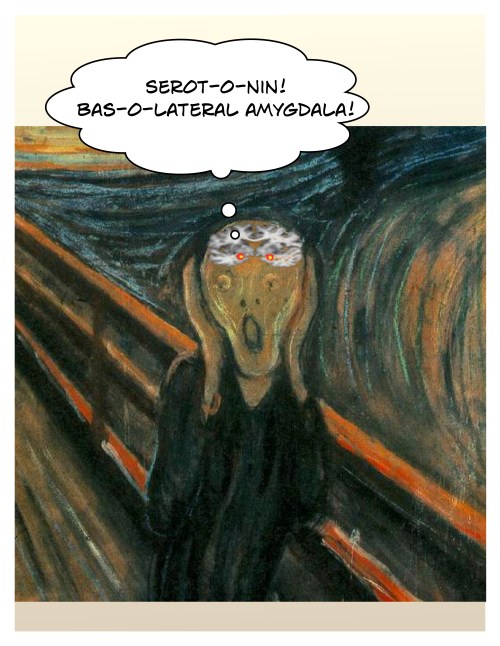
5HTT-LPR short allele

thescreamo

Read Full Post »

Neuromodulation

neuomodulation_floor

Read Full Post »

occasional sentiment

deadend

Read Full Post »

Logo of the United States National Institute o...
Image via Wikipedia

Many thanks to Dr. Christina S. Barr from the National Institutes of Health/National Institute on Alcohol Abuse and Alcoholism-Laboratory of Clinical and Translational Studies, National Institutes of Health Animal Center for taking the time to comment on her team’s recent publication, “Functional CRH variation increases stress-induced alcohol consumption in primates” [doi:10.1073/pnas.0902863106] which was covered here.  On behalf of students and interested readers, I am so grateful to her for doing this!  Thank you Dr. Barr!

For readers who are unfamiliar with the extensive literature on this topic, can you give them some basic background context for the study?

“In rodents, increased CRH system functioning in parts of the brain that drive anxious responding (ie, amygdala) occurs following extended access to alcohol and causes animals to transition to the addicted state.  In rodent lines in which genetic factors drive increased CRH system functioning, those animals are essentially phenocopies of those in the post-dependent state.  We had a variant in the macaque that we expected would drive increased CRH expression in response to stress, and similar variants may exist in humans.  We, therefore, hypothesized that this type of genetic variation may interact with prior stress exposure to increase alcohol drinking.”

Can you tells us more about the experimental design strategy and methods?

“This was a study that relied on use of archived NIAAA datasets. The behavioral and endocrine data had been collected years ago, but we took a gene of interest, and determined whether there was variation. We then put a considerable amount of effort into assessing the functional effects of this variant, in order to have a better understanding of how it might relate to individual variation. We then genotyped archived DNA samples in the colony for this polymorphism.”

“I am actually a veterinarian in addition to being a neuroscientist- we have the “3 R’s”. Reduce, refine, and replace…..meaning that animal studies should involve reduced numbers, should be refined to minimize pain/distress and should be replaced with molecular studies if possible.  This is an example of how you can marry use of archived data and sophisticated molecular biology techniques/data analysis to come up with a testable hypothesis without the use of animal subjects. (of course, it means you need to have access to the datasets….;)”

How do the results relate to broader questions and your field at large?

“I became interested in this system because it is one that appears to be under intense selection.  In a wide variety of animal species, individuals or strains that are particularly stress-reactive may be more likely to survive and reproduce successfully in highly variable or stressful environments. Over the course of human evolution, however, selective pressures have shifted, as have the nature and chronicity of stress exposures.  In fact, in modern society, highly stress-reactive individuals, who are no less likely to be eaten by a predator (predation not being a major cause of mortality in modern humans), may instead be more likely to fall susceptible to various-stress related disorders, including chronic infections, diabetes, heart disease, accelerated brain aging, stress-related psychiatric disorders, and even drug and alcohol problems. Therefore, these genetic variants that are persistent in modern humans may make individuals more vulnerable to “modern problems.”

I do hope this helps. Let me know if it doesn’t, and I will try to better answer your questions.”

THANK YOU AGAIN VERY MUCH DR. BARR!!

Reblog this post [with Zemanta]

Read Full Post »

Read Full Post »

The Colbert Report
Image via Wikipedia

Science IS fun … props to Francis Collins for going out on a limb for the younger crowd on the Colbert Report.

Reblog this post [with Zemanta]

Read Full Post »

x chromosomes

Xchromosome

Read Full Post »

gene walk

walk_dna_green

Read Full Post »

neo-Darwinist graffiti

neoDarwin_grafitti

Read Full Post »

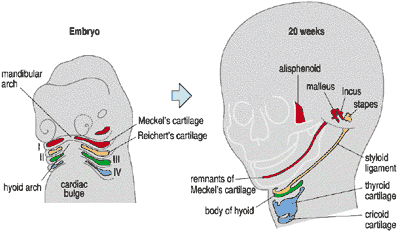
arch_fatesAm having a wonderful time reading, “Your Inner Fish” by Professor Neil Shubin – an exploration into the deep evolutionary roots of the human body.  Amazed to contemplate the embryonic structures known as the branchial arches, or gill arches – which we share with sharks! – and the role of the gcm2 gene that is expressed in these arches and controls salt balance in humans and fish.  Pharyngula has a wonderful post on this !! 

Hoping to find more deep evolutionary roots of mind and brain.
innershark

Reblog this post [with Zemanta]

Read Full Post »

meme-art 5

switchboard

Read Full Post »

« Newer Posts - Older Posts »