
This type of wasteful silliness would never happen in the small and efficiently regulated pufferfish city genome.
#urbanmetaphor
Posted in Uncategorized on September 19, 2012| Leave a Comment »
This type of wasteful silliness would never happen in the small and efficiently regulated pufferfish city genome.
#urbanmetaphor
Posted in Uncategorized on September 19, 2012| Leave a Comment »

… to whoever started using the “the genome is like a city … when you get down to the street level, there’s a lot of activity, but mostly meaningless … full of bums”
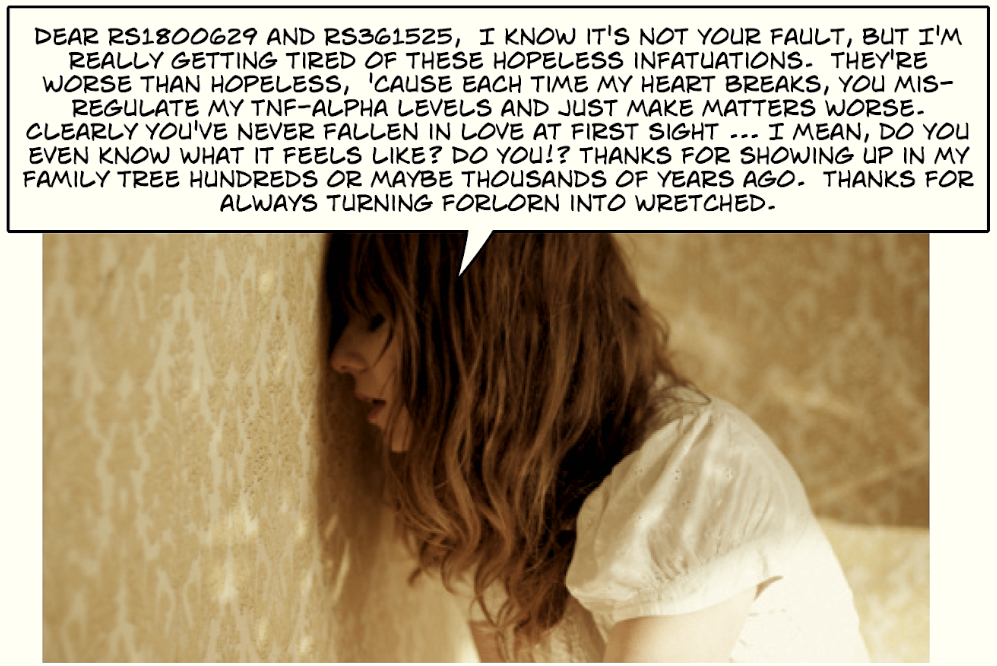
Posted in immunity, TNF-alpha, Uncategorized on March 12, 2012| Leave a Comment »
Posted in Uncategorized on March 4, 2012| Leave a Comment »
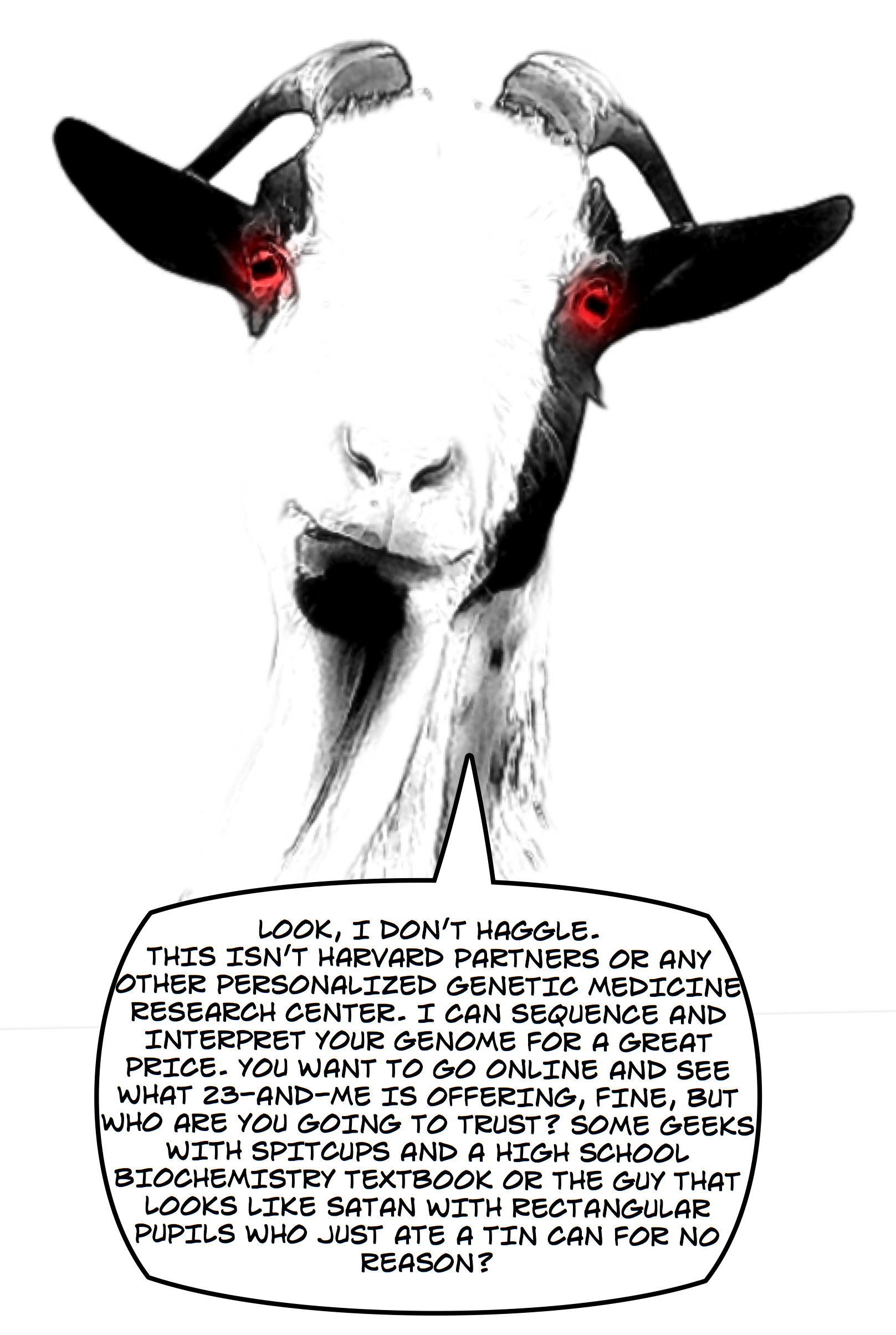
Posted in Uncategorized, tagged Genetic testing, Personalized medicine, silly on February 27, 2012| Leave a Comment »

when you realize that the genetic risk of that allele you carry was calculated using a small population from south-western-upper-middle-eurasia-stan … and doesn’t really apply to your individual situation.
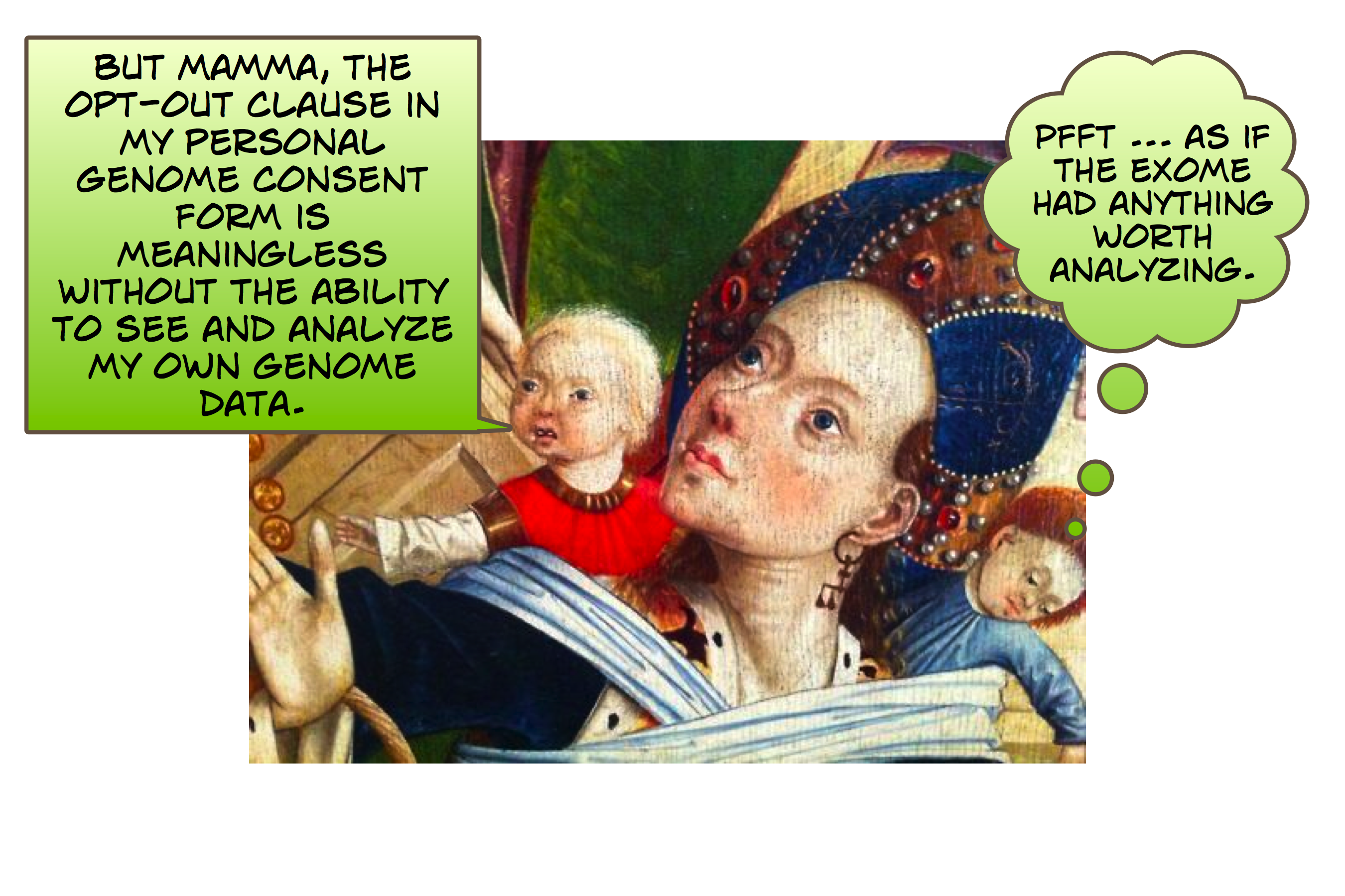
Posted in Uncategorized, tagged consent, legal, Personalized medicine on February 26, 2012| Leave a Comment »
Posted in Uncategorized, tagged comics on February 19, 2012| Leave a Comment »
Posted in Uncategorized on February 11, 2012| Leave a Comment »
Posted in Uncategorized, tagged Genetic testing, Health insurance, Personalized medicine on February 4, 2012| Leave a Comment »
Perhaps just a little bit. One Law Professor’s experience.
“As it happens, … It turned out that I had a genetic variant that implied a moderately increased risk of meningioma, the second most common type of brain tumor.
The information came a little late to be useful. Last summer, … found me half conscious on the floor. The diagnosis at the local hospital was meningioma, a benign (i.e. non-cancerous) tumor inside my skull but fortunately outside my brain.”
Posted in Uncategorized, tagged amygdala, Emotion, fear, limbic system on January 23, 2012| Leave a Comment »
Posted in Uncategorized, tagged Empathy, humanity on January 22, 2012| Leave a Comment »
 We all have a story. You know, the narrative of you … your life, its twists and turns … the person you are inside, the person you want(ed) to be … the special, unique person that you are. Your story is something you naturally think about … a lot. Is this who I am? … is this the way I want my life to be? In some ways, our personal narratives are our most prized possessions … the one thing we hope will never be lost, even long after we are gone.
Everyone has a story. Each parent, sibling, friend, co-worker and stranger you meet has a story. When you see them in passing, you can be sure that some part of their mind is dwelling on their own personal narrative … whether it be the clothes they selected, the food they prepared or perhaps the job they are quitting or new place they are moving away to. Just like you and me, their own personal narrative matters.
Sure, you might know personal or genetic information about those close to you … but do you know their stories? Do you know how they came to be who they are? and who they want to be? Do you know how their parents shaped their view of themselves? What major experiences shaped their view of themselves? Do you know what they think is special about themselves? Do you know what they feel afraid of? what they think are their best and worst traits? Do you know their narrative?
Mind you … knowing a person’s story is not the same thing as knowing “them”. Knowing someone vs. knowing someone’s narrative can be two separate things … one being their story, and the other, your story (about who you perceive them to be). Do you know the inner story; the one that they tell to themselves, about who they are?
Think of the person you love the most in this world … the person you long to be closer and closer to … to share everything with. How well do you really know their inner story? Not “them” as you perceive them, but the way they perceive themselves. How well do they know your inner story? If you know their inner story, ask yourself if you feel motivated to help them develop into the person that they long to be. Do you? Do you think they wake up each day and try to help your inner story blossom? Do they protect and preserve your story so that it remains alive in the world?
We all have a story … an epic adventure … of love, fulfillment, loss and failure … with a beginning and an end. We are surrounded by a myriad of these epic tales everyday and one of the most humane and loving things you can do for another person is to just listen … listen to their story … let their voice be heard … and let them know their story is amazing and that you will never forget it.
Posted in PINK1, Substantia nigra, Uncategorized, tagged aging, Mental disorder, Parkinson's disease, Substantia nigra on January 6, 2012| Leave a Comment »
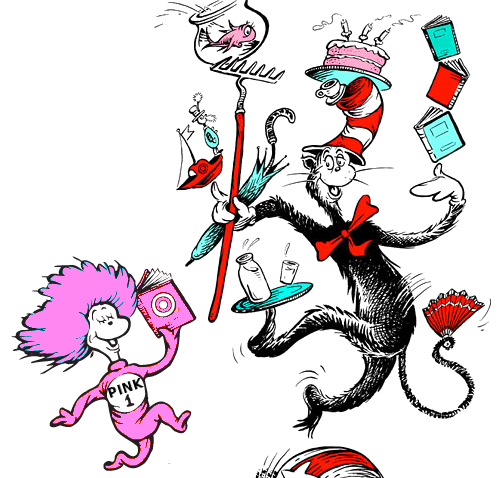
Mitochondrial damage is associated with premature aging in the body and related disorders such as Parkinson’s Disease in the brain. If you want to grow old and healthy … be nice to your mitochondria … eat healthy foods and exercise.
When mitochondria are damaged, cells can use proteolysis to clean them out, but when this cleaning out process fails … trouble ensues. PINK1 plays a role on the clearance of damaged mitochondria as revealed by Dr. Derek P. Narendra and colleagues: PINK1 Is Selectively Stabilized on Impaired Mitochondria to Activate Parkin
Since neurons in the Substantia Nigra are postmitotic, any mitochondrial damage they acquire could accumulate over an organism’s lifetime, leading to progressive mitochondrial dysfunction—including increased oxidative stress, decreased calcium buffering capacity, loss of ATP, and, eventually, cell death—unless quality control processes eliminate the damaged mitochondria.
The findings we report in this paper suggest a new model in which PINK1 and Parkin together sense mitochondria in distress and selectively target them for degradation. In this pathway, PINK1 acts as a flag that accumulates on dysfunctional mitochondria and then signals to Parkin, which tags these mitochondria for destruction. Since disease-causing mutations in PINK1 or Parkin disrupt this pathway, patients with these mutations may not be able to clean up their damaged mitochondria, leading to the neuronal damage typical of parkinsonism.
Dr. Terry Wahls has some very inspiring experiences to share on the topic of mitochondrial care.
Posted in Uncategorized on January 6, 2012| Leave a Comment »
Posted in Uncategorized, tagged ENIGMA, Functional neuroimaging, power calculation, Statistics on January 5, 2012| Leave a Comment »
 Dr. Tal Yarkoni: “Functional MRI in Health Psychology and beyond: A call for caution”
In practice, the modal fMRI sample size of 15 – 20 subjects often provides little power to detect anything but very large effects (Yarkoni, 2009). For example, a one-sample t test performed on 20 subjects at a statistical threshold of p < .001 (the modal threshold in the fMRI literature) has only 40% power to detect even a canonically ‘large’ effect of d = 0.8. For a correlational analysis, the same sample size provides only 12% power to detect an extremely large correlation of r = 0.5.
How many LOW and UNDER-powered imaging genetic studies (where genetic variation is merely one of many variables correlated with individual differences in task or baseline BOLD responses) have I have covered in this blog? Eeeek! I’d better not go there … I’ll go to ENIGMA instead.
[pic cred]
Posted in Uncategorized, tagged executive function, Frontal lobe on January 5, 2012| Leave a Comment »
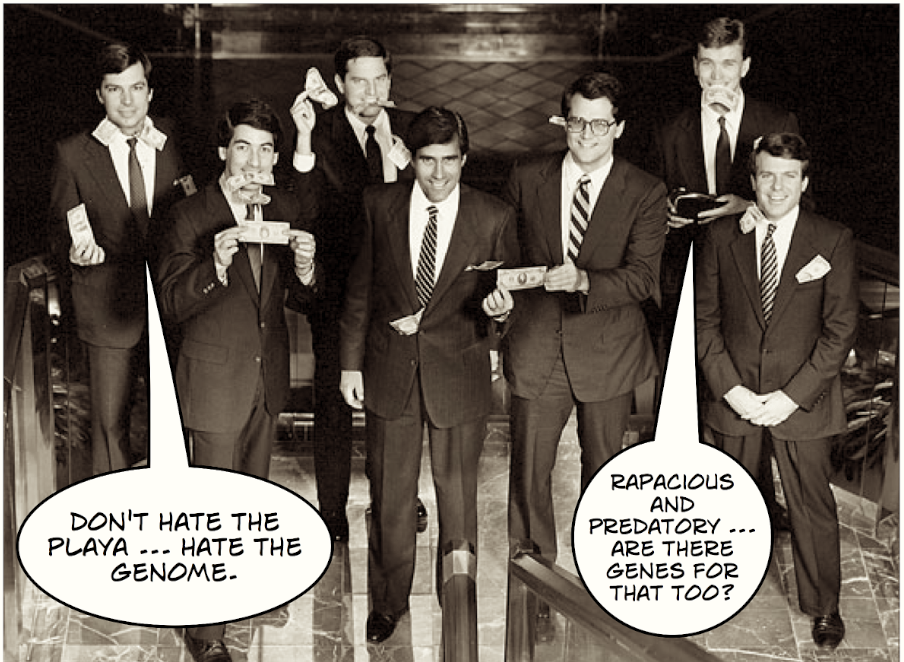
You mean these types of executives? No … well, sort of, maybe. Some people can control their thoughts and actions better than others.
Individuals vary widely in their abilities to control their own thoughts and actions. Some people seem ruled by impulses, while others manage successfully to regulate their behaviors. From the perspective of cognitive psychology, such variation reflects individual differences in executive functions, a collection of correlated but separable control processes that regulate lower-level cognitive processes to shape complex performance.
Results indicated that executive functions are correlated because they are influenced by a highly heritable (99%) common factor that goes beyond general intelligence or perceptual speed, and they are separable because of additional genetic influences unique to particular executive functions. This combination of general and specific genetic influences places executive functions among the most heritable psychological traits.
Posted in SNAP25, Uncategorized, tagged Art, evolution, Frontal lobe on January 4, 2012| Leave a Comment »
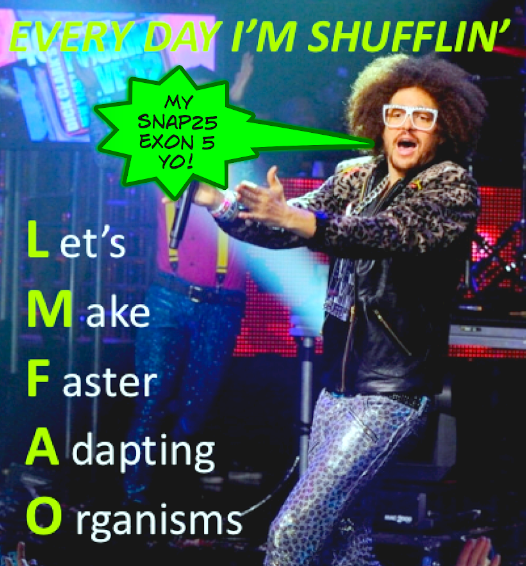
… but you knew that already. Here’s an example of how a phenomenon known as exon shufflin’ can lead to evolutionary diversity (here involving SNAP25‘s exon 5a variant for early brain development while the exon 5b variant is used later in development) . Perhaps we owe our awesome, ahem, “higher” cognitive abilities to this ancient exon duplication … video below notwithstanding.
Posted in Uncategorized, tagged Heritability on January 3, 2012| Leave a Comment »
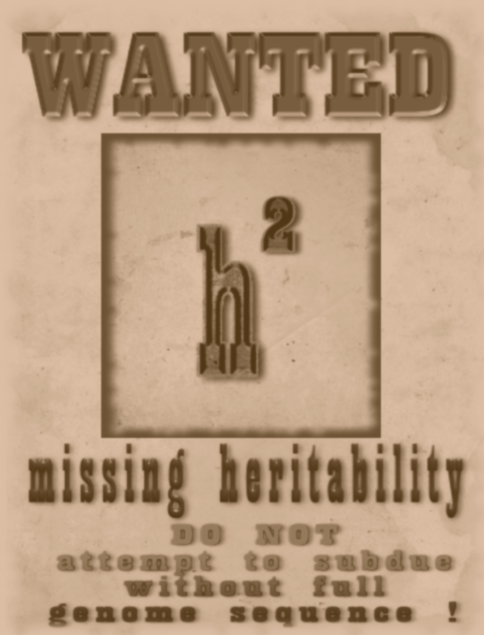
Some call it “phantom heritability” while others call it “dark matter” … whatever … genes are definitely not “beans in a bag” that independently add up to influence development. They interact in complex bio-physical-3D-proteo-ribonucleic-tertiary-etc.-etc. ways.
“Ultimately,” they concluded, “the most important goal for biomedical research is not explaining heritability — that is, predicting personalized patient risk — but understanding pathways underlying disease and using that knowledge to develop strategies for therapy and prevention.” [paper]
Note to self: Abandon any musings of future employment in the “predicting personalized patient risk” business … unless someone comes up with a useful model that helps best fit these interactions.
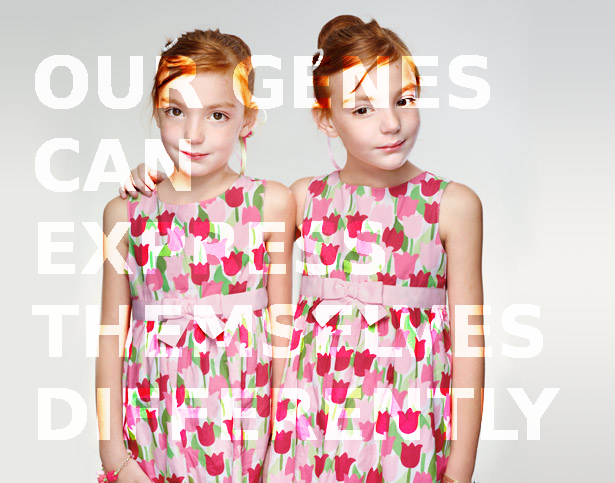
Posted in Uncategorized, tagged Twin on January 3, 2012| Leave a Comment »
Posted in Uncategorized, tagged Art on December 23, 2011| Leave a Comment »





 Genes 2 Brains 2 Mind 2 Me