Just echoing the recent story of an Italian court that decided to shorten – by 1 year – the sentence of a defendant convicted of murder, based on genetic and brain imaging data. Here is a previous post and podcast link covering some of the issues on this topic.
Posted in Uncategorized | Tagged justice, law, legal, Supreme Court | Leave a Comment »
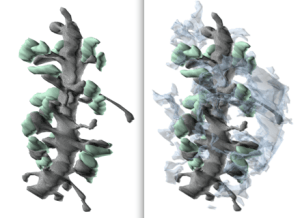 If you compare the left panel to the right panel, you’ll see a dendrite (grey) with dendritic spines (green) on the left-side and then, on the right-side, these spines enveloped by the membrane of an astrocyte (white). These images were obtained from synapse-web.org who use a method known as 3D reconstruction of serial section electron microscopy – or something like that – to better understand what types of structural factors underlie normal and abnormal synaptic function. What is so amazing to me are the delicate ruffles of the astrocyte membrane that seem to want to ensheath each spine. Was any organelle so gently and well cared for? Perhaps not. These are dendritic spines afterall – the very structures that form synaptic contacts and process the neural signals – that allow us to think and function.
It turns out that astrocytes not only seem to care for dendritic spines, but also provide the essential signal that initiates the sprouting of neuronal spines in the first place. As covered in their recent paper, “Gabapentin Receptor α2δ-1 Is a Neuronal Thrombospondin Receptor Responsible for Excitatory CNS Synaptogenesis” [doi:10.1016/j.cell.2009.09.025] Eroglu and colleagues report the discovery – in mice – of CACNA2D1 the alpha-2/delta-1 subunit of the voltage-dependent calcium channel complex encodes a protein that binds to thrombospondins (humans have THBS1 and THBS2) which are adhesive glycoproteins that mediate cell-to-cell and cell-to-matrix interactions – and are required for the formation of new dendritic spines. When neurons are cultured in the absence of thrombospondins, they fail to produce new spines and mice that do not make thrombospondins do not make very many excitatory synaptic spines.
The interesting twist to me is that thrombospondins are secreted solely by astrocytes! The newly identified CACNA2D1 receptor – as revealed by Eroglu et al., – binds to the EGF-repeats of thrombospondin and initiates a signalling cascade that results in the sprouting of new – silent – dendritic spines. Gabapentin, a drug that is prescribed for seizures, pain, methamphetamine addiction and many other mental health conditions appears to bind to CACNA2D1 and interfere with the binding of thrombospondin and also inhibits the formation of new spines in vitro as well during the development of somatotopic maps in the mouse whisker barrel cortex.
This seems to be an important discovery in the understanding of how cognitive development unfolds since much of the expression of thrombospondin and its effects on synaptogenesis occur in the early postnatal stages of development. I will follow this thread in the months to come.
![Reblog this post [with Zemanta]](https://i0.wp.com/img.zemanta.com/reblog_c.png)
Posted in CACNA2D1, THBS1, THBS2 | Tagged CACNA2D1, Chemical synapse, Dendrite, Dendritic spine, Development, gabapentin, Neuron, neurontin, synaptogenesis, Voltage-dependent calcium channel | Leave a Comment »

- Image by shehal via Flickr
“A devil, a born devil, on whose nature
Nurture can never stick; on whom my pains,
Humanely taken, all, all lost, quite lost
And as with age his body uglier grows,
So his mind cankers.”
So says the wizard Prospero about the wretched Caliban in Shakespeare’s The Tempest (Act IV, Scene I, lines 188 – 192). Although Shakespeare was not a neuroscientist (more to his credit!), his poignant phrase, “on whose nature, Nurture can never stick” strikes the very core of the modern debates on the role of genes and personal genomes, and perhaps reminds us that our human experience is delicately balanced amidst the interaction of genes and environment.
Among the some 20,500 genes in the human genome (yes, this is the latest estimate from Eric Lander this past weekend) one particularly amazing gene stands out. CACNA2D1 the alpha-2/delta-1 subunit of the voltage-dependent calcium channel complex (which also binds to the widely-prescribed drug Gabapentin) encodes a protein who, in conjunction with other related subunits, forms a calcium channel to mediate the influx of calcium ions into neurons when membrane polarization occurs. In the recent article, “Gabapentin Receptor α2δ-1 Is a Neuronal Thrombospondin Receptor Responsible for Excitatory CNS Synaptogenesis” [doi:10.1016/j.cell.2009.09.025] Eroglu and colleagues reveal that this single gene – initiates the development of synapses – the dynamic structures whose ever changing interconnections make us who we are – that allow “nurture to stick” as it were.
More on the biology of CACNA2D1 and its interactions with its ligand – Thrombospondins – to come.
Posted in CACNA2D1 | Tagged Brain, Development, gabapentin, Genetics, Human genome, neurontin, synaptogenesis, Tempest | Leave a Comment »
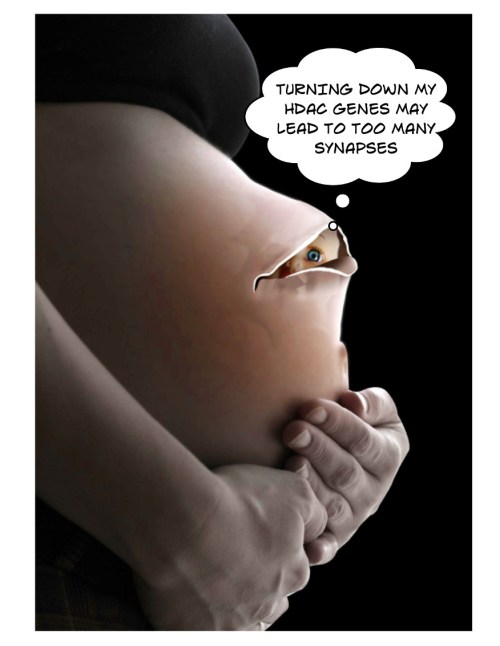
Posted in Uncategorized | Tagged Art, meme-art | Leave a Comment »

- Image via Wikipedia

File this story under “the more you know, the more you don’t know” or simply under “WTF!” The new paper, “Microduplications of 16p11.2 are associated with schizophrenia” [doi:10.1038/ng.474] reveals that a short stretch of DNA on chromosome 16p11.2 is – very rarely – duplicated and – more rarely – deleted. In an analysis of 8,590 individuals with schizophrenia, 2,172 with developmental delay or autism, 4,822 with bipolar disorder and 30,492 controls, the the microduplication of 16p11.2 was strongly associated with schizophrenia, bipolar and autism while the reciprocal microdeletion was strongly associated with developmental delay or autism – but not associated with schizophrenia or bipolar disorder.
OK, so the title of my post is misleading (hey, its a blog) since there are clearly many additional factors that contribute to the developmental outcome of autism vs. schizophrenia, but this stretch of DNA seems to hold clues about early development of brain systems that go awry in both disorders. Here is a list of the brain expressed genes in this 600 kbp region (in order from telomere-side to centromere-side): SPN, QPRT, C16orf54, MAZ, PRRT2, C16orf53, MVP, CDIPT, SEZ6L2, ASPHD1, KCTD13, TMEM219, TAOK2, HIRIP3, INO80E, DOC2A, FLJ25404, FAM57B, ALDOA, PPP4C, TBX6, YPEL3, GDPD3, MAPK3, CORO1A.
Any guess as to which one(s) are the culprits? I’ll go with HIRIP3 given its role in chromatin structure regulation – and the consequent regulation of under- (schiz?)/over- (autism) growth of synapses. What an amazing mystery to pursue.
Posted in Chromosome structural variants | Tagged autism, Bipolar disorder, Brain, Development, DNA, Gene expression, Mental disorder, Mental health, Mood, schizophrenia | 1 Comment »

- Image by Oliver Lavery via Flickr
Daniel R. Weinberger, M.D., Chief of the Clinical Brain Disorders Branch and Director of the Genes, Cognition and Psychosis Program, National Institute of Mental Health discusses the background, findings and general issues of genes and mental illness in this brief interview on his paper, “A primate-specific, brain isoform of KCNH2 affects cortical physiology, cognition, neuronal repolarization and risk of schizophrenia”. Click HERE for the podcast and HERE for the original post.
Thanks again to Dr. Weinberger for his generous participation!
![Reblog this post [with Zemanta]](https://i0.wp.com/img.zemanta.com/reblog_e.png)
Posted in Uncategorized | Tagged Development, evolution, Frontal lobe, Gene expression, Genetic testing, Mental health, Podcast, schizophrenia | Leave a Comment »

Posted in Uncategorized | Tagged Art, meme-art | Leave a Comment »
Posted in Uncategorized | Tagged Art, meme-art, synaptogenesis | Leave a Comment »
“Methland: The Death and Life of an American Small Town” by Nick Reding is a closer look at the rise of illicit methamphetamine use that grew along socio-economic fault-lines propagated by the rise of financial capitalism and deregulation beginning in the late 1970’s. Now 30 years later, there is no end in sight for the worlds most addictive home-grown drug that continues to ensnare millions of lives and render our closely held ideal of “small town life” an empty myth. So go small towns all across America into the darkness – where politicians cater to corporate behemoths who they fear as too big to fail or just as likely to offshore to lower wage economies. An eye-opening and heartbreaking documentary of how an addictive drug can highlight the socio-economic and political failures of a society.
Posted in Uncategorized | Tagged Book Reviews, Capitalism, Drug addiction, economics, Methamphetamine, Too Big to Fail policy | 1 Comment »
 Hey, why should neurons get all the adulation – you know – like an organization with 40,000 members complete with an annual fest in exotic locales? After all, glial cells outnumber neurons many-fold and a single astrocyte can ensheath and support many hundreds of neurons. Perhaps it may be that who gets top billing may not be so much an issue of who is more important, but just a matter of who is better known (its who you know in life that matters right?).
These were my thoughts at the start of Professor Ben A. Barres’ talk, “What do Glial Cells Do?” which I greatly enjoyed today. One of the key things glia do, it turns out, is to help neurons form new synapses. This can be shown by culturing astrocytes and then applying the conditioned media to rat ganglion cells – who respond by making new postsynaptic densities and also increasing the externalization of AMPA receptors. The mediator of this process was identified as thrombospondin – a molecule that is secreted by astrocytes and binds, via its EDF-repeat domain, to a neurally expressed molecule known as alpha-2-delta-1 calcium channel subunit which signals in an integrin-like manner to initiate the formation of excitatory synapses. A few other highlights from the talk were:
-thrombospondin is the gene which is MOST upregulated in expression when human vs. monkey brain mRNA levels are compared.
-the synapse-inducing effects of astrocytes work only in immature astrocytes and injured/reactive astrocytes, but not mature ones.
-overexpression of the alpha-2-delta-1 calcium channel subunit can induce synapse formation.
-some medications such as gabapentin/neurontin bind to the alpha-2-delta-1 calcium channel subunit and can actually interfere with the new synapse formation – red flagging these meds for use during pregnancy and in children
-there is a metal-binding domain in alpha-2-delta-1 calcium channel subunit which may – possibly – be a target for lead binding and be a reason for why small amounts of exposure to lead can lead to mental retardation
Another highlight of the talk was Professor Barres brief personal comments on the importance of gender and cultural diversity in the practice of science. I was impressed by his warm and supportive remarks to students who may be concerned about diversity and discrimination in the field of science. Check out his wikipedia page for more.
Posted in Uncategorized | Leave a Comment »

Todays session, “Synaptic Receptor and Regulation” has been a wonderful overview of a great diversity of synaptic components. Across the talks, it is abundantly clear that synaptic proteins – particularly those located in the post-synaptic density (PSD) are over-represented in mental and developmental disorders. Hence, it is clear that understanding how these proteins work will help understand brain-related illness. Another common theme is that most of the proteins discussed so far seem to interact via a common latticework of proteins such as PSD95 and gephrin which are prone to polymerize in ways that provide a scaffold for ion channels and other receptors that intitiate action potentials. Hence, it seems that 3-D structure IS function when talking about synapses. Just a smattering of highlights for me were:
-amazing 3-D tomographic reconstructions of the PSD
-protein palmitoylation is necessary for proper spine formation (perhaps because ras & rho use such modifications during signalling?)
-that a conformational change in collybistin upon binding with neuroligins is what promotes the clustering of ion channels
-a failure to stabilize AMPA receptors is an underlying cause of mental retardation
-the localization of synapses in the axon initial segment is regulated by neurofascin – which is expressed just there in that very tiny aspect of a neuron!
-beautiful 3-D reconstructions of dentrites, spines and astrocytes entwined together and also detailed freeze-fracture replica images of AMPA receptor localization (clustered in the center of the active zone) and NMDA channels (more diffusely spaced)
-the dishevelled gene (the mouse knockout has a behavioral phenotype) regulates AcH receptor localization in c. elegans.
-red hot chilli pepper spice (a.k.a. capsaicin) is actually able to cause AMPA receptors to internalize and depress neural activity.
-the PSD is highly conserved in vertebrates and has very ancient evolutionary roots as far back as our common ancestor with yeast! yet the most divergent genes are those involved in neural development.
-still trying to figure out what “the calyx of held” is … more on that later … blasted wifi here
Posted in Uncategorized | Leave a Comment »
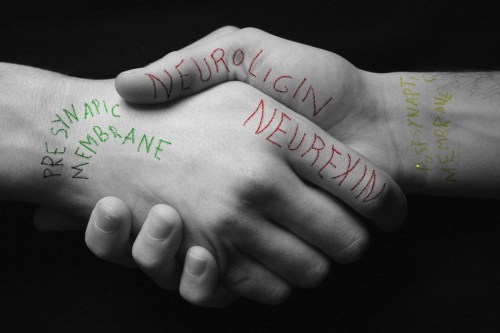
While most presentations at SfN cover brief snippets of research, yesterday it was a delight to hear the story of neurexins and neuroligins – the whole, decades worth of research, story – from Professor Thomas Sudhof, whose lab has been responsible for the purification and biochemical characterization of these proteins. Without re-telling the tale here, a few neat highlights about these proteins who form a transynaptic bridge with neurexins on the pre-synaptic membrane binding to neuroligins on the post-synaptic membrane:
-neurexins were first purified using alpha-latrotoxin (a.k.a black widow venom!)
-there are thousands of spice variants of a single neurexin gene and these have rather specific affinities for different splice variants of neuroligins (how are these splicing events regulated to ensure the right pairs find each other?)
-the mere act of ectopic expression of neuroligins is sufficient induce the formation of synapses in neuronal cell lines – however this will not happen if the neuroligin is missing its neurexin binding domain. Apparently, different neuroligin genes confer the formation of different types of inhibitory vs. excitatory synapses.
-interestingly, the deletion of any pair of the 3 (NL1,2,3) neuroligin genes has little effect – albeit for a few subtle social behavior phenotypes in mice. Deletion of all 3 of the NL genes is lethal.
-In humans, mutations in neuroligins such as R87W and R451C are associated with autism spectrum disorder. Apparently, these mutations do not fold properly and do not make it to the cell surface.
-The R451C mutation, when expressed in a mouse leads to more inhibitory synapses in the cortex and more excitatory synapses in the hippocampus. The mice are BETTER able to learn/unlearn the water-maze paradigm but show subtle social affiliation phenotypes.
-There are a number of other mutations in genes that interact with the neurexins and neuroligins that are also associated with mental disability, suggesting that the proper regulation of synaptic organization and excitatory/inhibitory balance is a key aspect of optimal mental function.
Posted in Uncategorized | Tagged autism, Autism spectrum | Leave a Comment »
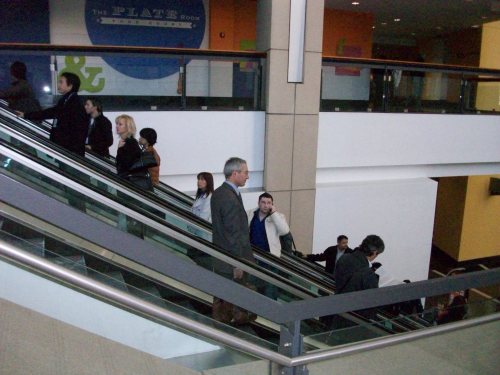 Happened to snap this pic of Thomas Insel, Director of NIMH this morning. I couldn’t help wonder what he might have been thinking.
“Sheese, my institute pays a bundle for this, and even I can’t find a bite to eat?”
Just wondering.
Posted in Uncategorized | Leave a Comment »
Should I take the shuttle bus or the Metra? Should I go to the big lecture or the smaller talk? Do I eat McD’s on level 2 or do I head off-site and take my chances? Lately it seems, these are the really big questions – in addition to the usual ones about how brains work and how they give rise to minds. But just what’s going on under the hood when you are weighing your options (McD’s vs. off-site eating turns out to be a false choice or Hobson’s choice as I discovered today)?
A number of fantastic insights were offered at today’s session on Basic Decision-Making Mechanisms. These speakers were fond of systems-level analyses and seemed most interested in patterns of brain activity that are correlated with performance on decision-making tasks. Not surprisingly, there are a number of such correlates, many, it seems, residing in the lateral and medial frontal cortex. What do these correlates do? and how, exactly, do they function to help me make the right decisions (sadly, this would be McD’s). J.T. McGuire from Princeton University showed interesting patterns of activity in ventral temporal lobes and suggested that one interpretation of these correlates was that frontal networks are regulators of circuits that carry out earlier stages of processing. P. Stiers from Maastricht University showed that there are a common set of frontal brain areas that co-activate across several executive function and decision-making tasks – and also that these regions show high functional connectivity regardless of tasks. Perhaps this suggests a pre-wired neural network – or at least a consortia of networks – as one question from the audience pointed out. In some individuals, lesions can impair decision-making and C. Azuar from the Centre de Recherche de l’Institut du Cerveau et de la Moelle épinière, La Pitié Salpêtrière Hospital in Paris revealed that these lesions tend to reside in the same frontal areas that are activated when healthy volunteers perform decision-making tasks – a finding that supports the “cascade model” of decision-making. Lastly, I enjoyed the presentation by J.J. Yoo of MIT who asked if real-time analysis of brain activations can be used to influence decisions or at least facilitate better memory of scenes. Are there brain states that predict better memory encoding? Her team focused the parahippocampal place area, where higher activity had been associated with better memory encoding, and then presented stimuli to subjects only when they were in a “good” brain state vs. “bad” brain state. This manipulation improved recall from 15% when in the “bad state” up to 22% recall when stimuli were presented to subjects when they were in the “good state”. Wow! Mind reading is for real.
Just think, at SfN 2029, we can have our brains scanned BEFORE deciding where to go for lunch!
Posted in Uncategorized | Leave a Comment »

Phrenological thinking, a popular pseudoscientific practice in the 1800’s suggested that the structure of the head and underlying brain held the clues to understanding human behavior. Today, amidst the ongoing convergence of developmental science, molecular & biochemical science and systems-dynamical science (to name just a few), there is – of course – no single or agreed-upon level of analysis that can provide all the answers. Circuit dynamics are wonderfully correlated with behavior, but they can be regulated by synaptic weights. Also, while developmental studies reveal the far reaching beauty of neuronal circuitry, such elegant wiring is of little benefit without healthy and properly regulated synaptic connections. Genes too, can be associated with circuit dynamics and behavior, but what do these genes do? Perchance encode proteins that help to form and regulate synapses? Synapses, synapses, synapses. Perhaps there is a level of analysis – or a nexus – where all levels of analysis intersect? What do we know about synapses and how these essential aspects of brain function are formed and regulated?
With this in mind I’ve been exploring the nanosymposium, “Molecular Dynamics and Regulation at Synapses” to learn more about the latest findings in this important crossroads of neurobiology. If you’re like me, you sort of take synapses for granted and think of them as being very tiny and sort of generic. Delve a while into the material presented at this symposium and you may come to view the lowly synapse – a single synapse – as a much larger, more complex, ever changing biochemical world unto itself. The number of molecular players under scrutiny by the groups presenting in this one session is staggering. GTPase activating proteins, kinases, molecular motors, receptors, proteases, cell adhesive proteins, ion channels and many others must interact according to standard biochemical and thermodynamic laws. At this molecular-soup level, it seems rather miraculous that the core process of vessicle-to-cell membrane fusion can happen at all – let alone in the precise way needed to maintain the proper oscillatory timing needed for Hebbian plasticity and higher-level circuit properties associated with attention and memory.
For sure, this is one reason why the brain and behavior are hard to understand. Synapses are very complex!
Posted in Uncategorized | Tagged Brain, Chemical synapse, Development, Genetics, Human behavior, Neuron, Psychology, synapse, synaptic plasticity | 1 Comment »
 In 13th century India, the story was originally told of a group of blind men (or men in the dark) who touch an elephant to learn what it is like. Each one touches a different part, but only one part, such as the side or the tusk. They then compare notes on what they felt, and learn they are in complete disagreement.
With this ancient story in mind, I’d like to introduce you to the annual conference of the Society for Neuroscience, or SfN, where brain enthusiasts across the globe gather for 5 days to compare notes – not on an elephant – but on something more massive – the brain and mind. The vast complexities of neural development and communication will be shared amongst some 31,000+ participants in an effort to integrate findings from molecular to neural physiology to systems dynamics to behavior and find some agreement on one of the all-time great biological mysteries.
As but a single humble molecular/cognitive/neuro/blogger, I will do my best to focus specifically on stories and highlights that address the dilemma of the bind men and the elephant and look for stories that interlink different levels of analysis and help integrate data and models across different levels of analysis. I am fascinated by the way in which data from molecular levels of analysis can be interlinked with synaptic and systems levels of analysis and so hope to relate some of these interconnections with my readers.
You can readily follow the action at this years gathering using the fantastic organizational, informatic tools on the SfN meeting planner. There are a number of resources to support neuro-bloggers and theme-specific neuro-tweeters. Also, DrugMonkey has a growing list of other SfN tweeters/bloggers. The real-time flow on Twitter #sfn09 as well as #sfnthemea & (b,c,d,e, and the notorious h) is already amazing !!
Please join the fray and share your thoughts with the SfN community! See you in Chicago.
Posted in Uncategorized | Tagged hashtags, Neural development, Neural network, Society for Neuroscience | 1 Comment »

Posted in Uncategorized | Tagged Art, meme-art | Leave a Comment »
Remarks
Re-Tweetin’
Tweets by genes2brains2meBlog Stats
- 192,027 clickitas
Posting since April 2007
General topics
23andMe Addiction Add new tag aging Anxiety Art Arts autism B. K. S. Iyengar Biology Brain Buddism Central nervous system Cognition comics Consciousness Depression Development DNA Dopamine dualism economics Emotion Empathy Epigenetics evolution fear Frontal lobe Functional magnetic resonance imaging Gene Gene expression Genetics Genetic testing GWAS Health Health care Health insurance Hippocampus History Intelligence Kundalini language Major depressive disorder medication Meditation meme-art Memory Mental disorder Mental health Mind Mutation Nervous system Neural network Neuron Pain parasympathetic nervous system Patañjali Personalized medicine philosophy placebo Psychology Reactive oxygen species Religion and Spirituality Rett Syndrome schizophrenia Social Sciences spirituality Stem cell Stress Suicide synaptogenesis Teachers and Centers Twin Yoga Yoga Sutras of PatanjaliSpecific Items
- 5HTT
- ABCB1
- acetylcholine
- Actin
- ACTN3
- ADH1C
- ADORA2A
- ADRA2A
- AKT
- AMPA receptor
- Amygdala
- Angular gyrus
- ANK3
- APOE
- ARHGAP18
- ASIC1a
- ASPM
- ATXN1
- AVPR1a
- BAF53b
- Basal Ganglia
- BDNF
- CABYR
- CACNA1C
- CACNA2D1
- Caudate nucleus
- CB1 receptor
- CDC34
- CDH13
- Cell adhesion molecules
- Cerebellum
- CHAT
- CHRM3
- CHRNA4
- CHRNA7
- Chromosome structural variants
- Cingulate cortex
- Circadian
- clinical trial
- CNR1
- CNTNAP2
- Collateral sulcus
- COMT
- Corpus callosum
- COX1
- CREB
- CRHR1
- DARPP32
- DAT
- default network
- DISC1
- DLPFC
- DNAJC
- DNMT
- Dopamine
- DPP4
- DRD2
- DRD4
- DTNBP1
- DYRK1A
- EDA2R
- EGR1
- Estrogen
- evolution
- FGF20
- FMR1
- FNBP1L
- FOXA2
- FOXP2
- Frontal cortex
- Frontal pole
- Fusiform gyrus
- G-protein
- GAB2
- GABA
- GABRA2
- GABRG1
- GATA4
- Glucocorticoid receptor
- Glutamate
- GPR6
- GRIA3
- GRIK2
- GTPase
- HDACs
- Hippocampus
- HOXB8
- HRK
- HTR2A
- Hypothalamus
- IL3
- immunity
- Inferior frontal gyrus
- Insula
- Intronic or repetitive sequences
- Kalirin
- KCNA2
- KCNH2
- KCNIP3
- KCNJ6
- Kinesin
- Lateral septum
- Lateral ventricle
- LDB1
- Leptin
- LIMK1
- Locus coeruleus
- MAOA
- MAPK
- MCPH1
- MCR1-4
- MDGA2
- MECP2
- meditation
- MET
- metabolism
- MHC loci
- microRNA
- Middle frontal gyrus
- middle occipital gyrus
- Middle temporal gyrus
- Mindfulness
- Mitochondria
- MKP-1
- Motor cortex
- Myelin
- Neural crest
- NEUROG1
- NLGN3/4
- Noradrenaline
- NPBWR1
- NPSR1
- NRG1
- NRXB1
- NTRK2
- Nucleus accumbens
- NURR1
- Olfactory bulb
- OPRM1
- Orbitofrontal cortex
- OTR
- OXTR
- Parahippocampal gyrus
- Parasympathetic NS
- Parietal cortex
- PARP-1
- PAX6
- PCLO
- PER1
- PINK1
- PLCB1
- Posterior parietal cortex
- PSD95
- Putamen
- quantum physics
- RARB
- RGS2
- RGS4
- Rho GTPase
- RLN
- ROR1
- RORB
- Rostral fronto-occipital fasciculus
- RSRC1
- SAPAP3
- self-awareness
- SEMA(1-7)
- SETDB1
- SEZ6
- SIRT1
- SLC1A1
- SLITRK1
- SNAP25
- SNORD115
- SNRPN
- SOD2
- Somatosensory cortex
- SRPX2
- Stria terminalis
- Striatum
- Substantia nigra
- Subthalamic nucleus
- Superior temporal cortex
- Suprachiasmatic nucleus
- Supramarginal gyrus
- SWI/SNF
- Sylvian fissure
- Telomere
- Temporal lobe
- TGF-alpha
- TH
- Thalamus
- Thap1
- THBS1
- THBS2
- TNF-alpha
- Torsin A
- TPH2
- UBE3A
- UGT2B17
- Uncategorized
- Vagus
- VEGF
- Ventral tegmental area
- VGF
- Visual cortex
- White matter
- Yoga and Meditation
- ZNF804A


 Genes 2 Brains 2 Mind 2 Me