Feeds:
Posts
Comments

Posts Tagged ‘Neuron’

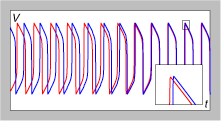
FTM_phase_locking_v4_0**PODCAST accompanies this post** In the brain, as in other aspects of life, timing is everything.  On an intuitive level, its pretty clear, that, since neurons have to work together in widely distributed networks, they have a lot of incentive to talk to each other in a rhythmic, organized way. Think of a choir that sings together vs. a cacophony of kids in a cafeteria – which would you rather have as your brain? A technical way of saying this could be, “Clustered bursting oscillations, with in-phase synchrony within each cluster, have been proposed as a binding mechanism. According to this idea, neurons that encode a particular stimulus feature synchronize in the same cluster.”  A less technical way of saying this was first uttered by Carla Shatz who said, “Neurons that fire together wire together” and “Neurons that fire apart wire apart“.  So it seems, that the control over neural timing and synchronicity – the rushing “in” of Na+ ions and rushing “out” of K+ ions that occur during cycles of depolarization and repolarization of an action potential take only a few milliseconds – is something that neurons would have tight control over.

With this premise in mind, it is fascinating to ponder some recent findings reported by Huffaker et al. in their research article, “A primate-specific, brain isoform of KCNH2 affects cortical physiology, cognition, neuronal repolarization and risk of schizophrenia” [doi: 10.1038/nm.1962].  Here, the research team has identified a gene, KCNH2, that is both differentially expressed in brains of schizophrenia patients vs. healthy controls and that contains several SNP genetic variants (rs3800779, rs748693, rs1036145) that are associated with multiple different patient populations.  Furthermore, the team finds that the risk-associated SNPs are associated with greater expression of an isoform of KCNH2 – a kind of special isoform – one that is expressed in humans and other primates, but not in rodents (they show a frame-shift nucleotide change that renders their ATG start codon out of frame and their copy non-expressed).  Last I checked, primates and rodents shared a common ancestor many millenia ago. Very neat – since some have suggested that newer evolutionary innovations might still have some kinks that need to be worked out.

In any case, the research team shows that the 3 SNPs are associated with a variety of brain parameters such as hippocampal volume, hippocampal activity (declarative memory task) and activity in the dorsolateral prefrontal cortex (DLPFC). The main suggestion of how these variants in KCNH2 might lead to these brain changes and risk for schizophrenia comes from previous findings that mutations in this gene screw up the efflux of K+ ions during the repolarization phase of an action potential.  In the heart (where KCNH2 is also expressed) this has been shown to lead to a form of “long QT syndrome“.  Thus, the team explores this idea using primary neuronal cell cultures and confirms that greater expression of the primate isoform leads to non-adaptive, quickly deactivating, faster firing patterns, presumably due to the extra K+ channels. 

The authors hint that fast & extended spiking is – in the context of human cognition – is thought to be a good thing since its needed to allow the binding of multiple input streams.  However, in this case, the variants seem to have pushed the process to a non-adaptive extreme.  Perhaps there is a seed of an interesting evolutionary story here, since the innovation (longer, extended firing in the DLPFC) that allows humans to ponder so many ideas at the same time, may have some legacy non-adaptive genetic variation still floating around in the human lineage.  Just a speculative muse – but fun to consider in a blog post.

In any case, the team has substantiated a very plausible mechanism for how the genetic variants may give rise to the disorder.  A scientific tour-de-force if there ever was one.

On a personal note, I checked my 23andMe profile and found that while rs3800779 and rs748693 were not assayed, rs1036145 was, and I – boringly – am a middling G/A heterozygote.  In this article, the researchers find that the A/As showed smaller right-hippocampal grey matter volume, but the G/A were not different that the G/Gs.  During a declarative memory task, the GGs showed little or no change in hippocampal activity while the AA and GA group showed changes – but only in the left hippocampus.  In the N-back task (a working memory task), the AA’s showed more changes in brain activation in the right DLPFC compared to the GGs and GAs.

For further edification, here is a video showing the structure of the KCNH2-type K+ channel.  Marvel at the tiny pore that allows red K+ ions to leak through during the repolarization phase of an action potential.   **PODCAST accompanies this post**

Reblog this post [with Zemanta]

Read Full Post »

Just stumbled onto this great educational resource ….

From an article that describes NERVE:

We’ve Got NERVE: A Call to Arms for Neuroscience Education
Kyle J. Frantz, Colleen D. McNerney and Nicholas C. Spitzer
“Are we neuroscientists doing our part to help revive science education, to stimulate teachers’ ingenuity, and diversify the intellectual capital among the next generation of scientists? Certainly we support progressive initiatives, including a major international Brain Awareness Campaign, local chapter grants for Society for Neuroscience (SfN) members, and activist committees for media relations, but are we doing enough? To enable neuroscientists worldwide to step out of the laboratory or office periodically to visit nontraditional neuroscience education venues, the Society for Neuroscience Public Education and Communication Committee has launched NERVE, the Neuroscience Education Resources Virtual Encycloportal (Fig. 1). This web-based compendium of teaching materials went live in September 2008 and has already received >10,000 visits from >100 countries around the globe. NERVE’s offerings are many: videos to stimulate discussion at town hall meetings, lesson plans for visits to local schools, and hands-on activities to break up long lectures, just to name a few. Regardless of the topic or venue, NERVE aims to meet our neuroscience education needs.”

The Journal of Neuroscience, March 18, 2009, 29(11):3337-3339; doi:10.1523/JNEUROSCI.0001-09.2009

Read Full Post »

Drawing of Purkinje cells (A) and granule cell...
Image via Wikipedia

If you like gardening, the doldrums of winter can be dreary indeed. Although I’d never admit to it, my neighbors might swear to having seen me outside strangely (pathetically) counting the number of branches on my icicle-laden roses and rhododendrons.  In any case, I do admit to spending way too much time forlornly staring at my garden from the window while fantasizing about all the things I’ll plant come springtime.

Each new branch brings a new burst of color and fragrance and concomitant joy.  A good thing right ?  Similarly, each neuron in the brain – which look just like little trees with branches – should also strive to send out as many new branches and make new synaptic connections.  Afterall, there are brain disorders associated with a loss of or fewer dendrites, such as Down’s syndrome and schizophrenia. More branches, more synapses, more brain power and concomitant joy ? Well, perhaps not quite.

A gene known as seizure-related gene 6 (sez6) which is expressed in the developing brain as well as in response to environmental stimulation, seems to play a role in limiting the the number of branches that a neuron can send out.  Gunnersen and colleagues [doi: 10.1016/j.neuron.2007.09.018] show that mice that carry an inactivated version of sez6 show more dendritic branches (implying that the normal function of the active gene is to inhibit branch formation), and that this is definitely not a good thing.  These sez6(-/-) mice, while looking rather indistinguishable from their normal littermates, did not perform as well on tasks involving motor control, memory and emotional sensitivity (implying that having too many branches may not be so beneficial).  In humans, a frameshift mutation involving an insertion of a C residue at position 1435 of the cDNA is associated with febrile seizures, similarly suggesting that dendritic overload can have negative effects on human brain function.

Clearly, the human brain seeks a balance between too many and too few dendritic branches.  I suppose most experienced gardeners would also agree that too many branches is not desirable.  Perhaps they are right.  However, I don’t think I’d mind much if plants came with an analogous sez6 mutation !

Reblog this post [with Zemanta]

Read Full Post »

Gut of an USB DriveImage by pchow98 via Flickr One of the cool things about the brain & one of the ways in which it differs markedly from our current computer systems is that cells and synapses are living dynamic entities that grow and sprout new connections in response to experience. Since the 1980’s studies using protein synthesis inhibitors have shown that protein synthesis is necessary for an organism to store, recall and re-store, etc. various aspects of memory. The question for some time has been, “well, what protein(s) exactly ?” In their paper entitled, “ERK-dependent PSD-95 induction in the gustatory cortex is necessary for taste learning, but not retrieval” [DOI:10.1038/nn.2190], Elkobi et al., examine the role of PSD-95 a sort of general purpose scaffolding protein expressed in post-synaptic membranes that anchors the many molecular components that make up the synaptic machinery. They show that PSD-95 is indeed upregulated in the rat gustatory cortex after exposure to a novel stimulus (flavor) and that when it is selectively down-regulated via lentiviral expressed siRNA, that the creation of long term memories was disrupted. Interestingly, the paper shows a 3-hr time lag in the induction of PSD-95 after exposure to the memorable stimulus. Wow, that means I have 3 hours to selectively block long-term memories … I wonder what would be worth not remembering ?

Reblog this post [with Zemanta]

Read Full Post »

Fred Sanford
Image by Thomas Hawk via Flickr

Mouse models of complex neurological illness are a powerful means to dissect molecular pathways and treatment paradigms. Current mouse models for the tremors and movement difficulties seen in Parkinson disease include genes such as parkin, alpha-synuclein, LRRK2, PINK1 and DJ-1. These models however, do not show the motor control problems and spontaneous degeneration of dopamine neurons as seen in PD in human patients. A new mouse model as reported by Kittappa and colleagues, unlike previous models, does, however, show amazing verisimilitude to PD. In their paper, “The foxa2 Gene Controls the Birth and Spontaneous Degeneration of Dopamine Neurons in Old Age(DOI) the authors find that mice with only a single copy of the foxa2 gene acquire motor deficits and a late-onset degeneration of dopamine neurons. The age-related spontaneous cell death preferentially affects dopamine producing neurons in the substantia nigra that are affected in PD. The link between genetic risk and environmental exposure to oxidative toxins, a known risk factor in PD, is remarkably straightforward as foxa2 appears to be a regulator of superoxide dismutase, a potent protective scavenger of damage-inducing free radicals. More amazingly still, the authors demonstrate that foxa2 plays a key role in the birth of dopamine neurons – thus opening up new therapeutic possibilities of simultaneously producing new neurons and blocking apoptotic death of old ones. This fox brings new hope for treatment !

Reblog this post [with Zemanta]

Read Full Post »

Neuron of fetal origin in the maternal brainImage by koolkao via Flickr Damage to the human brain, ie. loss of cells due to programmed or non-programmed cell death is presently considered to be an irreversible fate. Many a skilled neurosurgeon can place new neurons or stem cells into damaged areas, but that does little good unless those cells are able to sprout new axons and dendrites that migrate outward – sometimes very long distances – and make the proper synaptic connections and re-establish functional neural networks. Presumably, the instructions that tell a cell where, and how far to go, and whom to synapse with when you get there, are a mix of autonomous and pre-programmed genetic instructions but also environmentally determined (turn left when you see the McDonald’s at the globus pallidus). Kelsch and team, in their open-access paper, “Distinct Mammalian Precursors Are Committed to Generate Neurons with Defined Dendritic Projection Patterns(DOI) show that, for a certain type of neuron at least, the instructions are pre-programmed. The research team found that granule cell precursor cells in a part of the mouse brain called the olfactory bulb, show distinct patterns of where dendritic trees connect with other cells – in either deep layers of the cortex or superficial layers. These cells maintain their layer-specific patterns of dendritic connectivity even after transplantation suggesting that all the instructions needed are contained within the nucleus of the cell. Further understanding of the specific genetic instructions contained therein opens new roadways for the repair of brain damage.

Reblog this post [with Zemanta]

Read Full Post »

One of several versions of the painting Image via Wikipedia Many of the unpleasant feelings and physiological changes associated with fear and anxiety can be traced back to a tiny brain region known as the amygdala. Neuroimaging studies often find this region abnormally active in people having difficulty down-regulating negative emotions. It is no surprise then, that when genes that regulate innate fear and the reactivity of this brain region are identified there is much hope for future medications that might target these biochemical pathways and relieve emotional suffering. So it is that Coryell and colleagues identify such a gene, ASIC1a, the acid sensing ion channel 1a, and report in their paper, “Targeting ASIC1a Reduces Innate Fear and Alters Neuronal Activity in the Fear Circuit(DOI) and report that more expression of this gene results in mice with more innate fear and, that less expression or blockade of this gene results in less innate fear. The gene appears expressed in a well-studied fear circuit including the cingulate cortex, the amygdala and the bed nucleus of the stria terminalis, so any type of pharmacologic manipulation would be predicted to affect the entire fear circuit. The normal function of ASIC1a – a proton sensor – is presumably to regulate pH within and/or across cell membranes. Such changes in pH are known to affect synaptic transmission in a manner such that lower pH inhibits NMDA channels and higher pH activates NMDA channels, so it is possible that the effects of ASIC1a on fear may be ultimately due to effects on synaptic plasticity. An exciting candidate not to be feared.

Related articles by Zemanta

Reblog this post [with Zemanta]

Read Full Post »

Human Embryonic Stem cell colony on mouse embr...Image via Wikipedia There is rightly much ado over the recent stem cell breakthrough. Indeed, who wouldn’t want to have an eternal supply of sprightly new cells to swap in to replace run-down geezer cells. Swapping in a neuron, however, is not quite so simple, as these cells are highly differentiated with far reaching projections and specific connections that have been pruned based on a lifetime of experience (ie. memories). Such is the dilemma of a neuron – how to stay fit and maintain that luxuriant bushy morphology and experience-pruned connectivity for 100 years or more ? Wu and company, in their recent paper, “Regulation of Dendritic Development by Neuron-Specific Chromatin Remodeling Complexes(DOI) show that neurons employ specialized SWI/SNF-like chromatin remodeling machinery to maintain dendritic arbor. Neurons from mice lacking BAF53b showed poor activity-dependent dendritic growth which is an amazing and profound result. This is because the dendrites are far, far, far away from the nucleus and yet, remodeling of nuclear DNA is exerting regulatory control over activity-dependent morphology changes. Beautiful bodies and smart as well !

Reblog this post [with Zemanta]

Read Full Post »

B.F.Image via Wikipedia

I’m not sure what Skinner would have thought, but its clear that, nowadays, mechanisms of behavior can be understood in terms of dynamic changes in neural systems and, furthermore, that individual differences in these neural dynamics are heavily regulated by genetic variation. Consider the recent paper by Lobo et al., “Genetic control of instrumental conditioning by striatopallidal neuron–specific S1P receptor Gpr6(DOI). The authors use molecular genetics to seek out and find key genetic regulators of a specific and fundamental form of learning – operant or instrumental conditioning, pioneered by B.F. Skinner – wherein an individual performs an act and, afterwards, receives (+ or -) reinforcing feedback. This type of learning is distinct from classical conditioning where, for example, Pavlov’s dogs heard a bell before dinner and eventually began to salivate at the sound of the bell. In classical conditioning, the cue comes before the target, whereas in operant conditioning, the feedback comes after the target. Interestingly, the brain uses very different neural systems to process these different temporal contingencies and Lobo and company dive straight into the specific neural circuits – striatopallidal medium spiny neurons – to identify genes that are differentially expressed in these cells as compared to other neurons and, in particular, striatonigral medium spiny neurons. The GPR6 gene was found to be the 6th most differentially expressed gene in these cells and resultant knockout mice, when placed in an operant chamber, were much faster than control animals in learning the bar press association with a sugar pellet reward. The expression of GPR6 in striatopallidal cells predicts that they should have a normal function in inhibiting or slowing down such associations, so it makes sense that the GPR6 knockout animals are faster to learn these associations. This is one of the first genes whose function seems specifcially linked to a core cognitive process – Skinner might have been impressed after reading the paper.

Reblog this post [with Zemanta]

Read Full Post »

« Newer Posts