
- Image by audioeric via Flickr
pointer to: The Willard Suitcase Exhibit on the documentation of forgotten belongings – hundreds of suitcases of personal belongings – of former residents of Willard Psychiatric Center.
![Reblog this post [with Zemanta]](https://i0.wp.com/img.zemanta.com/reblog_c.png)
Posted in Uncategorized, tagged Art, Mental disorder, Mental health on September 24, 2009| Leave a Comment »
pointer to: The Willard Suitcase Exhibit on the documentation of forgotten belongings – hundreds of suitcases of personal belongings – of former residents of Willard Psychiatric Center.
Posted in Uncategorized, tagged Art, Arts, Cave painting, Evolutionary Psychology, Psychology, Social Sciences on September 24, 2009| Leave a Comment »

pointer to: Amazing conference exploring Evolutionary Origins of Art and Aesthetics.
No genetics talks (this time ’round) but plenty of brain science pertaining to art and human nature.
Posted in Uncategorized, tagged Functional magnetic resonance imaging, NeuroImage, Web Design and Development, YouTube on September 23, 2009| Leave a Comment »
Pointer to: NeuroImage establishes a YouTube Channel with the aim of collaborating with the community with a free-to-view platform for posting and viewing videos related to all areas of neuroimaging.
Posted in Uncategorized, tagged Art, meme-art on September 23, 2009| Leave a Comment »
Same brain-gene-y goodness, new URL starting tomorrow.
http://genes2brains2mind2me.com
Thanks so much for reading!!!
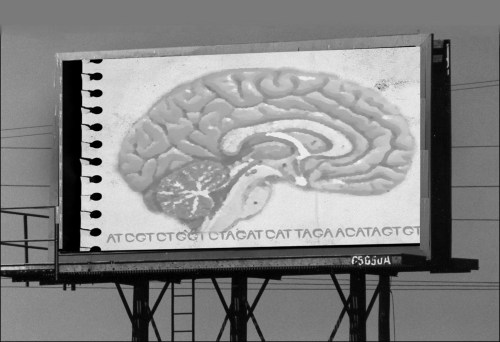
Posted in Uncategorized, tagged Art, meme-art on September 20, 2009| Leave a Comment »
Posted in Uncategorized, tagged Genetic testing, Mental disorder, Mental health, Statistical survey on September 19, 2009| Leave a Comment »

pointer to: Razib Khan’s results (600+ respondents!) survey on genetic testing and psychiatric illness. Very informative!
Posted in Uncategorized, tagged Education, National Medal of Science, Oregon, University of Oregon on September 18, 2009| Leave a Comment »

pointer to: Announcement from the University of Oregon, that Professor Michael Posner has been awarded the National Medal of Science – the highest honor given by the U.S. government to scientists, engineers and inventors. Professor Posner is widely known and admired for his teaching and research on the biology of attention networks.
I was a most fortunate postdoctoral advisee of his from 2000-2003.
Posted in Uncategorized, tagged Art, meme-art on September 18, 2009| Leave a Comment »
Posted in Uncategorized, tagged Brain, Emotion, Health, Mental health, personality, Psychology, Social Sciences on September 17, 2009| Leave a Comment »
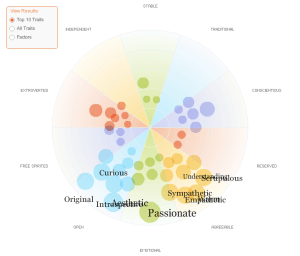 With more and more genes being directly associated with personality or as moderators of correlations between personality and brain structure/function (here, here, here, here) it was fun to try out the latest online “big-5 personality profiler“.
10 mins of self-reflective fun. My profile displayed at left.
Posted in Uncategorized, tagged Mental health, NAMI, Trojan horse on September 17, 2009| Leave a Comment »

pointer to Jim Edwards’ article on a very unfortunate conflict of interest within NAMI – a very grassy grass roots organization providing outreach, advocacy and educational support to families and patients coping with mental illness.
According to NAMI, some 56% of its budget (annual revenues have been > $13M) was funded by pharma!
My own stigma-busting efforts are with a wonderfully dedicated group of NAMI volunteers (i.e. we do everything ourselves and don’t get a nickel from NAMI). WTF? This is a shame.
Posted in Uncategorized, tagged Art, Arts, humanity, population on September 17, 2009| Leave a Comment »
Not a human genetics site per se, but a wonderful experience in humanity – pointer to 6 billion others .org
Posted in Uncategorized, tagged Art, Arts, Poetry on September 17, 2009| Leave a Comment »
Posted in Uncategorized, tagged Biology, DNA, Gene, Genetics, Health, Hypothalamic-pituitary-adrenal axis, Rhesus Macaque, Stress on September 11, 2009| Leave a Comment »

For humans, there are few sights more heart-wrenching than an orphaned child (or any orphaned vertebrate for that matter). Isolated, cold, unprotected, vulnerable – what could the cold, hard calculus of natural selection – “red in tooth and claw” – possibly have to offer these poor, vulnerable unfortunates?
So I wondered while reading, “Functional CRH variation increases stress-induced alcohol consumption in primates” [doi:10.1073/pnas.0902863106]. In this paper, the authors considered the role of a C-to-T change at position -248 in the promoter of the corticotropin releasing hormone (CRH or CRF) gene. Its biochemical role was examined using nuclear extracts from hypothalamic cells, to demonstrate that this C-to-T nucleotide change disrupts protein-DNA binding, and, using transcriptional reporter assays, that the T-allele showed higher levels of transcription after forskolin stimulation. Presumably, biochemical differences conferred by the T-allele can have a physiological role and alter the wider functionality of the hypothalamic-pituitary-axis (HPA axis), in which the CRH gene plays a critical role.
The authors ask whether primates (rhesus macaques) who differ in genotype (CC vs. CT) show any differences in physiological stress reactivity – as predicted by differences in the activity of the CRH promoter. As a stressor, the team used a form of brief separation stress and found that there were no differences in HPA function (assessed by ACTH and Cortisol levels) in animals who were reared by their mothers. However, when the stress paradigm was performed on animals who were reared without a mother (access to play with other age-matched macaques) there were significant differences in HPA function between the 2 genetic groups (T-alleles showing greater release of stress hormones). Further behavioral assessments found that the peer reared animals who carried the T-allele explored their environment less when socially separated as adults (again no C vs. T differences in maternally reared animals). In a separate assessment the T-carriers showed a preference for sweetened alcohol vs. sweetened water in ad lib consumption.
One way of summarizing these findings, could be to say that having no mother is a bad thing (more stress reactivity) and having the T-allele just makes it worse! Another way could be to say that the T-allele enhances the self-protection behaviors (less exploration could be advantageous in the wild?) that arise from being orphaned. Did mother nature (aka. natural selection) provide the macaque with a boost of self-preservation (in the form of a T-allele that enhances emotional/behavioral inhibition)? I’m not sure, but it will be fun to report on further explorations of this query. Click here for an interview with the corresponding author, Dr. Christina Barr.
—p.s.—
The authors touch on previous studies (here and here) that explored natural selection on this gene in primates and point out that humans and macaques both have 2 major haplotype clades (perhaps have been maintained in a yin-yang sort of fashion over the course of primate evolution) and that humans have a C-to-T change (rs28364015) which would correspond to position -201 in the macaque (position 68804715 on macaque chr. 8), which could be readily tested for similar functionality in humans. In any case, the T-allele is rare in macaques, so it may be the case that few orphaned macaques ever endure the full T-allele experience. In humans, the T-allele at rs28364015 seems more common.
Nevertheless, this is yet another – complicated – story of how genome variation is not destiny, but rather a potentiator or life experience – for better or worse. Related posts on genes and early development (MAOA-here), (DAT-here), (RGS2-here), or just click the “development tag“.
Posted in Uncategorized, tagged economics, Health insurance on September 6, 2009| Leave a Comment »
Al Franken ably handles a “taxed enough already” crowd on healthcare debate topics … democratic process at its best … the frontrow presence of a 90 y.o. lady draws some focus on how young folks resent being saddled with future debt to pay for current payouts – no one seems to take note or care that she is there. Go Senator Al!
Posted in Uncategorized, tagged Art on September 5, 2009| 1 Comment »

pointer to: Tales of a Borderline is an exhibition of artwork by artists with Borderline Personality Disorder (BPD). This disorder affects a person’s emotions, causing emotional instability. The exhibition currently features the work of artists Tamar Whyte, Anita Kaiser-Petzenka, Karin Birner and Irene Apfalter and has been curated by Dr. Dagmar Weidinger.
Posted in Uncategorized, tagged comics, Genetic testing on September 5, 2009| Leave a Comment »
Posted in Uncategorized, tagged Genetic testing, Personalized medicine on September 2, 2009| Leave a Comment »

pointers to: “Personalized Genetics: DTC Genetic Tests Are Hype” and “The World of Genetic Genealogy and DTC Genetic Testing Never Sleeps…”
Even though the data collection technology still outpaces the deeper understanding of the data, we’re learning more and more all the time.
Posted in Uncategorized, tagged Book Reviews, books on August 30, 2009| Leave a Comment »

via CrunchBase
Very much enjoyed Jeff Jarvis’ recent book “What Would Google Do?” on the new, next economy. There, the old strategy of hoarding information for competitive gain, is supplanted by internet-based demand for openness, spontaneity and honesty among a long tail of interconnected, self-organizing individuals and small communities. Jarvis traverses all facets of the economic landscape and sees how this new ethos is on the rise. Indeed, a new social-political-economic era seems to be emerging.
I was inspired to focus on the spontaneous, entrepreneurial act of opening up and sharing my personal thoughts and dig deeper into the issues I care about. Thanks Professor Jarvis!
Posted in Uncategorized, tagged economics, Health 2.0, Health insurance on August 27, 2009| Leave a Comment »

pointer to: Bloomberg Economics Radio – two top healthcare economics experts amicably discuss (.mp3) the current reform efforts – both agree the mendacity and outright lies are deeply poisoning the debate. The first main issue is the so-called “uninsured issue” which most other countries have resolved (simply, everyone deserves to be and is covered) which they see as resolvable through public-private and/or private-exchanges for the 20-25 million folks who cannot afford coverage – at little or no extra cost to the tax payer. The much larger ($trillions$) question remains how to keep up with good medical care and keep down costs. Both agree that incentives to physicians that promote the use of evidence-based practices – rather than fee-for-procedure would accomplish this. However, both see this as a VERY long-term debate that will progress incrementally in the decades to come. Certainly the health 2.0 movement will transform this conversation in the decades to come.
A welcome respite of scholarship and collegial respect amidst the rising demagoguery in the heartland. Related posts here and here.
Posted in Uncategorized on August 25, 2009| 1 Comment »

pointer to: “Placebos Are Getting More Effective. Drugmakers Are Desperate to Know Why.” with details on the difficulties in developing meds to treat mental illness. One choice quote, “Ironically, Big Pharma’s attempt to dominate the central nervous system has ended up revealing how powerful the brain really is.”
A post related to genetics of placebo response here.



 Genes 2 Brains 2 Mind 2 Me