Feeds:
Posts
Comments

Archive for the ‘Uncategorized’ Category

TruGenetics bust

Split-second shot MOUNTAIN HOME AIR FORCE BASE...
Image via Wikipedia

Just popped into my inbox …

Dear Registrant,
Thank you for participating in TruGenetics’ pre-registration Beta.
We wanted to inform you that despite our best efforts and contrary to our expectations, our funding sources did not come through and to date, we have been unable to secure funding for launching our genome scanning program. Given the current economic climate, we are also unsure how long the funding process will take.
We understand that some of you may want to seek genome scanning services from other companies. Therefore, we are offering you the option to remove your information from our database. Using your username and password, you can log on to http://www.trugenetics.com and delete your record from our database at your convenience.
We will continue our fundraising efforts and we will inform you of any progress toward our goal.
Again, we appreciate you pre-registering with TruGenetics.
Sincerely,
TruGenetics Management Team

Reblog this post [with Zemanta]

Read Full Post »

homebrew comics 12

Stability breeds instability and back we go again

Read Full Post »

Family history web imagepointer to next week’s conference in Bethesda NIH State-of-the-Science Conference: Family History and Improving Health.  From the website, “Family history is also critical to determining who will benefit from genetic testing for both common and rare conditions, and can facilitate interpretation of genetic test results.”  You can watch live or later via an archived webcast!

Reblog this post [with Zemanta]

Read Full Post »

MFrankIf you’re interested in the neurobiology of learning and decision making, then you might be interested in this brief interview with Professor Michael Frank who runs the Laboratory of Neural Computation and Cognition at Brown University.

From his lab’s website: “Our research combines computational modeling and experimental work to understand the neural mechanisms underlying reinforcement learning, decision making and working memory. We develop biologically-based neural models that simulate systems-level interactions between multiple brain areas (primarily basal ganglia and frontal cortex and their modulation by dopamine). We test theoretical predictions of the models using various neuropsychological, pharmacological, genetic, and neuroimaging techniques.”

In this interview, Dr. Frank provides some overviews on how genetics fits into this research program and the genetic results in his recent research article “Prefrontal and striatal dopaminergic genes predict individual differences in exploration and exploitation”. Lastly, some lighthearted, informal thoughts on the wider implications and future uses of genetic information in decision making.

To my mind, there is no one else in the literature who so seamlessly and elegantly interrelates genetics with the modern tools of cognitive science and computational neurobiology.  His work really allows one to cast genetic variation in terms of its influence on neural computation – which is the ultimate way of understanding how the brain works.  It was a treat to host this interview!

Click here for the podcast and here, here, here for previous blog posts on Dr. Frank’s work.

Reblog this post [with Zemanta]

Read Full Post »

Water droplets forming out of turned on shower...
Image via Wikipedia

Last summer I took a day to drive to Camden, NJ to attend a free lecture & spit event at the Coriell Institute.  Today, I was pleased to find that the data are flowing through their user-friendly web portal.  After about 40 minutes of standardized online family, lifestyle & medical history questionnaires, I was able to view my data:

Iron Overload Genetic Variant #1 (HFE rs1800562)
GG – low risk
Type 2 Diabetes – Variant #1 (rs7754840)
CG – medium risk
Prostate Cancer – Variant #1 (rs16901979)
CC – low risk
Coronary Artery Disease – Variant #1 (rs1333049)
GC  – low risk
Melanoma Genetic Variant #1 (rs910873)
CC  – low risk

These data match my 23andMe results (except for Melanoma Genetic Variant #1 (rs910873) which is not covered by 23andMe) and the online medical education resources for each genetic test are extensive.  According to the site, more data and related medical education will be flowing soon.

Glad to have this free, albeit minimal,  access to my genome information!

Reblog this post [with Zemanta]

Read Full Post »

Esther Dyson
Image by rexhammock via Flickr

pointer to: Information technology investor and member of the pioneering “PGP-10” personal genome volunteer Esther Dyson has a great article on the Health 2.0 movement in – the mainstream of all mainstream media – the Financial Times.

Reblog this post [with Zemanta]

Read Full Post »

Image representing 23andMe as depicted in Crun...
Image via CrunchBase

pointer to: Great Q&A on Freakonomics with 23andMe founder Anne Wojcicki. Nice overview of peoples’ concerns and interests in personal genomes.

Reblog this post [with Zemanta]

Read Full Post »

1/365 [dazed & confused]
Image by PhotoJonny via Flickr

pointer to: Daniel MacArthur and Neil Walker’s (@ Genetic Future bog) in-depth coverage of various critiques on the recent back-to-back-to-back Nature magazine trifecta (covered here) on GWAS results for schizophrenia.  Rough going for the global corsortia and a major f**king bummer for folks like myself who have been hoping that these vast studies would provide a solid basis for genome-based cognitive intervention strategies in the future.  Some of the discussion in the comments section points to the weakness in the diagnostic criteria, which is a topic also covered here recently.

Perhaps there is hope in the brain systems / imaging-based approaches that are taking off as genome technology spreads into cognitive and imaging science. Tough to scan 10’s of thousands of people however. Double F**K!

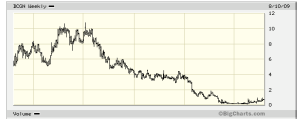
I guess DSM-based psychiatric genetics is just about dead for the time being.  The announcement of the soon to shutter deCODE Genetics and its 5-year stock price captures the failure of this endeavor.

decode1

Reblog this post [with Zemanta]

Read Full Post »

Printing press from 1811, photographed in Muni...
Image via Wikipedia

“B-b-book”? you say – as in words printed – on paper?  Yes, its a book, “The Genetics of Cognitive Neuroscience” for which my colleagues and I contributed chapter 5. Despite the 15th century medium, the collection of ideas and expertise assembled by the editors makes the book a great intoduction to this evolving topic.

Reblog this post [with Zemanta]

Read Full Post »

Passing the Wreckage
Image by arbyreed via Flickr

Was sort of holding my breath with fingers and toes crossed these past few weeks, but now am given up.  Much like team Obama’s efforts to regulate the financial services industry (only slightly less of a clusterf**k than healthcare), its a slow motion trainwreck where the average taxpayer just ends up worseoff after all the political concessions.  Seems like the very folks who are most vocal are the ones who’d rather not change a thing.

This is my take on the doublespeak within the beltway:

BUSINESS: We are being crushed by rising healthcare costs.

INSURANCE: We only make a nickel on every $1 we pay out to doctors, and they are always raising their fees.

DOCTORS: We’re forced to treat the growing ranks of uninsured and must shoulder the burden when they cannot pay.

OK, so lets try to expand medicare and design a wider government managed plan…

BUSINESS: We can’t afford the higher taxes to pay for universal care and our employees don’t want to give up the plans they have.

INSURANCE: We don’t want to compete with the government-run plan since it will undercut ours.

DOCTORS:  We don’t want “evidence-based medicine” and to be told by the government what we can do and how much we can charge – we like our perverse incentives!

And don’t forget about Mr. and Mrs. middle-class USA who want top-o-the-line care but don’t want to pay more than they did in the 1960’s.

What a total bust. I think the Health 2.0 movement is doing something really interesting – outside the system – and also very key – something that can elevate the most needy, uninsured members of society to the forefront.

No more dwelling on the wreckage.  On to strategies that help.  More science & more Health 2.0!

Reblog this post [with Zemanta]

Read Full Post »

Municipality Hall of Chongqing, China
Image via Wikipedia

Hat tip to Daniel MacArthur who points to this story from CNN. “About 30 children aged 3 to 12 years old and their parents are participating in a new program that uses DNA testing to identify genetic gifts and predict the future”  “For about $880, Chinese parents can sign their kids up for the test and five days of summer camp in Chongqing, where the children will be evaluated in various settings from sports to art. The scientific results, combined with observations by experts throughout the week, will be used to make recommendations to parents about what their child should pursue.

What’s the chinese word for SCAM?

Reblog this post [with Zemanta]

Read Full Post »

Homo Sapiens album cover
Image via Wikipedia

pointer to: Professor Paul De Grauwe‘s interview (mp3) and recent article in the Financial Times declaring the flawed debate on macroeconomic policy (to stimulate or not) based on present models that do not account for the emotional and cognitive biases of homo sapiens.  He calls for new behavioral economic models based on the work of Robert Shiller and others who – together with psychologists and neuroimagers – are synthesizing a newer evolution of homo economicus – which may lead us to a better (less crisis-prone perhaps?) macroeconomic world.  (A few related posts on this topic here)

Hmmm. What might the genome of homo economicus look like?

Reblog this post [with Zemanta]

Read Full Post »

NewAntidepressant.png
Image by mrapplegate via Flickr

pointer to: Study: US Anti-Depressant Use Doubles From 1996 to 2005 at the Furious Seasons blog.  Yikes!  What is happening?

Reblog this post [with Zemanta]

Read Full Post »

Nalazište pračovjeka Krapina
Image via Wikipedia

pointer to this 5-part video discussion from the 2009 World Science Festival.

In part 1 @ 8:30mins Sir Paul Nurse makes the plug for the nexus of neuroscience-genomics-humanities.  In part 3 @0:20secs Renee Reijo Pera makes the case for basic developmental biology as a key, while @12:00mins Francis Collins makes the case for parenting as a key shaper of the potential of the genome.  In part 4 @16:00mins Nikolas Rose cautions on the “screen & intervene” mentality that has grown (degenerated) around the nexus of genomics and neuroscience.  Lastly, in part 5 @4:25mins Francis Collins stirs up the panel with questions on human spirituality.

Each of these topics is something I’m striving to explore more here.  What a wonderfully interesting future lies ahead in this area!


Reblog this post [with Zemanta]

Read Full Post »

pointer to Jen S. McCabe’s blog on healthcare management and gracious video share of her experience with her 23andMe personal genome data.

Reblog this post [with Zemanta]

Read Full Post »

PRINCETON, NJ - OCTOBER 13:  Princeton Profess...
Image by Getty Images via Daylife

pointer to: Paul Krugman’s summary of basic factors that prevent healthcare from ever functioning in an efficient Adam Smith, Burton Malkiel kind of free market.  His comments based on Kenneth Arrow‘s 1963 paper “Uncertainty and the welfare economics of health care“.

Reblog this post [with Zemanta]

Read Full Post »

The Sofiensaal in 1900.
Image via Wikipedia

just a pointer to: Madness & Modernity: Mental illness and the visual arts in Vienna 1900

“Vienna in 1900 was a city obsessed with the mind. Political unrest had left the Viennese with an overwhelming sense that they were living in ‘nervous times’.”

Sounds like the media scene today.

Reblog this post [with Zemanta]

Read Full Post »

homebrew comics 11

Independence of the FED in banana republico
… caught this related video on the same topic on July 24th.

The core issues of government transparency and consumer protection seem to apply to healthcare reform as well.  How best can the government protect consumers ? paternalistic behavior or transparency ?

Consumer protection: myth or bluedog denial

Read Full Post »

Lessons in economics
Image by Grim Reaper With A Lawnmower via Flickr

Very much enjoyed Professor & Blogger Tyler Cowen’s new book.  He muses on the deep seated joy that people have in self-ordering information and the economic value that comes from facilitating this natural instinct.  As a blogger-in-training, the book has really helped me better understand how a blog might fit into existing value-chains within the world of homo-economicus who, according to Professor Cowen, is using social media to become more entrepreneurial and humane.  Its easy to imagine how folks may try and self-order their genome information in the years to come.  I hope I can help facilitate this by sharing my own enthusiasm and experience as an early adopter.  If you want your assumptions on human behavior to be shaken up in a good way – read this book!

Reblog this post [with Zemanta]

Read Full Post »

RICHMOND, CANADA - FEBRUARY 12:  Simon Whitfie...
Image by Getty Images via Daylife

While often the object of scorn from its capitalistic southern neighbor, the Canada Foundation for Innovation has just awarded Dr. David Kennedy a large research grant to deploy both neuroimaging and genetic markers in the development of personalised treatment for schizophrenia – through a program dubbed “neuroIMAGENE“.  Dr. Kennedy suggests that this technological strategy may actually save money in the long run by helping physicians select the proper medication and dosage.

Capitalistic scorn huh? This news comes as the U.S. healthcare flagship GE healthcare flushes its own personalized medicine effort all the while nary a Canadian bank requires bailout largesse.  Indeed.

Reblog this post [with Zemanta]

Read Full Post »

« Newer Posts - Older Posts »