
- Image via Wikipedia

A recent analysis of brain structure in healthy individuals who carry a common 2,445-bp deletion in intron 2 of the doublecortin domain containing 2 (DCDC2) gene found that heterozygotes for the deletion showed higher grey matter volumes for several brain areas known to be involved in the processing of written and spoken language (superior, medial and inferior temporal cortex, fusiform, hippocampal / parahippocampal, inferior occipito-parietal, inferior and middle frontal gyri, especially in the left hemisphere) [doi:10.1007/s11682-007-9012-1]. The DCDC2 gene sits within a well known locus frequently found to be associated with developmental dyslexia, and associations of reading disability with DCDC2 have been confirmed in population-based studies. 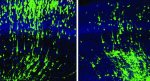 Further work on DCDC2 (open access) shows that the DNA that is deleted in the 2,445-bp deletion in intron 2 carries a number of repeating sequences to which developmental transcription factors bind and that inhibition of DCDC2 results in altered neuronal migration (the right-hand panel shows altered radial migration when DCDC2 is inhibited). Perhaps the greater grey matter volumes are related to this type of neuronal migration finding? Will be interesting to follow this story further!
![Reblog this post [with Zemanta]](https://i0.wp.com/img.zemanta.com/reblog_e.png)
Posted in Frontal cortex, Fusiform gyrus, Hippocampus, Parahippocampal gyrus, Temporal lobe | Tagged brain structure, Development, Dyslexia, reading disability | Leave a Comment »
Posted in APOE | Tagged Art, meme-art | Leave a Comment »

- Image by bethd821 via Flickr
Whether you are a carpenter, plumber, mechanic, electrician, surgeon or chef, your livelihood depends on a set of sturdy, reliable, well-honed, precision tools. Similarly, neuroscientists depend on their electrodes, brain scanners, microscopes and more recently their genome sequencers. This is because they are not just trying to dissect the brain – the physical organ – but also the psychological one. As the billions of neurons connected by trillions of synapses process electrical impulses – a kind of neural information – it is the great endeavor of cognitive-molecular-neuro-psychology (or whatever you wish to call the art) to figure out how all of those neurons and connections come into being and how they process information in ways that lead to your personality, self-image, hopes, dreams, memories and the other wonderful aspects of your mental life. How and why does information flow through the brain in the way it does? and how and why does it do so in different ways for different people? Some, for instance, have informally related Sigmund Freud‘s models of mental structure to a kind of plumbing wherein psychic energy was routed (or misrouted) through different structural aspects of the mind (pipes as it were). Perhaps such a model was fitting for the great industrial era in which he lived – but perhaps not in today’s highly information-based, inter-connected and network-oriented era. If our understanding of mental life is a product of our tools, then perhaps we should be sure that our modern tools are up to the job.
One recent paper reminded me of how important it is to double check the accuracy and precision of one’s tools was the research article, “Quantifying the heritability of task-related brain activation and performance during the N-back working memory task: A twin fMRI study” [doi:10.1016/j.biopsycho.2008.03.006] by Blokland et al.. In this report, the team summarizes the results of measurments of the brain activity – not structure – but rather activity as measured by their chosen tool, the MRI scanner. This research team, based in UCLA and known as one of the best in the field, asks whether the so-called BOLD response (an indirect measure of neural activity) shows greater concordance in identical (monozygotic) vs. fraternal (dizygotic) twins. To generate brain activity, the research team asked the subjects to perform a task called an N-back workng memory task, which entails having to remember something that happend “N” times ago (click here for further explanation of N-back task or play it on your iphone). If you’ve done this, you’ll know that its hard – maddeningly so – and it requires a lot of concentration, which, the researchers were counting on to generate activity in the prefrontal cortex.
After looking at the brain activity patterns of some 29 MZ pairs and 31 DZ pairs, the team asked if the patterns of brain activity in the lateral frontal cortex were more similar in the MZ pairs vs. the DZ pairs. If so, then it would suggest that the scanning technology (measurement of the BOLD response) is sufficiently reliable and precise enough to detect the fraction of individual differences in brain activty that arise from additive genetic variation. If one actually had such super-precise tool, then one could begin to dissect and tease apart aspects of human cognition that are regulated by individual genetic variation – a very super-precise and amazing tool – that might allow us to understand mental life in biologically-based terms (and not Freud’s plumbingesque analogies). If only such a tool existed! Somewhat amazingly, the scanning tools did seem to be able to detect differences between the BOLD response correlations of MZ pairs vs. DZ pairs. The BOLD response correlations were greater for MZ vs. DZ in the middle frontal gyrus, angular gyrus, supramarginal gyrus when activity for the 2-back task was compared to the 0-back task. The team were cautious to extend these findings too far, since the standard deviations are large and the estimates of heritability for the BOLD response are rather low (11-36%), but, overall, the team suggests that the ability to use the fMRI methods in conjunction with genetic markers shows future promise.
Meanwhile, the literature of so-called “imaging-genetic” findings begins to grow in the literature. I hope the tools are reliable and trustworthy enough to justify conclusions and lessons about human genetic variation and its role in mental life. Will certainly keep this cautionary report in mind as I report on the cognitive genetics literature in the future.
Posted in Angular gyrus, Middle frontal gyrus, Supramarginal gyrus | Tagged Brain, Cognition, Frontal lobe, Functional magnetic resonance imaging, Magnetic resonance imaging, Prefrontal cortex, Psychology, Sigmund Freud, Twin | Leave a Comment »

Posted in Uncategorized | Tagged Art, meme-art | Leave a Comment »

 pointer to: amazing project on the complexities of managing mental illness in America today. Scientific progress makes for policy dilemma in an era of economic decline. Heartbreaking.
From the website: MINDS ON THE EDGE: Facing Mental Illness is a multi-platform media project that explores severe mental illness in America.
The centerpiece of the project is a television program airing on PBS stations in October 2009. This video component is part of a national initiative that includes extensive web content with tools for civic engagement, active social media on Facebook and Twitter, and an ambitious strategy to engage citizens, professionals in many fields, and policy makers at all levels of government. The goal is to advance consensus about how to improve the kinds of support and treatment available for people with mental illness.
The television program MINDS ON THE EDGE: Facing Mental Illness effectively illuminates challenging ethical issues as well as systemic flaws in program and policy design, service coordination, and resource allocation. These problems are contributing to a mental health system that is widely acknowledged to be broken. MINDS ON THE EDGE also provides a glimpse of innovative solutions that are currently being implemented across the country. These innovations, many shaped by the guidance and expertise of people with mental illness, offer promising solutions and hopeful direction to transform the mental health system.
![Reblog this post [with Zemanta]](https://i0.wp.com/img.zemanta.com/reblog_c.png)
Posted in Uncategorized | Tagged economics, healthcare policy, Mental disorder, Mental health, Public Broadcasting Service, Television program | 1 Comment »

[picapp src=”e/7/8/1/Children_Attend_Classes_9572.jpg?adImageId=4955179&imageId=1529412″ width=”380″ height=”253″ /]
This year, my 5 year-old son and I have passed many afternoons sitting on the living room rug learning to read. While he ever so gradually learns to decode words, eg. “C-A-T” sound by sound, letter by letter – I can’t help but marvel at the human brain and wonder what is going on inside. In case you have forgotten, learning to read is hard – damn hard. The act of linking sounds with letters and grouping letters into words and then words into meanings requires a lot of effort from the child (and the parent to keep discomfort-averse child in one place). Recently, I asked him if he could spell words in pairs such as “MOB & MOD”, “CAD & CAB”, “REB & RED” etc., and, as he slowly sounded out each sound/letter, he informed me that “they are the same daddy“. Hence, I realized that he was having trouble – not with the sound to letter correspondence, or the grouping of the letters, or the meaning, or handwriting – but rather – just hearing and discriminating the -B vs. -D sounds at the end of the word pairs. Wow, OK, this was a much more basic aspect of literacy – just being able to hear the sounds clearly. So this is the case, apparently, for many bright and enthusiastic children, who experience difficulty in learning to read. Without the basic perceptual tools to hear “ba” as different from “da” or “pa” or “ta” – the typical schoolday is for naught.
With this in mind, the recent article, “Genetic determinants of target and novelty-related event-related potentials in the auditory oddball response” [doi:10.1016/j.neuroimage.2009.02.045] caught my eye. The research team of Jingyu Liu and colleagues asked healthy volunteers just to listen to a soundtrack of meaningless beeps, tones, whistles etc. The participants typically would hear a long stretch of the same sound eg. “beep, beep, beep, beep” with a rare oddball “boop” interspersed at irregular intervals. The subjects were instructed to simply press a button each time they heard an oddball stimulus. Easy, right? Click here to listen to an example of an “auditory oddball paradigm” (though not one from the Liu et al., paper). Did you hear the oddball? What was your brain doing? and what genes might contribute to the development of this perceptual ability?
The researchers sought to answer this question by screening 41 volunteers at 384 single nucleotide polymorphisms (SNPs) in 222 genes selected for their metabolic function in the brain. The team used electroencephalogram recordings of brain activity to measure differences in activity for “boop” vs. “beep” type stimuli – specifically, at certain times before and after stimulus onset – described by the so-called N1, N2b, P3a, P3b component peaks in the event-related potentials waveforms. 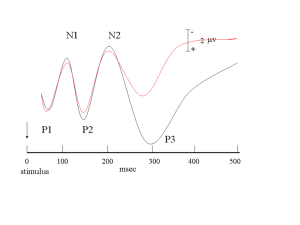 Genotype data (coded as 1,0,-1 for aa, aA, AA) and EEG data were plugged into the team’s home-grown parallel independent components analysis (ICA) pipeline (generously provided freely here) and several positives were then evaluated for their relationships in biochemical signal transduction pathways (using the Ingenuity Pathway Analysis toolkit. A very novel and sophisticated analytical method for certain!
The results showed that certain waveforms, localized to certain areas of the scalp were significantly associated with the perception of various oddball “boop”-like stimuli. For example, the early and late P3 ERP components, located over the frontal midline and parieto-occipital areas, respectively, were associated with the perception of oddball stimuli. Genetic analysis showed that several catecholaminergic SNPs such as rs1800545 and rs521674 (ADRA2A), rs6578993 and rs3842726 (TH) were associated with both the early and late P3 ERP component as well as other aspects of oddball detection.
Both of these genes are important in the synaptic function of noradrenergic and dopaminergic synapses. Tyrosine hydroxylase, in particular, is a rate-limiting enzyme in catecholamine synthesis. Thus, the team has identified some very specific molecular processes that contribute to individual differences in perceptual ability. In addition to the several other genes they identified, the team has provided a fantastic new method to begin to crack open the synaptic complexities of attention and learning. See, I told you learning to read was hard!
Posted in ADRA2A, Frontal cortex, Noradrenaline, Parietal cortex, TH | Tagged 23andMe, Brain, Dopamine, Electroencephalography, ERP, Frontal lobe, Genetic testing, ICA, Independent Component Analysis, Literacy, Noradrenaline, Perception, Psychology, Reading, Signal transduction, Single-nucleotide polymorphism | Leave a Comment »

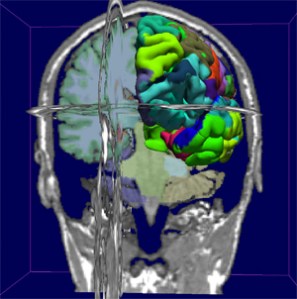 The brain is a wonderfully weird and strange organ to behold. Its twists and folds, magnificent, in and of themselves, are even moreso when we contemplate that the very emotional experience of such beauty is carried out within the very folds. Now consider the possibility of integrating these beauteous structure/function relationships with human history – via the human genome – and ask yourself if this seems like fun. If so, check out the recent paper, “Genetic and environmental influences on the size of specific brain regions in midlife: The VETSA MRI study” [doi:10.1016/j.neuroimage.2009.09.043].
Here the research team – members of the Biomedical Informatics research Network – have carried out the largest and most comprehensive known twin study of brain structure. By performing structural brain imaging on 404 male twin pairs (important to note here that the field still awaits a comparable female study), the team examined the differences in identical (MZ) vs. fraternal (DZ) pair correlations of the structure of some 96 different brain regions. The authors now provide an updated structural brain map showing what structures are more or less influenced by genes vs. environment. Some of the highlights from the paper are that genes accounted for about 70% of overall brain volume, while in the cortex, genes accounted for only about 45% of cortical thickness. Much of the environmental effects were found to be non-shared, suggesting, as expected, that individual experience can have strong effects on brain structure. The left and right putamen showed the highest additive genetic influence, while the cingulate and temporal cortices showed rather low additive genetic influences (below 50%).
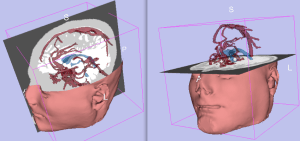
If you would like to play around with a free brain structure visualization tool, check out Slicer 3D, which can be obtained from the BIRN homepage or directly here. I had fun this morning digitally slicing and dicing grey matter from ventricles and blood vessels.
Posted in Basal Ganglia, Cingulate cortex, Striatum, Superior temporal cortex | Tagged Biomedical Informatics research Network, Brain, Genetics, Magnetic resonance imaging, Twin | Leave a Comment »

- Image via Wikipedia

Many thanks to Dr. Christina S. Barr from the National Institutes of Health/National Institute on Alcohol Abuse and Alcoholism-Laboratory of Clinical and Translational Studies, National Institutes of Health Animal Center for taking the time to comment on her team’s recent publication, “Functional CRH variation increases stress-induced alcohol consumption in primates” [doi:10.1073/pnas.0902863106] which was covered here. On behalf of students and interested readers, I am so grateful to her for doing this! Thank you Dr. Barr!
For readers who are unfamiliar with the extensive literature on this topic, can you give them some basic background context for the study?
“In rodents, increased CRH system functioning in parts of the brain that drive anxious responding (ie, amygdala) occurs following extended access to alcohol and causes animals to transition to the addicted state. In rodent lines in which genetic factors drive increased CRH system functioning, those animals are essentially phenocopies of those in the post-dependent state. We had a variant in the macaque that we expected would drive increased CRH expression in response to stress, and similar variants may exist in humans. We, therefore, hypothesized that this type of genetic variation may interact with prior stress exposure to increase alcohol drinking.”
Can you tells us more about the experimental design strategy and methods?
“This was a study that relied on use of archived NIAAA datasets. The behavioral and endocrine data had been collected years ago, but we took a gene of interest, and determined whether there was variation. We then put a considerable amount of effort into assessing the functional effects of this variant, in order to have a better understanding of how it might relate to individual variation. We then genotyped archived DNA samples in the colony for this polymorphism.”
“I am actually a veterinarian in addition to being a neuroscientist- we have the “3 R’s”. Reduce, refine, and replace…..meaning that animal studies should involve reduced numbers, should be refined to minimize pain/distress and should be replaced with molecular studies if possible. This is an example of how you can marry use of archived data and sophisticated molecular biology techniques/data analysis to come up with a testable hypothesis without the use of animal subjects. (of course, it means you need to have access to the datasets….;)”
How do the results relate to broader questions and your field at large?
“I became interested in this system because it is one that appears to be under intense selection. In a wide variety of animal species, individuals or strains that are particularly stress-reactive may be more likely to survive and reproduce successfully in highly variable or stressful environments. Over the course of human evolution, however, selective pressures have shifted, as have the nature and chronicity of stress exposures. In fact, in modern society, highly stress-reactive individuals, who are no less likely to be eaten by a predator (predation not being a major cause of mortality in modern humans), may instead be more likely to fall susceptible to various-stress related disorders, including chronic infections, diabetes, heart disease, accelerated brain aging, stress-related psychiatric disorders, and even drug and alcohol problems. Therefore, these genetic variants that are persistent in modern humans may make individuals more vulnerable to “modern problems.”
I do hope this helps. Let me know if it doesn’t, and I will try to better answer your questions.”
THANK YOU AGAIN VERY MUCH DR. BARR!!
Posted in Uncategorized | Tagged Addiction, Depression, Development, Emotion, evolution, Genetics, Mental health, National Institutes of Health, Stress | Leave a Comment »

- Image via Wikipedia

Science IS fun … props to Francis Collins for going out on a limb for the younger crowd on the Colbert Report.
Posted in Uncategorized | Tagged colbert, Education, Francis Collins, fun, Genetics, Personalized medicine, science | Leave a Comment »
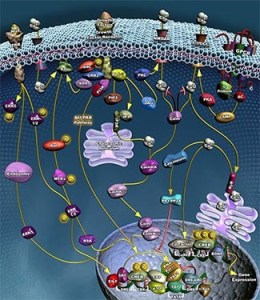 According to Joseph LeDoux, “One of the most important contributions of modern neuroscience has been to show that the nature/nurture debate operates around a false dichotomy: the assumption that biology, on one hand, and lived experience, on the other, affect us in fundamentally different ways” (ref). Indeed. While I know not where the current debate stands, I’d like to point to a fantastic example of just how inextricably linked the genome is to the environment. In their recent paper, “A Biological Function for the Neuronal Activity-Dependent Component of Bdnf Transcription in the Development of Cortical Inhibition” [doi:10.1016/j.neuron.2008.09.024] Hong et al., ask what happens when you take away the ability of a given gene to respond to the environment. This is not a traditional “knockout” experiment – where the gene is inactivated from the moment of conception onwards – but rather a much more subtle type of experimental manipulation. What happens when you prevent nurture from exerting an effect on gene expression?
The team focused on the BDNF gene whose transcription can be initiated from any one of eight promoter sites (I-XIII). These sites vary in activity depending on the phase of development and/or the tissue or type of cell – all of which make for a complex set of instructions able to turn the BDNF gene on and off in precise developmental and/or tissue-specific ways. In the case of promoter IV, it appears to be triggered in the cortex in response to Ca++ release that occurs when neurons are firing – a phenomena called, “neuronal activity dependent transcription” – a top example of how the environment can influence gene expression. Seeing as how BDNF promoter IV is important for this type of environment-induced gene expression, the team asked what happens when you remove this particular promoter?
To do this, the team constructed – keep in mind that these are – mice that contain mutations in several of the Calcium (Ca++) response elements in the promoter IV region. They introduced point mutations so that the Ca++ sensitive protein CREB could not bind to the promoter and activate gene expression. OK, so what happens?
Firstly, the team reports that the mutant mice are more or less indistinguishable from controls in appearance, gait, growth rate, brain size and can also reproduce and transmit the mutations. WOW! Is that one strike AGAINST nurture? The team then shows that BDNF levels are more than 50% reduced in cultured neurons, but that levels of other immediate early genes are NOT affected (as expected). In living animals, the effects were similar when they asked how much gene expression occurs in the sensory cortex when animals are exposed to light (after an extended period of darkness). OK, so there are few effects, so far, other than lower levels of nurture-induced BDNF expression – hmmm. Looking more closely however, the team found that the mutant mice generated lower levels of inhibitory neuron activity – as measured by the firing of miniature inhibitory postsynaptic currents. Follow-on results showed that the total number of inhibitory neurons (parvalbumin and NPY + GABAergic cells) was no different than controls and so it would seem that the activity dependence of BDNF is important for the maintenance of inhibitory synapses.
Hence, the team has found that what “nurture” does (via the BDNF promoter IV in this case) is to exert an effect on the connectivity of inhibitory neurons. Wow, thanks mother nurture! Although it may seem like an obscure role for something as important as THE environment, the team points out that the relative balance of excitation-to-inhibition (yin-yang as covered here for Rett syndrome) is crucial for proper cognitive development.
To explore the notion of inhibory/excitation balance further, check out this (TED link) video lecture, where Michael Merzenich describes this imbalance as a “signal-to-noise” problem wherein some children’s brains are rather noisy (due to any number of genetic/environmental reasons – such as, perhaps, poorly maintained inhibitory connections). This can make it harder to develop and function in life. Perhaps someday, the genetic/environment research like that of Hong and colleagues will inform the rehabilitative strategies developed by Merzenich.
Posted in BDNF | Tagged BDNF, Biology, CREB, Development, Epigenetics, Gene expression, Genetics, Michael Merzenich, Neuron, Rett Syndrome | Leave a Comment »


 It was a delight today to chat with Monica Coenraads, Executive Director of the Rett Syndrome Research Trust. The RSRT has teamed up with a deeply focused world-class team of research scientists to translate the fruits of basic research on Rett syndrome into viable cures. Whether you are a scientist, student or concerned family member, you will learn a lot from exploring the RSRT website, blog as well as this short video lecture. Just by a strange, unanticipated coincidence, today marks the 10-year annivesary of the identification of MeCP2 as the underlying gene for Rett syndrome. Click here for prior blog posts on Rett syndrome. (click here for podcast)
Posted in MECP2 | Tagged Development, economics, Epigenetics, Genetic Disorders, Genetic testing, Mental disorder, Mental health, Podcast, Rett Syndrome | Leave a Comment »

Remarks
Re-Tweetin’
Tweets by genes2brains2meBlog Stats
- 191,758 clickitas
Posting since April 2007
General topics
23andMe Addiction Add new tag aging Anxiety Art Arts autism B. K. S. Iyengar Biology Brain Buddism Central nervous system Cognition comics Consciousness Depression Development DNA Dopamine dualism economics Emotion Empathy Epigenetics evolution fear Frontal lobe Functional magnetic resonance imaging Gene Gene expression Genetics Genetic testing GWAS Health Health care Health insurance Hippocampus History Intelligence Kundalini language Major depressive disorder medication Meditation meme-art Memory Mental disorder Mental health Mind Mutation Nervous system Neural network Neuron Pain parasympathetic nervous system Patañjali Personalized medicine philosophy placebo Psychology Reactive oxygen species Religion and Spirituality Rett Syndrome schizophrenia Social Sciences spirituality Stem cell Stress Suicide synaptogenesis Teachers and Centers Twin Yoga Yoga Sutras of PatanjaliSpecific Items
- 5HTT
- ABCB1
- acetylcholine
- Actin
- ACTN3
- ADH1C
- ADORA2A
- ADRA2A
- AKT
- AMPA receptor
- Amygdala
- Angular gyrus
- ANK3
- APOE
- ARHGAP18
- ASIC1a
- ASPM
- ATXN1
- AVPR1a
- BAF53b
- Basal Ganglia
- BDNF
- CABYR
- CACNA1C
- CACNA2D1
- Caudate nucleus
- CB1 receptor
- CDC34
- CDH13
- Cell adhesion molecules
- Cerebellum
- CHAT
- CHRM3
- CHRNA4
- CHRNA7
- Chromosome structural variants
- Cingulate cortex
- Circadian
- clinical trial
- CNR1
- CNTNAP2
- Collateral sulcus
- COMT
- Corpus callosum
- COX1
- CREB
- CRHR1
- DARPP32
- DAT
- default network
- DISC1
- DLPFC
- DNAJC
- DNMT
- Dopamine
- DPP4
- DRD2
- DRD4
- DTNBP1
- DYRK1A
- EDA2R
- EGR1
- Estrogen
- evolution
- FGF20
- FMR1
- FNBP1L
- FOXA2
- FOXP2
- Frontal cortex
- Frontal pole
- Fusiform gyrus
- G-protein
- GAB2
- GABA
- GABRA2
- GABRG1
- GATA4
- Glucocorticoid receptor
- Glutamate
- GPR6
- GRIA3
- GRIK2
- GTPase
- HDACs
- Hippocampus
- HOXB8
- HRK
- HTR2A
- Hypothalamus
- IL3
- immunity
- Inferior frontal gyrus
- Insula
- Intronic or repetitive sequences
- Kalirin
- KCNA2
- KCNH2
- KCNIP3
- KCNJ6
- Kinesin
- Lateral septum
- Lateral ventricle
- LDB1
- Leptin
- LIMK1
- Locus coeruleus
- MAOA
- MAPK
- MCPH1
- MCR1-4
- MDGA2
- MECP2
- meditation
- MET
- metabolism
- MHC loci
- microRNA
- Middle frontal gyrus
- middle occipital gyrus
- Middle temporal gyrus
- Mindfulness
- Mitochondria
- MKP-1
- Motor cortex
- Myelin
- Neural crest
- NEUROG1
- NLGN3/4
- Noradrenaline
- NPBWR1
- NPSR1
- NRG1
- NRXB1
- NTRK2
- Nucleus accumbens
- NURR1
- Olfactory bulb
- OPRM1
- Orbitofrontal cortex
- OTR
- OXTR
- Parahippocampal gyrus
- Parasympathetic NS
- Parietal cortex
- PARP-1
- PAX6
- PCLO
- PER1
- PINK1
- PLCB1
- Posterior parietal cortex
- PSD95
- Putamen
- quantum physics
- RARB
- RGS2
- RGS4
- Rho GTPase
- RLN
- ROR1
- RORB
- Rostral fronto-occipital fasciculus
- RSRC1
- SAPAP3
- self-awareness
- SEMA(1-7)
- SETDB1
- SEZ6
- SIRT1
- SLC1A1
- SLITRK1
- SNAP25
- SNORD115
- SNRPN
- SOD2
- Somatosensory cortex
- SRPX2
- Stria terminalis
- Striatum
- Substantia nigra
- Subthalamic nucleus
- Superior temporal cortex
- Suprachiasmatic nucleus
- Supramarginal gyrus
- SWI/SNF
- Sylvian fissure
- Telomere
- Temporal lobe
- TGF-alpha
- TH
- Thalamus
- Thap1
- THBS1
- THBS2
- TNF-alpha
- Torsin A
- TPH2
- UBE3A
- UGT2B17
- Uncategorized
- Vagus
- VEGF
- Ventral tegmental area
- VGF
- Visual cortex
- White matter
- Yoga and Meditation
- ZNF804A


 Genes 2 Brains 2 Mind 2 Me