In previous posts, we have explored some of the basic molecular (de-repression of chromatin structure) and cellular (excess synaptogenesis) consequences of mutations in the MeCP2gene – a.k.a the gene whose loss of function gives rise to Rett syndrome. One of the more difficult aspects of understanding how a mutation in a lowly gene can give rise to changes in cognitive function is bridging a conceptual gap between biochemical functions of a gene product — to its effects on neural network structure and dynamics. Sure, we can readily acknowledge that neural computations underlie our mental life and that these neurons are simply cells that link-up in special ways – but just what is it about the “connecting up part” that goes wrong during developmental disorders?
In a recent paper entitled, “Intact Long-Term Potentiation but Reduced Connectivity between Neocortical Layer 5 Pyramidal Neurons in a Mouse Model of Rett Syndrome” [doi: 10.1523/jneurosci.1019-09.2009] Vardhan Dani and Sacha Nelson explore this question in great detail. They address the question by directly measuring the strength of neural connections between pyramidal cells in the somatosensory cortex of healthy and MeCP2 mutant mice. In earlier reports, MeCP2 neurons showed weaker neurotransmission and weaker plasticity (an ability to change the strength of interconnection – often estimated by a property known as “long term potentiation” (LTP – see video)). In this paper, the authors examined the connectivity of cortical cells using an electrophysiological method known as patch clamp recording and found that early in development, the LTP induction was comparable in healthy and MeCP2 mutant animals, and even so once the animals were old enough to show cognitive symptoms. During these early stages of development, there were also no differences between baseline neurotransmission between cortical cells in normal and MeCP2 mice. Hmmm – no differences? Yes, during the early stages of development, there were no differences between genetic groups – however – once the team examined later stages of development (4 weeks of age) it was apparent that the MeCP2 animals had weaker amplitudes of cortical-cortical excitatory neurotransmission. Closer comparisons of when the baseline and LTP deficits occurred, suggested that the LTP deficits are secondary to baseline strength of neurotransmission and connectivity in the developing cortex in MeCP2 animals.
So it seems that MeCP2 can alter the excitatory connection strength of cortical cells. In the discussion of the paper, the authors point out the importance of a proper balance of inhibition and excitation (yin and yang, if you will) in the construction or “connecting up part” of neural networks. Just as Rett syndrome may arise due to such a problem in the proper linking-up of cells – who use their excitatory and inhibitory connections to establish balanced feedback loops – so too may other developmental disorders such as autism, Down’s syndrome, fragile X-linked mental retardation arise from an improper balance of inhibition and excitation.
pointer to:Computational Models of Basal Ganglia Function where Kenji Doya provides computational explanations for neuromodulators and their role in reinforcement learning. In his words, “Dopamine encodes the temporal difference error — the reward learning signal. Acetylcholine affects learning rate through memory updates of actions and rewards. Noradrenaline controls width or randomness of exploration. Serotonin is implicated in “temporal discounting,” evaluating if a given action is worth the expected reward.”
This type of amazing research provides a pathway to better understand how genes contribute to how the brain “works” as a 3-dimensional biochemical computational machine.
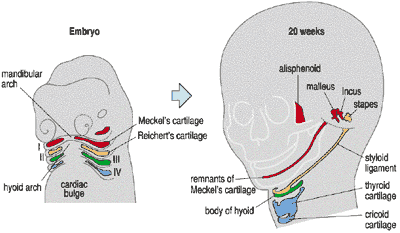
Am having a wonderful time reading, “Your Inner Fish” by Professor Neil Shubin – an exploration into the deep evolutionary roots of the human body. Amazed to contemplate the embryonic structures known as the branchial arches, or gill arches – which we share with sharks! – and the role of the gcm2 gene that is expressed in these arches and controls salt balance in humans and fish. Pharyngula has a wonderful post on this !!
Hoping to find more deep evolutionary roots of mind and brain.
Celebrities and politicians are known for their love of the spotlight. “Me, me, me!” are the words to get ahead by in our modern media circus. As well, it can even be – in the unglamorous world of science – where, in characteristically geeky form, the conventional wisdom is to shout, “my hypothesis, my hypothesis, my hypothesis!”. Once, for example, I had a grad school professor say she was not allowed by her department to teach about glial cells in her brain development class. Another distinguished professor once told me, “don’t even bother sending a grant in, if it is focused on white matter“. No sir, it appears that modern neuroscience shall only focus on one main hypothesis – the neuron doctrine and not on the lowly support cells (astrocytes, oligodendrocytes & microglia) that, actually, make up more than 90% of the human brain. Hmmm, who would have thought to find such a cult of neuronal celebrity in the halls of academia?
With this in mind, I really enjoyed the recent paper “Rett Syndrome Astrocytes Are Abnormal and Spread MeCP2 Deficiency through Gap Junctions” [doi:10.1523/jneurosci.0324-09.2009] by Maezawa and colleagues. The authors point out several critical gaps in the literature – namely that the expression of MeCP2 (the gene that, when mutated, gives rise to Rett syndrome) in neurons does NOT account for all of the many facets of the syndrome. For example, when MeCP2 is deleted only in neurons (in a mouse model), it results in a milder form of abnormal neural development than when deleted in all CNS cell types ( the full mouse syndrome: stereotypic forelimb motions, tremor, motor and social behavioral abnormalities, seizures, hypoactivity, anxiety-like behavior and learning/memory deficits). Also, it is not possible to reverse or rescue these deficits when a functional version of MeCP2 is expressed under a neuron-specific promoter. However, when re-expressed under its endogenous promoter – it is possible to rescue the syndrome (free access article).
The authors thus looked much more closely at the expression of MeCP2 and found that they could indeed visualize the expression of the MeCP2 protein in cultured ASTROCYTES – who are a very, very important type of support cell (just think of the personal secretary Lloyd to Ari Gold on the TV show “Entourage”). The team then examined how astrocytes that lack 80% of the expression of MeCP2 might interact with neurons – the very cells they normally support with secretions of growth factors and cytokines. It turns out that both normal and MeCP2-deficient neurons do not thrive when co-cultured with astrocytes that have weak MeCP2 expression. The team reports that dendritic length is reduced after a day and also a fews days of co-culture, suggesting that the MeCP2-deficient astrocytes are failing to provide the proper trophic support for their neuronal celebrity counterparts. Short dendrites are generally considered a bad-thing since this would predict poorer connectivity, and poorer cognition across the brain.
Hence, it seems that the lowly astrocyte is far more important in understanding what goes wrong in Rett syndrome. Ironically, in this case however, the celebrity status of the neuron remains untarnished as astrocytes can now be blamed for the consequences of MeCP2 mutations. The authors suggest that treatment of Rett syndrome via astrocytes is a worthwhile avenue of investigation. This new direction in the search for a cure will be an exciting story to follow!
pointer to:The Willard Suitcase Exhibit on the documentation of forgotten belongings – hundreds of suitcases of personal belongings – of former residents of Willard Psychiatric Center.
The cognitive and emotional impairments in the autism spectrum disorders can be difficult for parents and siblings to understand and cope with. Here are some graphics and videos that might assist in understanding how genetic mutations and epigenetic modifications can lead to various forms of social withdrawl commonly observed in the autism spectrum disorders in children.
In this post, the focus is just on the MecP2 gene – where mutations are known to give rise to Rett Syndrome – one of the autism spectrum disorders. I’ll try and lay out some of the key steps in the typical bare-bones-link-infested-blogger-fashion – starting with mutations in the MecP2 gene. Disclaimer: there are several fuzzy areas and leaps of faith in the points and mouse model evidence below, and there are many other genes associated with various aspects of autism spectrum disorders that may or may not work in this fashion. Nevertheless, still it seems one can begin to pull a mechanistic thread from gene to social behavior Stay tuned for more on this topic.
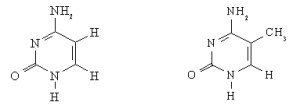
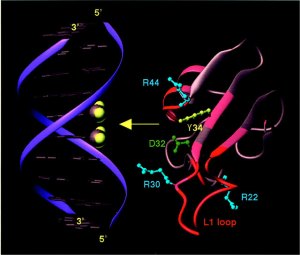
1. The MecP2 gene encodes a protein that binds to 5-Methylcytosine – very simply – a regular cytosine reside with an extra methyl group added at position 5. Look at the extra -CH3 group on the cytosine residue in the picture at right. See? That’s a 5-methylcyctosine residue – and it pairs in the DNA double helix with guanosine (G) in the same fashion as does the regular cyctosine reside (C). OK, now, mutations in the gene that encode the MecP2 gene – such as those found at Arginine residue 133 and Serine residue 134 impair the ability of the protein to bind to these 5-Methylcyctosine residues. The figure at left illustrates this, and shows how the MecP2 protein lines up with the bulky yellow 5-Methylcytosine residues in the blue DNA double helix during binding.
2. When the MecP2 protein is bound to the methylated DNA, it serves as a binding site for another type of protein – an HDAC or histone deacetylase. The binding of MecP2 and HDAC (and other proteins (see p172 section 5.3 of this online book “Chromatin Structure and Gene Expression“)). The binding of the eponymously named HDAC’s leads to the “de-acetylation” of proteins known as histones. The movie below illustrates how histone “de-acetylation” leads to the condensation of DNA structure and repression or shutting down of gene expression (when the DNA is tightly coiled, it is inaccessible to transcription factors). Hence: DNA methylation leads (via MecP2, HDAC binding) to a repression on gene expression.
3. When mutated forms of MecP2 cannot bind, the net result is MORE acetylation and MORE gene expression. As covered previously here, this may not be a good thing during brain development since more gene expression can induce the formation of more synapses and – possibly – lead to neural networks that fail to grow and mature in the “normal” fashion. The figure at right suggests that neural networks with too many synapses may not be appropriately connected and may be locked-in to sub-optimal architectures. Evidence for excessive synaptogenesis is abundant within the autism spectrum disorders. Neuroligins – a class of genes that have been implicated in autism are known to function in cell & synaptic adhesion (open access review here), and can alter the balance of excitation/inhibition when mutated – which seems consistent with this heuristic model of neural networks that can be too adhesive or sticky.
4. Cognitive and social impairment can result from poor-functioning neural networks containing, but not limited to the amygdala. The normal development of neural networks containing the forntal cortex and amygdala are important for proper social and emotional function. The last piece of the puzzle then would be to find evidence for developmental abnormalities in these networks and to show that such abnormalities mediate social and/or emotional function. Such evidence is abundant.
Regarding the effects of MecP2 however, we can consider the work of Adachi et al., who were able to delete the MecP2 gene – just in the amygdala – of (albeit, an adult) mouse. Doing so, led to the disruption of various emotional behaviors – BUT NOT – of various social interaction deficits that are observed when MecP2 is deleted in the entire forebrain. This was the case also when the team infused HDAC inhibitors into the amygdala suggesting that loss of transcriptional repression in the adult amygdala may underlie the emotional impariments seen in some autism spectrum disorders. Hence, such emotional impairments (anxiety etc.) might be treatable in adults (more on this result later and its implications for gene-therapy).
Whew! Admittedly, the more you know – the more you don’t know. True here, but still amazing to see the literature starting to interlink across human-genetic, mouse-genetic, human-functional-imaging levels of analysis. Hoping this rambling was helpful.
Pointer to: NeuroImage establishes a YouTube Channel with the aim of collaborating with the community with a free-to-view platform for posting and viewing videos related to all areas of neuroimaging.
The homunculus (argument) is a pesky problem in cognitive science – a little guy who might suddenly appear when you propose a mechanism for decision making, spontaneous action or forethought etc. – and would take credit for the origination of the neural impulse. While there are many mechanistic models of decision making that have slain the little bugger – by invoking competition between past experience and memory as the source of new thoughts and ideas – one must always tread lightly, I suppose, to be wary that cognitive mechanisms are based completely in neural properties devoid of a homuncular source.
Still, the human mind must begin somewhere. After all, its just a ball of cells initially, and then a tube and then some more folds, layers, neurogenesis and neural migration etc. before maturing – miraculously – into a child that one day looks at you and says, “momma” or “dada”. How do these neural networks come into being? Who or what guides their development toward that unforgettable, “momma (dada)” moment? A somewhat homuncluar “genetic program” – whose instructions we can attribute to millions of years of natural selection? Did early hominid babies say “momma (dada)? Hmmm. Seems like we might be placing a lot of faith in the so-called “instructions” provided by the genome, but who am I to quibble.
On the other hand, you might find that the recent paper by Akhtar et al., “Histone Deacetylases 1 and 2 Form a Developmental Switch That Controls Excitatory Synapse Maturation and Function” [doi:10.1523/jneurosci.0097-09.2009] may change the way you think about cognitive development. The team explores the function of two very important epigenetic regulators of gene expression – histone deacetylases 1,2 (HDAC1, HDAC2) on the functionality of synapses in early developing mice and mature animals. By epigenetic, I refer to the role of these genes in regulating chromatin structure and not via direct, site-specific DNA binding. The way the HDAC genes work is by de-acetylating – removing acetyl groups – thus removing a electrostatic repulsion of acetyl groups (negative charge) on histone proteins with the phosphate backbone of DNA (also a negative charge). When the histone proteins carry such an acetyl group, they do NOT bind well to DNA (negative-negative charge repulsion) and the DNA molecule is more open and exposed to binding of transcription factors that activate gene expression. Thus if one (as Akhtar do) turns off a de-acetylating HDAC gene, then the resulting animal has a genome that is more open and exposed to transcription factor binding and gene expression. Less HDAC = more gene expression!
What were the effects on synaptic function? To summarize, the team found that in early development (neonatal mouse hippocampal cells) cells where the HDAC1 or 2 genes were turned off (either through pharmacologic blockers or via partial deletion of the gene(s) via lentivirus introduction of Cre recombinase) had more synapses and more synaptic electrical activity than did hippocampal cells from control animals. Keep in mind that the HDACs are located in the nucleus of the neuron and the synapses are far, far away. Amazingly – they are under the control of an epigenetic regulator of gene expression; hence, ahem, “epigenetic puppetmasters”. In adult cells, the knockdown of HDACs did not show the same effects on synaptic formation and activity. Rather the cells where HDAC2 was shut down showed less synaptic formation and activity (HDAC1 had no effect). Again, it is amazing to see effects on synaptic function regulated at vast distances. Neat!
The authors suggest that the epigenetic regulatory system of HDAC1 & 2 can serve to regulate the overall levels of synaptic formation during early cognitive development. If I understand their comments in the discussion, this may be because, you don’t necessarily want to have too many active synapses during the formation of a neural network. Might such networks might be prone to excitotoxic damage or perhaps to being locked-in to inefficient circuits? The authors note that HDACs interact with MecP2, a gene associated with Rett Syndrome – a developmental disorder (in many ways similar to autism) where neural networks underlying cognitive development in children fail to progress to support higher, more flexible forms of cognition. Surely the results of Akhtar et al., must be a key to understanding and treating these disorders.
Interestingly, here, the controller of these developmental phenotypes is not a “genetic program” but rather an epigenetic one, whose effects are wide-spread across the genome and heavily influenced by the environment. So no need for an homunculus here.
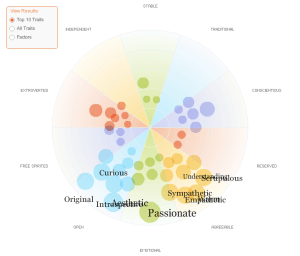
With more and more genes being directly associated with personality or as moderators of correlations between personality and brain structure/function (here, here, here, here) it was fun to try out the latest online “big-5 personality profiler“.
10 mins of self-reflective fun. My profile displayed at left.
pointer to Jim Edwards’ article on a very unfortunate conflict of interest within NAMI – a very grassy grass roots organization providing outreach, advocacy and educational support to families and patients coping with mental illness.
According to NAMI, some 56% of its budget (annual revenues have been > $13M) was funded by pharma!
My own stigma-busting efforts are with a wonderfully dedicated group of NAMI volunteers (i.e. we do everything ourselves and don’t get a nickel from NAMI). WTF? This is a shame.
In Robert Sapolsky’s book, “Why Zebras Don’t Get Ulcers“, he details a biological feedback system wherein psychological stress leads to the release of glucocorticoids that have beneficial effects in the near-term but negative effects (e.g. ulcers, depression, etc.) in the long-term. The key to getting the near-term benefits and avoiding the long-term costs – is to be able to turn OFF the flow of glucocorticoids. This is normally dependent on circuitry involving the frontal cortex and hippocampus, that allow individuals to reset their expectations and acknowledge that everything is OK again. Here’s the catch (i.e. mother nature’s ironic sense of humor). These very glucocorticoids can initiate a kind of reorganization or ‘shrinkage’ to the hippocampus – and this can disable, or undermine the ability of the hippocampus to turn OFF the flow of glucocorticoids. Yes, that’s right, the very switch that turns OFF glucocorticoid flow is disabled by exposure to glucocorticoids! Can you imagine what happens when that switch (hippocampus) get progressively more disabled? Your ability to turn OFF glucocorticoids gets progressively worse and the negative effects of stress become more and more difficult to cope with.
Sounds depressing. Indeed it is, and there are many findings of reduced hippocampal volume in various depressive illnesses. The complex problem at hand, then, is how to reverse the runaway-train-like (depression leads to glucocorticoids which leads to smaller hippocampus which leads to more depression) effects of stress and depression?
One new avenue of research has been focused on the ability of the hippocampus to normally produce new cells – neurogenesis – throughout life. Might such cells be useful in reversing hippocampal remodeling (shrinkage)? If so, what molecules or genes might be targeted to drive this process in a treatment setting?
The recent paper by Joffe and colleagues, “Brain derived neurotrophic factorVal66Met polymorphism, the five factor model of personality and hippocampal volume: Implications for depressive illness” [doi: 10.1002/hbm.20592] offers some key insights. They examined 467 healthy participants of the Brain Resource International Database (a personalized medicine company with a focus on brain health) using personality tests, structural brain imaging and genotyping for an A-to-G variation (valine-to-methionine) polymorphism in the BDNF gene. They report that lower volume of the hippocampus was associated with higher scores of neuroticism (worriers) – but, this negative relationship was not found in all people – just those who carry the A- or methionine-allele. Thus, those individuals who carry the G/G (valine/valine) genotype of BDNF may be somewhat more protected from the negative (hippocampal remodeling) effects of psychological stress. Interestingly, the BDNF gene seems to play a role in brain repair! So perhaps this neuro-biochemical pathway can be explored to further therapeutic benefit. Exciting!!
By the way, the reason zebras don’t get ulcers, is because their life revolves around a lot of short term stressors (mainly hungry lions) where the glucocorticoid-stress system works wonderfully to keep them alive. Its only homo sapiens who has enough long-term memory to sit around in front of the TV and incessantly fret about the mortgage, the neighbors, the 401K etc., who have the capacity to bring down all the negative, toxic effects of chronic glucocorticoids exposure upon themselves. My 23andMe profile shows that I am a G/G valine/valine … does this mean I’m free to worry more? Now I’m worried. More on BDNF here.


![Reblog this post [with Zemanta]](https://i0.wp.com/img.zemanta.com/reblog_c.png)

 Am having a wonderful time reading, “
![Reblog this post [with Zemanta]](https://i0.wp.com/img.zemanta.com/reblog_e.png)

 Celebrities and politicians are known for their love of the spotlight. “Me, me, me!” are the words to get ahead by in our modern


 OK, now, mutations in the gene that encode the MecP2 gene – such as those found at Arginine residue 133 and Serine residue 134 impair the ability of the protein to bind to these 5-Methylcyctosine residues.
  The
The 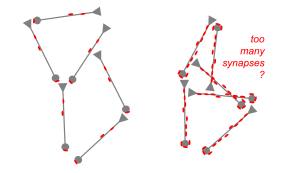 suggests that neural networks with too many synapses may not be appropriately connected and may be locked-in to sub-optimal architectures.



 With more and more genes being directly associated with personality or as moderators of correlations between personality and brain structure/function (



 Genes 2 Brains 2 Mind 2 Me