Feeds:
Posts
Comments

Archive for the ‘Uncategorized’ Category

Peter Mark Roget (Roget's Thesaurus)
Image by dullhunk via Flickr

On Fridays, after a regular practice session, our shala is open for quiet meditation.  This is a new experience for me, even as I’ve read much about the mental and physical health benefits accrued by experienced practitioners.  As someone who is totally exhausted after practice – indeed, I couldn’t move another muscle even if I wanted – I always think it will be easy to settle in, and pass 30 minutes  in quiet stillness.

Sure enough though, even as my body is spent and motionless, my mind starts to wander, and wander, and wander some more.  “Damn”, I think, “here we go again”. Just a few minutes in, and I’m losing a battle – with myself.  “This is going to be the longest 30 minutes of my life!” What to do?

Some experts say to simply LABEL your thoughts and feelings.  Just find a word to place on the thought or feeling – and then – let it go.  Does this really work?  How does this trick work?

Recent brain imaging studies seem to show that when a word is applied to a negative emotion,  the brain changes how it processes that emotion and shifts processing to neural systems that avoid centers of the brain (the amygdala, in particular) that send neural projections to our face, gut and heart (areas where we tend to physically “feel” our bad feelings).   It seems that our ability to use words is an important tool in how we cope with emotional experience.  Either we succumb to the storms of negative emotions that can well up inside us from time to time (and feel lousy inside), or we can manage these feelings – using our words – and feel less lousy inside.   Apparently, the use of words, alters neural processing – leading us to experience less tightening in the chest, clenching in the gut, etc.,  etc. than we would otherwise feel when negative emotions come over us.  One of the researchers, David Cresswell, remarks: “This is an exciting study because it brings together the Buddha‘s teachings – more than 2,500 years ago, he talked about the benefits of labeling your experience – with modern neuroscience.”

But this is easier said than done.

How do I label a thought?  How do I label an emotion?  I mean, “I feel, um, um, frustrated, lousy, anxious … crap … I’m not exactly sure how I feel?  What’s the word I’m looking for?

Indeed – the words – the words – as in, “In the beginning was the Word, and the Word was with God, and the Word was God.” WORDS.  Do I know enough words?  How many words are there anyway to describe all the possible feelings that a person can feel?  How many do you know?

Check this list out.    There are more than 3,000 words in the English language to describe various feelings.  Thank you Peter Mark Roget (who, ironically, worked on the first thesaurus as a means to cope with negative feelings associated with depression).  I will bring my thesaurus – full of these tools to help me label my feelings – to meditation practice from now on!

Enhanced by Zemanta

Read Full Post »

signaling (animated)
Image by Genista via Flickr

One thing I’ve learned doing yoga is that introspection – like the postures – takes a lot of practice.

Here’s a pointer to a great new science article on the basic brain biology of introspection, or “thinking about thinking”.  The article, Relating Introspective Accuracy to Individual Differences in Brain Structure by Fleming et al., describes experiments where participants had to (a) make a rather difficult perceptual observation and then (b) self-report how confident they were in that judgment.  From the introduction …

Our moment-to-moment judgments of the outside world are often subject to introspective interrogation. In this context, introspective or “metacognitive” sensitivity refers to the ability to discriminate correct from incorrect perceptual decisions, and its accuracy is essential for the appropriate guidance of decision-making and action.

… sounds a lot like the way people describe meditation as being an active or “aware” state where (a) very basic perceptual information (sounds, feelings, vibrations) are (b) seamlessly coupled, labeled or processed with more abstract and/or deeper thoughts.  As Thomas Metzinger suggests in his book, The Ego Tunnel, the ability to become “aware” of early sensory perceptions is an important aspect of understanding the so-called “real world” as opposed to the world that our ego, or conscious mind normally builds for us.  Metzinger points to Paul Churchland‘s ideas on “eliminative materialsm” as emphasizing the importance of (a) early sensory experience and its (b) coupling with introspective abilities.  Churchland’s ideas (from p53 in Metzinger’s book):

“I suggest then, that those of us who prize the flux and content of our subjective phenomenological experience need not view the advance of materialist neuroscience with fear and foreboding.” … “Quite the contrary.  The genuine arrival of a materialist kinematics and dynamics for psychological states and cognitive processes will constitute not a gloom in which our inner life is suppressed or eclipsed, but rather a dawning, in which its marvelous intricacies are finally revealed – most notably, if we apply [it] ourselves, in direct self-conscious introspection.”

Churchland’s notion of a revelation of our true inner lives (via an understanding of sensory processes) – loosely – reminds me of some of the ancient yogic notions of a gap between the “real” world and our everyday “mental” world.  These notions are a core of yoga spirituality.  As covered in-depth by Mircea Eliade in Yoga: Immortality and Freedom:

For Samkhya and Yoga the problem is clearly defined.  Since suffering has its origins in ignorance of “Spirit” – that is,  in confusing “Spirit” with psychomental states – emancipation can be obtained only if the confusion is abolished. (p14)   …   Yoga accepts God, but we shall see that Patanjali does not accord him very much importance.  The revelation is based on knowledge of the ultimate reality – that is, on an “awakening” in which object completely identifies itself with subject.  (The “Self” “”contemplates” itself;  it does not “think” itself, for thought is itself an experience and, as such, belongs to praktri.)(p29)

So it seems that both the ancient yogis and some modern scientists suggest that there is indeed a gap between the way the world really “is” and the way we “think” about it.  To close this gap, it may help to train ourselves to the difference between “contemplating” – which emphasizes basic sensory information (listening, feeling, etc.) – rather than just “thinking” about stuff.  I think this aspect of our mental life may be, in part, what Churchland is emphasizing and also is one of the most basic tenets of vipassana meditation.

Just focus on the basic sensory perceptions … live in this moment!

The brain scientists who performed the research on the relation of (a) basic sensory perceptual processes to (b) judgments of its accuracy used brain imaging to examine correlations in brain structure (gray matter volume and white-matter integrity) with performance on the (a) and (b) tasks and found a number of brain regions in the very front of the brain that were correlated with “introspective ability” (more on the science here).  I wonder if they were thinking of mediation when they wrote:

This raises the tantalizing possibility of being able to “train” metacognitive ability by harnessing underlying neural plasticity in the regions that we identify here.

I suppose a few old ascetic yogis out there might have chuckle at the thought of a western “training program” (just 10 minutes a day, no batteries required etc.) … methinks it takes practice – A LOT of practice!

Enhanced by Zemanta

Read Full Post »

Last night I sat together with my 6 y.o. son at a kirtan in our yoga shala listening, clapping, chanting and singing along with Girish and his band.  My little guy is something of a yogi himself – even though we’re both newbies to yoga.  (At left is his drawing of  yoga class.)

At some point during the performance, as we sat together on the floor and the vibrations pulsed through us, I looked down at his gentle innocent face – and it suddenly dawned on me – why I’ve been feeling so compelled to expose him (and his younger brother) to kids yoga classes – not to mention kirtans.

Someday, I’ll be long gone from this world.

How will my children find me when I gone?

Where will they look?

How can they find comfort in time of distress?  How can they connect with “me” – my heart and soul?

There amidst the chanting, it became clear – that yoga, being a form of spirituality in its barest, stripped-down most primitive form – is a way that folks come to know their true selves, heart and soul.

Suddenly I realized that, someday when I am long gone, my sons will be able to find “me” –  my own self, heart and soul – RIGHT HERE! On the bare floor – wherever they are – between their own hands,  in the place where their own beads of sweat fall.  They will find their own selves – hearts and souls – in their practice – and know that their dad found his true self, heart and soul right there – in the very same place – where the sweat falls from the brow.

It felt so wonderfully comforting to realize that there IS a way to stay connected.  To share a living, breathing bond that survives long after the body.  There is a path! I think doing yoga with my kids is a way to build a passageway – through space and time – to find each other again – long after we leave this world.  I will never forget that moment of clarity.

I’ve seen many great dads in my town, and I think they all feel the same way – whether it be baseball, football, basketball, soccer etc.  Yoga – although a deeply spiritual endeavor – does not have to be special in this regard (you should see some of the fanatical baseball dads in my town!).  Perhaps, we all imagine that someday, our kids will play and teach their own kids in the same way we taught them.  Perhaps, many years from now, they’ll stop for a moment and think fondly of us – about the simple joy they shared, and – in that instant – realize that there is a living bond that cuts across space and time.

Whatever you LOVE to do –> teach it to your kids and you will forge a bond that survives long after you are gone!

Read Full Post »

Read Full Post »

The Buddha as an ascetic. Gandhara, 2-3rd cent...
Image via Wikipedia

One shorthand way I’ve come to think about yoga and other eastern religions is that its practitioners become adept at turning their attention away from stress, conflict, tragedy, etc. of mortal life and towards inner sources of tranquility and peace.  Basically, the meditative training helps one to experience a less conflicted and stressed-out life.

With this in mind,  I started Mircea Eliade‘s tome Yoga: Immortality and Freedom where,  in Chapter 1, Eliade – an academic authority on the topic – gets right to THE main point of Yoga and its historical antecedents found in the writings of ancient mystics, ascetics and Samkhya philosophy that sought to understand mortal and immortal components of man:

For Samkhya and Yoga the problem is clearly defined.  Since suffering has its origins in ignorance of “Spirit”  – that is, confusing “Spirit” with psychomental states – emancipation [from suffering] can be obtained only if the confusion is abolished.

OK, so Yoga will help emancipate me from suffering.  In plain-speak,  I will become (with practice) less stressed by the aches and pains and viscisitudes of life, which, in turn, yields a great many health benefits.  Sounds reasonable from a pure science point of view.  Nevertheless, Eliade emphasizes:

From the time of the Upanishads India rejects the world as it is and devaluates life as it reveals itself to the eyes of the sage – ephemeral, painful, illusory.  Such a conception leads neither to nihilism nor to pessimism.  This world is rejected, this life depreciated, because it is known that something else exists, beyond becoming, beyond temporality, beyond suffering.

Reject this world?  Really?  Is it so horrible?  If this life is so ridden with “universal suffering”, then why do yoga teachers always remind us to, “live in the moment”?  In the past months, I’ve been trying to embrace these passing moments … the rays of sun falling through the branches, the sound of the breeze, a momentary expression on my child’s face … you know … the moment.  I was really digging this aspect of yoga and its emphasis on the here and now and embracing the myriad small pleasures in life.  This effort has made my life more peaceful and full.  Eliade pops my yoga bubble further:

Intrinsically, then, this universal suffering has a positive, stimulating value.  It perpetually reminds the sage and the ascetic that but one way remains for him to attain freedom and bliss – withdrawal from the world, detachment from possessions and ambitions, radical isolation.

Is this where a yoga practice leads?  Radical isolation?  Avoiding all these precious so-called “painful” moments (children laughing, birds singing, waves splashing, etc. etc.).  Say it aint so Mircea!  I was really enjoying these moments.  The meditative practice of yoga has brought joy and calm to my everyday experience – an experience of a hundred passing, ordinary moments.

Hope to come to a deeper understanding of this central “Doctrine of Yoga” in the chapters to come.  I suspect that the purpose of Yoga is (from the philosophical point of view) somewhat loftier than to simply make its practitioners more joyful and calmer.  The super hard-core yogis of the past were probably seeking something more profound – full freedom, emancipation, immortality, samadhi etc.

Worthwhile to be sure, but, for me, for now, not at the expense of all the ordinary passing moments in life.

Post script: A closer look at the word “suffering” shows that it is translated from the sanskrit “dukha” which really just means discomfort or tension.  From wikipedia:

“It is perhaps amusing to note the etymology of the words sukha (pleasure, comfort, bliss) and duḥkha (misery, unhappiness, pain). The ancient Aryans who brought the Sanskrit language to India were a nomadic, horse- and cattle-breeding people who travelled in horse- or ox-drawn vehicles. Su and dus are prefixes indicating good or bad. The word kha, in later Sanskrit meaning “sky,” “ether,” or “space,” was originally the word for “hole,” particularly an axle hole of one of the Aryan’s vehicles. Thus sukha … meant, originally, “having a good axle hole,” while duhkha meant “having a poor axle hole,” leading to discomfort.”

So I need not remain hung-up on a tradition that tells me to both “live in the moment” and also “that these precious moments are chock full of suffering”.  Even happy experiences come with some underlying tension and uncertainty.  Indeed, the mind can easily wander its way from a happy to a troubled state in a few seconds.  Yes, there is constant tension to varying degrees in life.  How is it that yoga can help a person minimize their experience of this tension?

Enhanced by Zemanta

Read Full Post »

Manipura chakra
Image via Wikipedia

More on CG Jung‘s famous “chakra lectures” …

In lecture 2 he opines on symbolic and psychological aspects of the 3rd chakraManipura – shown here with a yellow center and red triangle that symbolize fire.  Interestingly, the location of this chakra overlaps with what we, today, call the “solar” plexus – not because of its symbolic connections to the fiery sun – but rather, simply because the neural projections from this plexus, located between the stomach and the spine, radiate outwardly in a sun-like fashion.

Jung notes that fire symbolism often follows water symbolism – just as occurs in the chakra hierarchy where the previous chakra is symbolized by water.  This ancient pattern of symbolism is common across many religious traditions.

“One sees all that very beautifully in the Catholic rite of baptism when the godfather holds the child and the priest approaches with the burning candle and says: Dono tibi lucem eternam (I give thee the eternal light) – which means, I give you relatedness to the sun, to the God.”

So, I guess, after a person emerges from the murky depths of water, the next stage of their spiritual journey or subconscious “awakening” is a time in their lives when they grow to feel connected to something greater than themselves, to something eternal, beyond the everyday world, perhaps cosmic or goldly, etc.  Jung suggests that this initial connection to “god” has long been symbolized by the sun and by fire.

“This is a worldwide and ancient symbolism, not only in the Christian baptism and the initiation in the Isis mysteries.  For instance, in the religious symbolism of ancient Egypt, the dead Pharoh goes to the underworld and embarks in the ship of the sun.  You see, to approach divinity means the escape from the futility of the personal existence, and the achieving of the eternal existence, the escape to a nontemporal form of existence.  The Pharoh climbs into the sun bark and travels through the night and conquers the serpent, and then rises again with the god, and is riding over the heavens for all eternity.”

Furthermore, Jung suggests, there is a shared, underlying psychological reason why so many ancient cultures used the common symbols of fire for this phase of their development.  It would seem that for many, that once they let go of the closely-held, relatively petty details of their day-to-day life and acknowledge a connection between themselves and the wider universe and things divine – that, upon letting go – their own fires of passion and emotion become alight.

So it is just that – you get into the world of fire, where things become red-hot.  After baptism, you get right into hell – that is the enantiodromia.  And now comes the paradox of the east: it is also the fullness of jewels.  But what is passion, what are emotions? There is the source of fire, there is the fullness of energy.  A man who is not on fire is nothing: he is ridiculous, he is two-dimensional. … So when people become acquainted with the unconscious they often get into an extraordinary state – they flare up, they explode, old buried emotions come up, they begin to weep about things which happened forty years ago.

I think I can relate to this notion.  Perhaps when you accept that you’re just a part of a larger plan, or just a single link in a long continuum, you stop worrying about the petty stuff which then allows your own deeper passions and emotions to flow more freely.  Both the good emotions related to creativity and love as well as feelings of sadness and loss that come along with recognizing your fate and limitations  – all begin to emerge.  These feelings make a person feel more “alive” than they would just playing it safe, workin’ 9-to-5 payin’ the bills etc., etc. and never allowing themselves to embark on their spiritual journey.

So it seems, as suggested by Jung, that we begin our spiritual awakening as humans have for thousands of years, by “taking the plunge” and choosing – not the “safe career” path – but a path in life that “means something” to us.  From the dark, uncertain waters, we emerge – and then the inner fires begin to burn, to inflame our passions and give us energy, to live and to create.

… can’t wait to see what’s in store next!

Enhanced by Zemanta

Read Full Post »

Television icons
Image via Wikipedia

just a pointer to a great SciVee episodeGenetic Contribution To Variation In Cognitive Function In Twins

Their data suggest that genetic influences on cognitive function act outside of the brain areas most commonly activated during cognitive tasks.  The areas where genes seem to exert influence on brain activity are quite variable from person to person (which is why they don’t show up in group-level analyses).  Thus folks with different genetic variability use slightly different brain areas to accomplish the same cognitive task.

Enhanced by Zemanta

Read Full Post »

Artist's depiction of the separation stage. Th...
Image via Wikipedia

Once in class, while trying to get my arms up during Prasarita Padottanasana C (no hopes for “over” and “down to the floor” for me, just “up” with merely a slight forward bend) my instructor said that the first time she was able to touch her clasped hands to the floor, she felt like she “went out of her body”.   Lucky her! Wouldn’t that be cool! I thought to myself.  Maybe someday.

Could her experience – possibly – be akin to the experiences of early Vedic writers and yogis who practiced strange and difficult postures as part of their spiritual development?

The yoga sutras III.39 “bandhakarana saithilyat pracara samvedanat ca cittasya parasariravesah” (Through relaxation of the causes of bondage, and the free flow of consciousness, the yogi enters another’s body at will.)  and  III.40 “udanajayat jala panka kantakadisu asangah utkrantih ca” (By mastery of udana vayu, the yogi can walk over water, swamps and thorns without touching them.  He can also levitate.) – seem to tenuously address something like “being out of one’s body”.

What science research studies today – unknown to the ancient sages who may have experienced such states – are the various brain systems that can give rise to such experiences. The fancy scientific terms for hallucinations of separating from one’s body are heautoscopy and autoscopy and go by other more common terms such as doppelganger or just “out of body experiences”.  As reported in, Brain electrodes conjure up ghostly visions (Nature, 2006) and in “Electrodes trigger out-of-body experience” (Nature, 2002):

Simple stimulation of the brain can cause the mind to play complex and creepy tricks on itself, neurologists have discovered. They found that, by inserting electrodes into a specific part of the brain [left temporoparietal junction], they could induce a patient to sense that an illusory ‘shadow person’ was lurking behind her and mimicking her movements.

People describe out-of-body experiences as feeling that their consciousness becomes detached from their body, often floating above it. … Blanke found that electrically stimulating one brain region — the right angular gyrus — repeatedly triggers out-of-body experiences. … The right angular gyrus integrates visual information — the sight of your body — and information that creates the mind’s representation of your body. This is based on balance and feedback from your limbs about their position in space.

So, the whole proposition of “out of body” seems less far-fetched to me,  perhaps there are possibilities to experience such states of mind – more plausible under conditions of neurological pathology – rather than during yoga practice.  But, something to meditate on in the years to come.

Enhanced by Zemanta

Read Full Post »

View of Capitol Hill from the U.S. Supreme Court
Image via Wikipedia

Pointer to Daniel MacArthur’s (Genomes Unzipped) post on the recent political grandstanding in consumer genetics.

This blog is more genomes, brains, social entrepreneurship and health 2.0 – than politics.   Hopefully the political phase will soon pass and some sensible regulations will preserve the right of consumers to access their genomes, while protecting consumers from scammers.

The one thing I hope does not happen is that the regulatory agencies (they work for us right?) “punt” on the issue and turn the whole consumer genetics ball of wax over to medical doctors and the medical insurance complex.  Like many, I am inspired by open-source, open-access, crowd-sourcing, bioinformatic and other open, web-based tools that allow consumers to by-pass the so-called “experts” in news media, finance, health and so many other industries that are being transformed by information technology.   The economic benefits for consumers are well documented, and so,  a country like the U.S. – economically sinking in a healthcare affordability crisis – might benefit (in the longer run) if it nurtured industries that helped consumers freely and openly ascertain their risks for illness without having to go through the economic choke point of an establishment of medical “experts”.

See health 2.0,  Regina Herzlinger’s “Who Killed Health Care?“,  Michael E. Porter and Elizabeth Olmsted Teisberg’s “Redefining Health Care: Creating Value-Based Competition on Results“,  Andy Kessler’s “The End of Medicine: How Silicon Valley (and Naked Mice) Will Reboot Your Doctor”  and Nobel Prize-winning economist Kenneth Arrow’s classic 1963 essay “Uncertainty and the Welfare Economics of Medical Care”  for some more on this.

Update:  The comment stream on Daniel MacArthur’s (Genomes Unzipped) post are chilling.  Many of the responders seem to have experience in the direct-to-consumer genetics business, and they don’t sound as optimistic as my (naive) self.  Part of one comment:

Seriously, you don’t understand. The DTC testing industry is ALREADY DEAD. In the Wall Street Journal, Shuren declared DTC subject to PMA approval, which costs tens of million of dollars! People are quitting the companies by the droves. 23andMe’s former director of regulatory affairs left for NextBio. VCs have refused to re-up. There will be no Series X+1 financing for an industry with no growth potential.

Enhanced by Zemanta

Read Full Post »

Nothing to do with science … but, when I was a kid, I papered my room with posters of baseball, football, soccer and other sport stars.  If I could do the same today (wife says no way), I’d put up a huge poster of this – 1998 Heisman Trophy winner Ricky Williams who practices yoga.  Some other famous professional athletes known to practice yoga are: LeBron James, Kareem Abdul-Jabbar, Ray Lewis, Andre Iguodala, Barry Zito … the list grows!

Read Full Post »

Shakti
Image by alicepopkorn via Flickr

Some of the most epic and beautiful of the yoga sutras are found in the final book IV.  One of them popped into mind when I came across a recent neuroscience report entitled, “Predicting Persuasion-Induced Behavior Change from the Brain” by Emily Falk and colleagues at the Department of Psychology at the  University of California, Los Angeles.  [DOI:10.1523/JNEUROSCI.0063-10.2010].  Here, a research team asks if there are places in the brain that encode future – yes, future actions.  More specifically, they asked 20 volunteers to lay in an MRI scanner and listen/view a series of messages on the benefits and importance of sunscreen.  Then, 1-week later, they inquired about the frequency of sunscreen use.  It turns out that sunscreen use did increase (suggesting the subjects read the messages), but more interestingly, that there were correlations in brain activity (in several regions of the brain) with the degree of increased sunscreen use.  That is, some individuals recorded a bit of brain activity that predicted their future use of sunscreen.

Very neat indeed!  although, there are likely many reasons to remain skeptical.  This is because the brain is a very complex system and, with so much going on inside, its likely anyone could find correlations in activity with any-old “something” and “some area of the brain” if they looked hard enough.  In this article however, the authors had preselected their brain regions of interest – the medial frontal cortex and the precuneus – since another group had shown that activity in these regions were able to predict future actions (on the order of a few seconds).  Thus, the research team was not looking for any willy-nilly correlation, but for a specific type of interaction between the brain and future action (this time on the order of weeks).

The particular ancient sutra that may have some poetic tie-ins here is IV.12 atita anagatam svarupatah asti adhvabhedat dharmanam “the existence of the past and future is as real as that of the present.  As moments roll into movements which have yet to appear as the future, the quality of knowledge in one’s intellect and consciousness is affected.”

Might there be neural traces predicting one future actions?  This research makes it seem possible.  Are these traces accessible to ordinary folks or advanced meditators?  Who knows.  As always, the joy lies in trying to find out and trying to reach ever deeper states of harmony and unity.  One thing I found intriguing was that the research team picked the medial prefrontal cortex and the precuneus because these brain regions,

“are reliably co-activated across a host of “self” processes and the extent to which people perceive persuasive messages to be self-relevant has long been thought to play a part in attitude and behavioral change”.

Certainly, when something feels relevant to “me” and reinforces my own “self” image, I’m more prone to remember and act upon it.  Yoga, for example! I hope I’m encoding signals now that will predict my attendance in class this week!

Enhanced by Zemanta

Read Full Post »

Experimercials

coffeespank

Husband:  Darling, I wish you would stop marketing the results of clinical trials for medications that you know have mainly placebo effects with no side effect.

Wife:  Dear, you are missing the point. The placebo lets us know that there is still something magical inside of us … something that hasn’t been educated-out, or televisioned-out, or churched-out, or spanked-out. Even when we know exactly how that whole experience is going to play out, it is still fun to play along. Do you know what I mean?

Husband:  Wait, are we talking about experimercials?

Read Full Post »

Nucleosome structure.
Image via Wikipedia

pointer to the NOVA program on epigenetics “Ghost in Your Genes” (YouTube link here).  Fantastic footage.  Great intro to epigenetics and so-called trans-generational effects and the inheritance of epigenetic marks – which, in some cases – are left by adverse or stressful experience.  A weird, wild, game-changing concept indeed – that my grandchildren could inherit epigenetic changes induced in my genome by adverse experience.

Reblog this post [with Zemanta]

Read Full Post »

The structure of part of a DNA double helix
Image via Wikipedia

just a pointer to: Genetic Future’s pointer to the recent article, “Family become first to have DNA sequenced for non-medical reasons“.    The father suggests, “it will be ethically improper if you don’t have your children sequenced“.

Early days.

Reblog this post [with Zemanta]

Read Full Post »

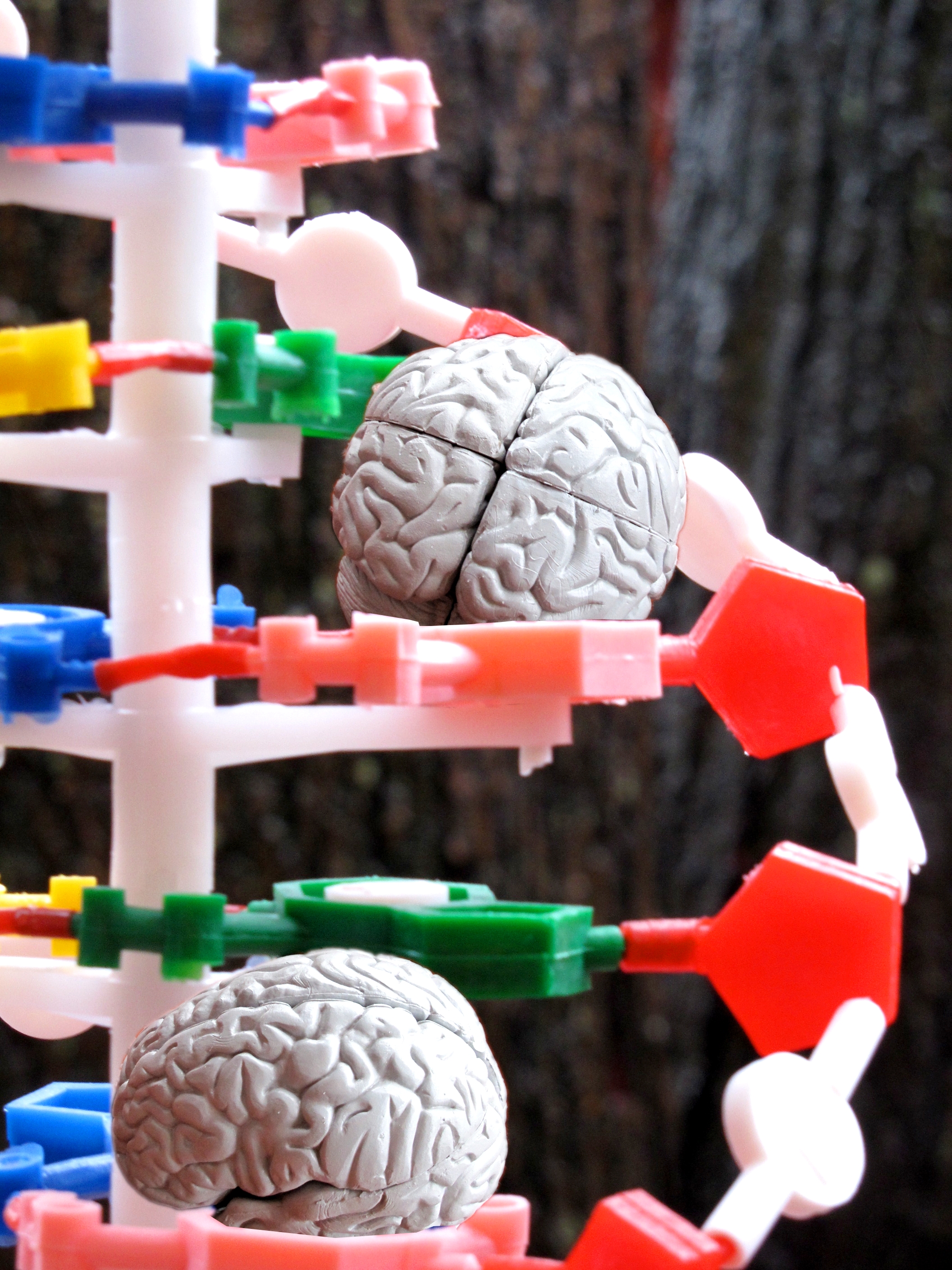
tiny lego brain

“Hey Dad, look at the little bwain!”  (my 4 y.o.)

Read Full Post »

Where's Waldo in Google Maps?
Image by Si1very via Flickr

In an earlier post on Williams Syndrome, we delved into the notion that sometimes a genetic variant can lead to enhanced function – such as certain social behaviors in the case of WS.  A mechanism that is thought to underlie this phenomenon has to do with the way in which information processing in the brain is widely distributed and that sometimes a gene variant can impact one processing pathway, while leaving another pathway intact, or even upregulated.  In the case of Williams Syndrome a relatively intact ventral stream (“what”) processing but disrupted dorsal stream (“where”) processing leads to weaker projections to the frontal cortex and amygdala which may facilitate gregarious and prosocial (a lack of fear and inhibition) behavior.  Other developmental disabilities may differentially disrupt these 2 visual information processing pathways.  For instance, developmental dyspraxia contrasts with WS as it differentially disrupts the ventral stream processing pathway.

A recent paper by Woodcock and colleagues in their article, “Dorsal and ventral stream mediated visual processing in genetic subtypes of Prader–Willi syndrome” [doi:10.1016/j.neuropsychologia.2008.09.019] ask how another developmental disability – Prader-Willi syndrome – might differentially influence the development of these information processing pathways.  PWS arises from the lack of expression (via deletion or uniparental disomy) of a cluster of paternally expressed genes in the 15q11-13 region (normally the gene on the maternally inherited chromosome is silent, or imprintedrelated post here).  By comparing PWS children to matched controls, the team reports evidence showing that PWS children who carry the deletion are slightly more impaired in a task that depends on the dorsal “where” pathway whilst some sparing or relative strength in the ventral “what” pathway.

Reblog this post [with Zemanta]

Read Full Post »

Corticotropin-releasing hormone
Image via Wikipedia

According to the authors of  “Protective effect of CRHR1 gene variants on the development of adult depression following childhood maltreatment: replication and extension”  [PMID: 19736354], theirs is “the first instance of Genes x Environment research that stress has been ascertained by more than 1 study using the same instrument“.  The gene they speak of is the Corticotropin-releasing hormone receptor 1 (CRHR1) gene (SNPs rs7209436, rs110402, rs242924 which can form a so-called T-A-T haplotype which has been associated with protection from early life stress (as ascertained using the Childhood Trauma Questionnaire CTQ)).

The research team examined several populations of adults and, like many other studies, found that early life stress was associated with symptoms of depressive illness but, like only 1 previous study, found that the more T-A-T haplotypes a person has (0,1,or 2) the less likely they were to suffer these symptoms.

Indeed, the CRHR1 gene is an important player in a complex network of hormonal signals that regulate the way the body (specifically the hypothalamic pituitary adrenal axis) transduces the effects of stress.  So it seems quite reasonable to see that individual differences in ones ability to cope with stress might correlate with genotype here.   The replication seems like a major step forward in the ongoing paradigm shift from “genes as independent risk factors” to “genetic risk factors being dependent on certain environmental forces”.  The authors suggest that a the protective T-A-T haplotype might play a role in the consolidation of emotional memories and that CRHR1 T-A-T carriers might have a somewhat less-efficient emotional memory consolidation (sort of preventing disturbing memories from making it into long-term storage in the first place?) – which is a very intriguing and testable hypothesis.

On a more speculative note … consider the way in which the stress responsivity of a developing child is tied to its mother’s own stress responsivity.  Mom’s own secretion of CRH from the placenta is known to regulate gestational duration and thus the size, heartiness and stress responsiveness of her newborn.  The genetic variations are just passed along from generation to generation and provide some protection here and there in an intertwined cycle of life.

The flowers think they gave birth to seeds,
The shoots, they gave birth to the flowers,
And the plants, they gave birth to the shoots,
So do the seeds they gave birth to plants.
You think you gave birth to the child.
None thinks they are only entrances
For the life force that passes through.
A life is not born, it passes through.

anees akbar

Reblog this post [with Zemanta]

Read Full Post »

Twin studies have long suggested that genetic variation is a part of healthy and disordered mental life.  The problem however – some 10 years now since the full genome sequence era began – has been finding the actual genes that account for this heritability.

It sounds simple on paper – just collect lots of folks with disorder X and look at their genomes in reference to a demographically matched healthy control population.  Voila! whatever is different is a candidate for genetic risk.  Apparently, not so.

The missing heritability problem that clouds the birth of the personal genomes era refers to the baffling inability to find enough common genetic variants that can account for the genetic risk of an illness or disorder.

There are any number of reasons for this … (i) even as any given MZ and DZ twin pair shares genetic variants that predispose them toward the similar brains and mental states, it may be the case that different MZ and DZ pairs have different types of rare genetic variation thus diluting out any similar patterns of variation when large pools of cases and controls are compared …  (ii) also, the way that the environment interacts with common risk-promoting genetic variation may be quite different from person to person – making it hard to find variation that is similarly risk-promoting in large pools of cases and controls … and many others I’m sure.

One research group recently asked whether the type of common genetic variation(SNP vs. CNV) might inform the search for the missing heritability.  The authors of the recent paper, “Genome-wide association study of CNVs in 16,000 cases of eight common diseases and 3,000 shared controls” [doi:10.1038/nature08979] looked at an alternative to the usual SNP markers – so called common copy number variants (CNVs) – and asked if these markers might provide a stronger accounting for genetic risk.  While a number of previous papers in the mental health field have indeed shown associations with CNVs, this massive study (some 3,432 CNV probes in 2000 or so cases and 3000 controls) did not reveal an association with bipolar disorder.  Furthermore, the team reports that common CNV variants are already in fairly strong linkage disequilibrium with common SNPs and so perhaps may not have reached any farther into the abyss of rare genetic variation than previous GWAS studies.

Disappointing perhaps, but a big step forward nonetheless!  What will the personal genomes era look like if we all have different forms of rare genetic variation?

Reblog this post [with Zemanta]

Read Full Post »

Wanted

Read Full Post »

Brains in the genes

Read Full Post »

« Newer Posts - Older Posts »